


Biomechanical Comparison of 1- and 2-Tunnel Suture Suspensionplasty Constructs for Basilar Thumb Arthritis
- PMID: 40642805
- PMCID: PMC12254138
- DOI: 10.1177/15589447251350175
Biomechanical Comparison of 1- and 2-Tunnel Suture Suspensionplasty Constructs for Basilar Thumb Arthritis
Abstract
Background: Trapeziectomy with suture button suspensionplasty (SBS) is a common treatment for thumb carpometacarpal (CMC) osteoarthritis. This study aimed to evaluate the effect of bone tunnel configuration and suture count on the construct stability.
Methods: Twelve matched specimens underwent trapeziectomy and randomization to either a 2-strand 1-tunnel (single SBS) or divergent 4-strand 2-tunnel suture button (crossed dual SBS) construct. Mechanical stiffness was measured using material testing machine with a semiconstrained axial load over 5-mm displacement. Trapezial space was measured under no load and in a light and heavy physiologic pinch grip models. Subsequently, specimens were randomized to undergo single SBS or divergent 2-strand 2-tunnel suture (crossed suture) constructs, and loaded pinch testing was performed. Primary outcomes were analyzed using matched-pair t-tests.
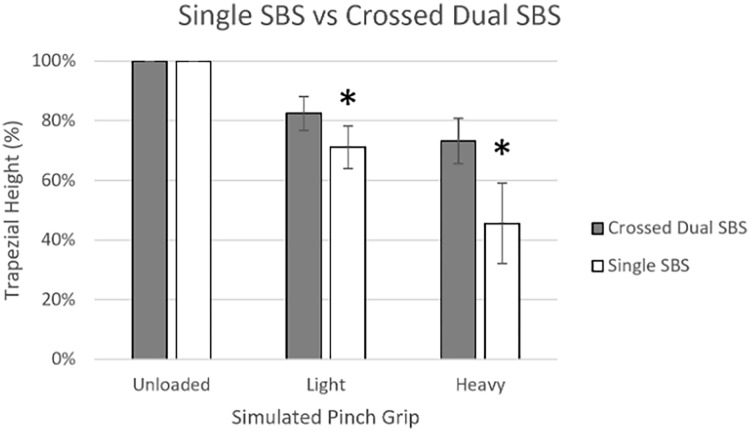
Results: The crossed dual SBS construct showed significantly higher stiffness compared to the single SBS construct in elastic deformation (19.9 vs 15.5 N/mm, P = .010) and maintained trapezial height better in both light (82% vs 71%, P = .021) and heavy (73% vs 46%, p = .004) pinch grips. The crossed suture technique also preserved trapezial height better than the single SBS construct in light (79% vs 64%, P = 0.021) and heavy (60% vs 44%, P = 0.039) pinch grips.
Conclusions: In the immediate postoperative period, a crossed dual SBS construct was stiffer to axial load and more stable in pinch grip compared to a single SBS construct. The novel crossed suture construct better preserved trapezial height then the singe SBS, suggesting that the crossed configuration may be more relevant than suture count in postoperative stability.
Keywords: CMC; anatomy; arthritis; basic science; biomechanics; diagnosis; specialty; surgery; suspensionplasty; thumb.
Conflict of interest statement
The author(s) declared the following potential conflicts of interest with respect to the research, authorship, and/or publication of this article: TP has received research funding from Acumed and has received research funding from Medartis. MR has received research funding from Acumed. CK is a paid consultant for Acumed Restore3d, Smith & Nephew, and Stryker. DR receives royalties from OsteoCentric and is a paid presenter or speaker for Acumed. Statement of Informed Consent: Informed consent was not obtained given that this study was a cadaveric study. IRB approval was obtained from Duke University.
Figures



References
LinkOut - more resources
Full Text Sources
