Association of hyperactivity-impulsivity and inattention symptom profiles with suicide attempt: an 18-year population-based cohort study
- PMID: 40645654
- PMCID: PMC12248219
- DOI: 10.1136/bmjment-2025-301725
Association of hyperactivity-impulsivity and inattention symptom profiles with suicide attempt: an 18-year population-based cohort study
Abstract
Background: Attention-deficit/hyperactivity disorder (ADHD) symptomatology in childhood is associated with a high risk of suicide attempt later in life. However, symptom presentation in ADHD is heterogeneous, and little is known about how suicide risk varies according to different profiles of ADHD symptoms and sex.
Objective: The aim was to investigate the longitudinal associations between childhood profiles of ADHD symptoms (ie, hyperactivity-impulsivity and inattention) and youth suicide attempt in males and females, separately.
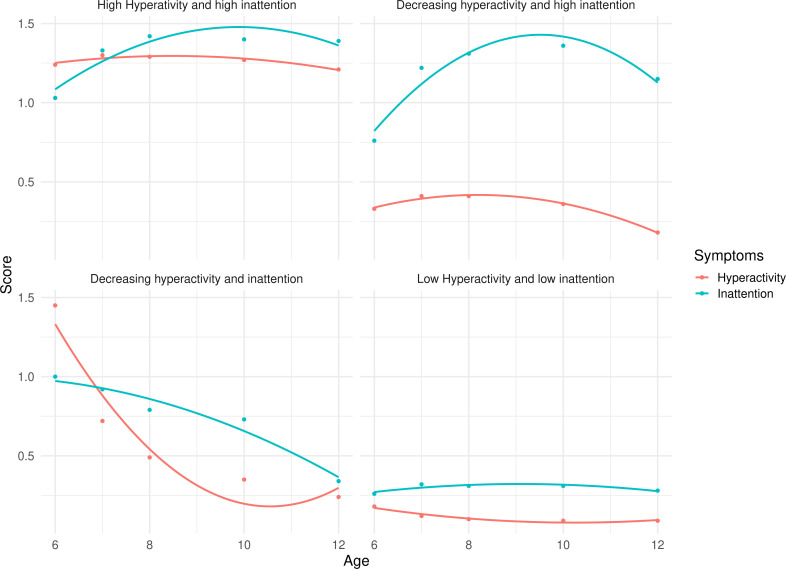
Methods: This population-based cohort study used data from three longitudinal cohorts: the Quebec Longitudinal Study of Child Development (QLSCD), the Quebec Longitudinal Study of Kindergarten Children (QLSKC) and the Quebec Newborn Twin Study (QNTS) for a total of 4399 participants (1490 from the QLSCD, 2134 from the QLSKC and 775 from the QNTS; 50% females) followed up from ages 6-23 years. Symptoms of hyperactivity-impulsivity and inattention were assessed by teachers five times from ages 6-12 years. Suicide attempt in adolescence and young adulthood (by age 23) was self-reported. Multitrajectory modelling was used to identify profiles of ADHD symptoms, and regression analysis was used to test their association with suicide attempt, adjusting for childhood socioeconomic and clinical characteristics.
Findings: We identified four ADHD symptom profiles with distinct associations with suicide attempt for males and females. Compared with those with persistently low symptoms, females with persistently high inattention and hyperactivity-impulsivity (OR: 2.54, CI 1.39 to 4.63) or high inattention and low hyperactivity-impulsivity (OR: 1.81, CI 1.21 to 2.70) were at higher risk of suicide attempt, while, among males, only those with decreasing hyperactivity-impulsivity and inattention over time (OR: 2.23, CI 1.20 to 4.13) were at higher risk of suicide attempt.
Conclusions: Risk of suicide attempt in children with ADHD symptoms varies according to both symptom profile and sex, the highest risk being for females with high inattention symptoms (with or without hyperactivity), and males with decreasing symptoms.
Clinical implications: Taking into account differences in both sex and ADHD symptoms profile may be relevant to more accurately identify and manage suicide risk in individuals with high ADHD symptoms, though caution is needed when generalising our population-based findings to clinical populations.
Keywords: Child & adolescent psychiatry; Suicide & self-harm.
© Author(s) (or their employer(s)) 2025. Re-use permitted under CC BY. Published by BMJ Group.
Conflict of interest statement
Competing interests: Prof. Cortese has declared reimbursement for travel and accommodation expenses from the Association for Child and Adolescent Central Health (ACAMH) in relation to lectures delivered for ACAMH, the Canadian AADHD Alliance Resource, the British Association of Psychopharmacology, and from Healthcare Convention for educational activity on ADHD and has received honoraria from Medice.
Figures

References
MeSH terms
LinkOut - more resources
Full Text Sources
Medical