


Decoding the heat stress resilience in Chickpea (Cicer arietinum L.): multi-trait analysis for genotypic adaptation
- PMID: 40646056
- PMCID: PMC12254367
- DOI: 10.1038/s41598-025-07573-7
Decoding the heat stress resilience in Chickpea (Cicer arietinum L.): multi-trait analysis for genotypic adaptation
Abstract
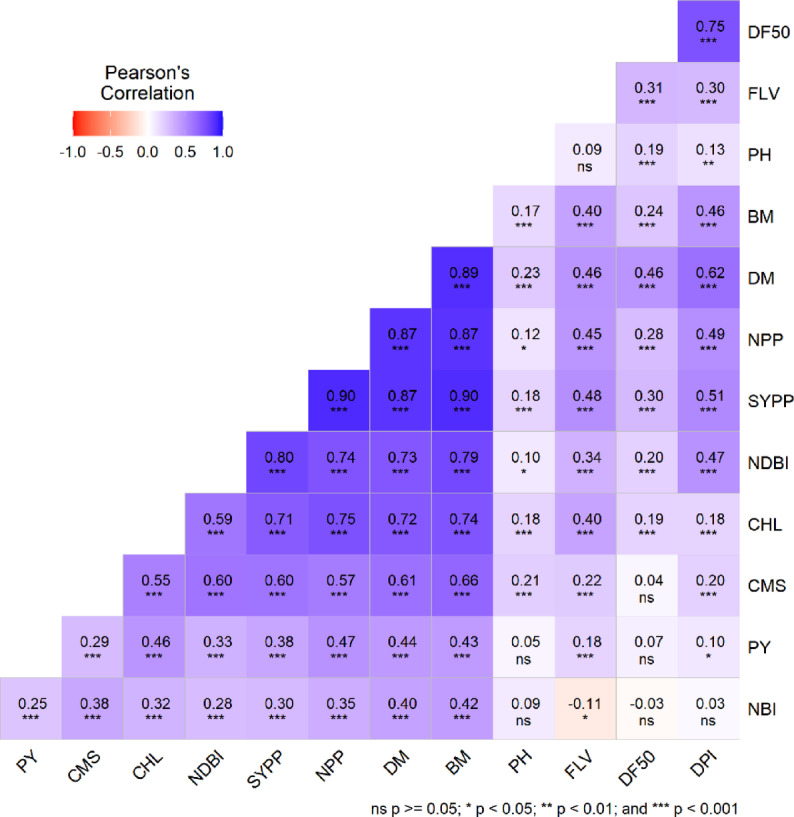
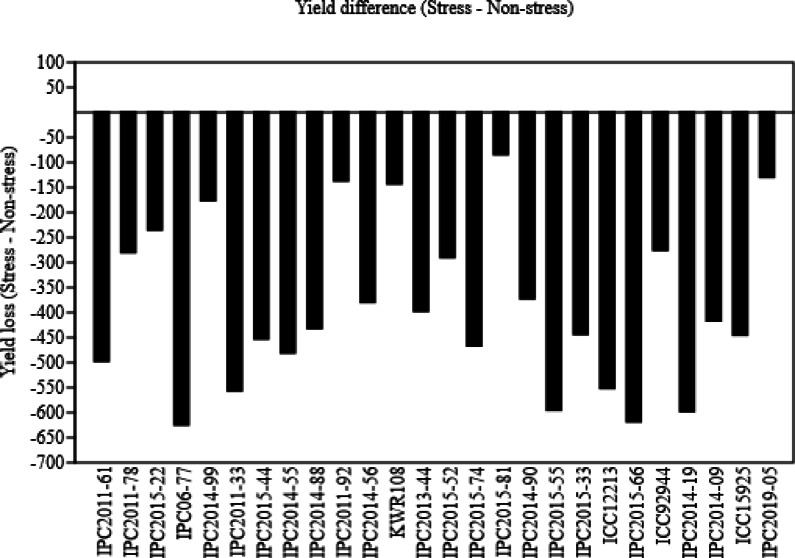
Increasing heat stress is detrimental to chickpea (Cicer arietinum L.) growth and production. Therefore, dedicated efforts are urgently needed to develop heat tolerant chickpea genotypes for food security. This study evaluates the tolerance of 26 chickpea genotypes under heat stress and non-stress conditions across three years (2017-18, 2018-19, and 2019-2020) under field conditions. Significant genotypic variation was observed for phenological (days to flowering, pod initiation, maturity) and physiological traits (chlorophyll content, nitrogen balance index, membrane stability) under both environments. Heat stress resulted in a considerable reduction in biomass and yield-related traits. Under heat stress, days to 50% flowering and maturity were reduced by 4 days and 24 days, respectively, while a 34.7% average yield reduction was observed compared to non-stressed conditions. Genotypes 'IPC 2014-55', 'IPC 2011-78', and 'ICC 92944' exhibited the least yield loss and showed better resilience under heat stress. The GGE biplot analysis identified genotypes with superior performance and stability, genotypes 'IPC 2014-55' and 'IPC 2011-78', performed consistently across both stressed and non-stressed conditions. AMMI analysis and PCA-based clustering revealed significant genotype-by-environment interactions, with certain genotypes like 'IPC 2019-05' exhibiting distinct variations under stress, because of extra early maturity. The study concludes that genotypes 'IPC 2014-55', 'IPC 2011-78', and 'IPC 2019-05' are promising candidates for breeding heat-tolerant chickpea. Correlation analysis indicated that selection of genotypes with high cell membrane stability, chlorophyll, high seed yield plant-1, and high pods plant-1 under heat stress environment are suitable for developing heat tolerant chickpeas.
Keywords: Advanced breeding lines; Genetic variability; Genotype × heat stress interaction; Principal component analysis; Stability.
© 2025. The Author(s).
Conflict of interest statement
Declarations. Competing interests: The authors declare no competing interests.
Figures
References
-
- FAOSTAT. Online database. accessed March 04, (2022). http://www.fao.org/FAOSTAT./en/#data (2020).
-
- Devasirvatham, V. et al. Reproductive biology of Chickpea response to heat stress in the field is associated with the performance in controlled environments. Field Crops Res.142, 9–19 (2013).
-
- Devasirvatham, V., Gaur, P. M., Raju, T. N., Trethowan, R. M. & Tan, D. K. Y. Field response of Chickpea (Cicer arietinum L.) to high temperature. Field Crops Res.172, 59–71 (2015).
-
- Kumar, A. et al. Identification and evaluation of heat tolerant Chickpea genotypes for enhancing its productivity in rice fallow area of Bihar and mitigating impacts of climate change. J. Pharmacog Phytochem. 6 (6S), 1105–1113 (2017).
MeSH terms
LinkOut - more resources
Full Text Sources
