. 2025 Sep;39(9):2196-2206.
doi: 10.1038/s41375-025-02690-8. Epub 2025 Jul 11.

A genome-wide association study identifies an African-specific locus on chromosome 21q22.12 associated with Burkitt lymphoma risk and survival

Affiliations

A genome-wide association study identifies an African-specific locus on chromosome 21q22.12 associated with Burkitt lymphoma risk and survival

Diptavo Dutta et al. Leukemia. 2025 Sep.

Abstract

Burkitt lymphoma (BL) is a B-cell malignancy that disproportionately affects children in sub-Saharan Africa. We performed a genome-wide association study (GWAS) in a combined set of 800 childhood cases and 3865 controls in East Africa, controlling for age, sex, country, population-specific principal components, and a genetic relationship matrix. This analysis identified a BL-protective region within chromosome 21q22.12 tagged by the rs111457485-T allele (odds ratio [OR] = 0.57; p = 5.7 × 10⁻⁹). The results were robust in standard meta-analysis (OR = 0.57, p < 1.6 × 10⁻⁸), sensitivity analyses (removing genomic outliers and related individuals), and after adjustment for Epstein-Barr virus (EBV) status. Genomic analyses revealed long-range (over ~700 kb) chromatin interactions between the chr21q22.12 locus and the RUNX1-P1 promoter region. The African-specific rs2242780-C allele (r2 = 0.69 with the rs111457485-T allele in the study controls) showed increased enhancer activity in in-vitro Luciferase reporter assays (p = 4.5 × 10⁻¹⁰), nominating it as the likely functional variant for the BL-associated loci. In addition to the association with reduced BL risk in GWAS (OR = 0.62, p = 2.24 × 10⁻⁸), the rs2242780-C allele was also associated with better survival in patients with abdominal-only BL in exploratory analyses (hazard ratio = 0.39, p = 0.038, 106 patients, 59 deaths). Our GWAS uncovered novel BL-protective loci near RUNX1, offering insights into the genetic etiology of BL in African children.


Conflict of interest statement

Competing interests: The authors declare no competing interests.

Figures

Fig. 1
Fig. 1. BL GWAS sites, sample sizes, and ancestral admixture patterns.
a Map showing the countries and geographic locations where BL patients and controls contributing to the GWAS were enrolled; green shading indicates geographical areas where participants in EMBLEM were recruited in Uganda, Tanzania, and Kenya. The red crosses mark the locations of the hospitals where BL patients were diagnosed, enrolled, and treated. The stars on a green background mark the capital cities in each country where the tertiary-level cancer care centers are located and are generally difficult to reach for poor patients in the rural study areas. In Malawi, cases and controls were enrolled at a tertiary cancer care hospital in Blantyre without restrictions on geographical areas of origin. The map was drawn via ESRI ArcGIS Pro software. No portions of this figure were imported as image components from a database. b Sample size in the BL GWAS (n = 4645) by case status and country. c Ancestry admixture plots of participants in the BL GWAS, by enrollment region and country. The font colors of the regions are matched to the font colors of the countries in the table. The ancestral admixture plots are presented with the regions sorted in a southeastward direction to highlight gradients of the dominant Nilotic and Bantu ancestries in the northern and southern regions, respectively. The proportion of Nilotic ancestry is highest in the northcentral region and lowest in Malawi, whereas that of Bantu ancestry is lowest in the northcentral region and highest in Malawi. The West African and Eurasian ancestries make minor contributions in some of the regions. In the BL GWAS, the population substructure and relatedness were adjusted for by including the country, the top three country-specific principal components (PCs), and the genetic relationship matrix (GRM).
Fig. 2
Fig. 2. BL GWAS association results.
a Manhattan plot presenting the results of the BL GWAS of 800 patients and 3845 controls. The dotted line represents the genome-wide significance threshold (−log10 p = 5 × 10−8). b Regional plot of the chr21q22.12 BL GWAS locus located within a ~ 1 Mb gene desert between the RUNX1 and SETD4 genes; the index SNP rs111457485 (OR = 0.57; p = 5.7 × 109) is marked in magenta. The markers are colored based on LD (r2) with rs111457485 in the total GWAS set (N = 4625). c 95% credible set for the chr21q22.12 BL GWAS locus comprising 17 credible set SNPs from fine-mapping analysis using SuSiE.
Fig. 3
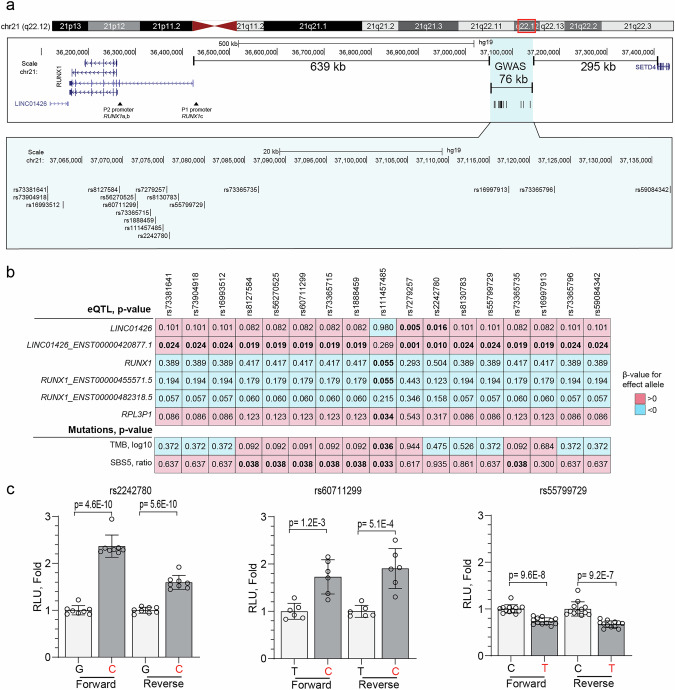
Fig. 3. Genomic profile of the chr 21q22.12 BL GWAS locus.
a Overview of the ~1 Mb region within the chr 21q22.12 locus, with a zoomed-in view of the 76 kb region comprising 17 CS-SNPs associated with BL risk; b Heatmap showing p values for the relationships between the 17 CS-SNPs and gene and isoform-level expression in the region in BL tumors (n = 86) and the total mutational burden (TMB) and the COSMIC SBS5 mutational signature in BL tumors (n = 89) of children from Uganda. Significant p values are bolded. The pink and blue colors represent the directions of β values for the effect alleles of all the SNPs. p-values and β values were derived from linear regression models adjusted for sex, age, and EBV status. Plots for select associations are shown in Fig. S10. c Results of Luciferase reporter assays in HEK293T cells identified significant regulatory activity for three of the 17 CS-SNPs tested, with allele-specific differences in both orientations. The results for the same SNPs in a BL-derived cell line (Raji) are shown in Fig. S12. The effect alleles of each variant are in red. Each transfection was performed in 6–12 technical replicates and repeated in 2–3 independent experiments with similar results. The results from one representative experiment are shown, with individual values, group means, and error bars representing standard deviation. p-values were calculated via an unpaired two-sided t-test.
Fig. 4
Fig. 4. Analysis of overall survival (OS) in 228 BL patients from Uganda.
The probability for overall survival (OS) is presented as unadjusted hazard ratios (HRs) and p-values (p) for OS by: a chemotherapy (reference: no chemotherapy) and b anatomic tumor sites (reference: head-only BL). HRs are for the entire period, with the 1-year OS probabilities reported in the text are shown by dashed lines on the Y-axis. p-values were calculated from the unadjusted Cox models using (a) chemotherapy and (b) anatomic sites as categorical variables. Multivariable Cox regression analysis of OS controlling for age, sex, EBV status and the number of chemotherapy drugs (0–6) in relation to rs2242780 (reference: GG genotype group, C allele is protective from BL in GWAS); c in the overall set (n = 228) with vital status; d In a subset of 59 BL patients with head-only tumors; e In a subset of 37 BL patients with head and abdominal tumors; f In a subset of 143 BL patients with abdominal tumors with or without head involvement (combining abdominal-only and head and abdominal tumors; g In a subset of 106 BL patients with abdominal-only tumors (Table S12).

References

    1. López C, Burkhardt B, Chan JKC, Leoncini L, Mbulaiteye SM, Ogwang MD, et al. Burkitt lymphoma. Nat Rev Dis Prim. 2022;8:78. - PubMed
    1. Linet MS, Brown LM, Mbulaiteye SM, Check D, Ostroumova E, Landgren A, et al. International long-term trends and recent patterns in the incidence of leukemias and lymphomas among children and adolescents ages 0-19 years. Int J Cancer. 2016;138:1862–74. - PubMed
    1. Mbulaiteye SM, Devesa SS. Burkitt lymphoma incidence in five continents. Hemato. 2022;3:434–53.
    1. Epstein MA, Achong BG, Barr YM. Virus particles in cultured lymphoblasts from Burkitt’s lymphoma. Lancet. 1964;1:702–3. - PubMed
    1. Bornkamm GW. Epstein-Barr virus and the pathogenesis of Burkitt’s lymphoma: more questions than answers. Int J Cancer. 2009;124:1745–55. - PubMed

MeSH terms

Substances

LinkOut - more resources