


Late bedtime was associated with increased androgen and reduced lean mass in women with polycystic ovary syndrome: a cross-sectional study
- PMID: 40646572
- PMCID: PMC12247343
- DOI: 10.1186/s13048-025-01730-2
Late bedtime was associated with increased androgen and reduced lean mass in women with polycystic ovary syndrome: a cross-sectional study
Abstract
Background: While the specific effects of bedtime on androgen levels and lean muscle mass remain understudied, circadian misalignment and sleep disturbances have been well-established as risk factors for various metabolic disorders. The present study aimed to investigate the relationship between bedtime, androgen-associated traits, and dual-energy X-ray absorptiometry (DEXA)-based lean mass (LM) in polycystic ovary syndrome (PCOS).
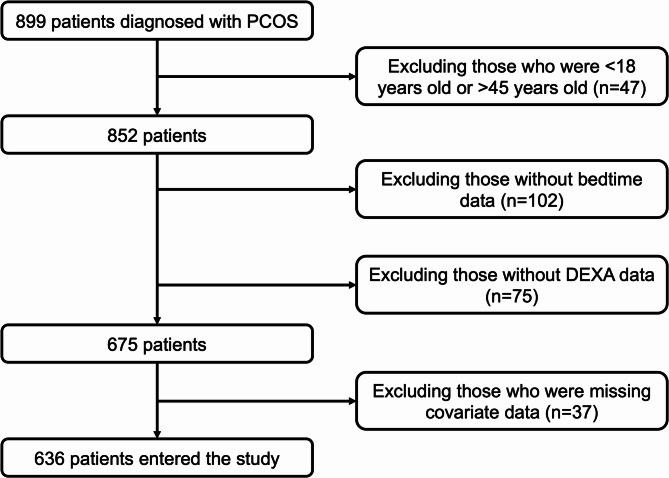
Methods: This cross-sectional study recruited 899 reproductive-aged women with PCOS from the PCOS subspecialty clinic at Shanghai Tenth People's Hospital, and finally, 636 women were included in the study. Anthropometric, metabolic, sex and reproductive hormonal characteristics, and body fat and lean composition measured by DEXA were collected. The information on bedtime was adapted from the Pittsburgh Sleep Quality Index, and bedtime was categorized into three aspects: early bedtime (≤ 23:00), intermediate bedtime (> 23:00 to 24:00), and late bedtime (> 24:00) according to the time of falling asleep.
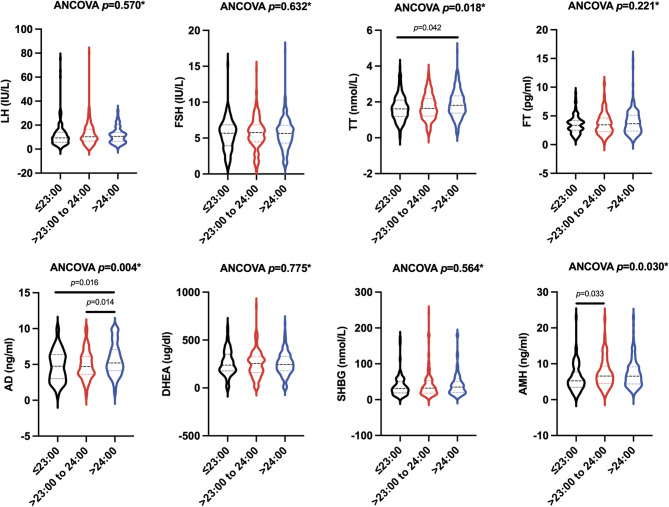
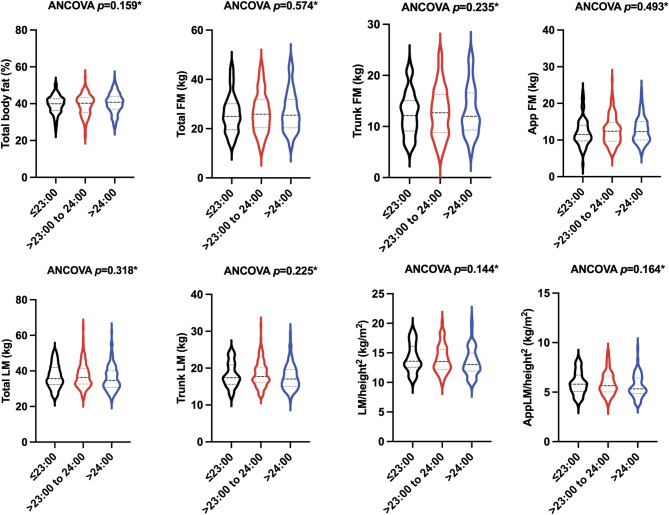
Results: The study included 636 women with PCOS (mean age 27.50 ± 4.93 years; mean body mass index [BMI] 25.00 ± 5.46 kg/m²), with 24.4% having early bedtime (≤ 23:00), 36.8% intermediate bedtime (> 23:00 to 24:00), and 38.8% late bedtime (> 24:00). After adjusting for age in covariance analysis, the late bedtime group had fewer annual menstrual cycles and higher total testosterone (TT), and the intermediate bedtime group had higher anti-Müllerian hormone (AMH) than the early bedtime group. Compared with the early and intermediate bedtime groups, those with late bedtime had higher androstenedione (AD) levels. After controlling possible confounding factors (age, BMI, homeostasis model assessment of insulin resistance, alanine aminotransferase, triglyceride, and serum uric acid), multiple liner regression analysis found that compared with early bedtime, late bedtime was independently associated with higher levels of TT and AD, meanwhile, intermediate bedtime was independently associated with higher levels of AMH. Following further adjustment for the above confounders and TT, late bedtime was independently correlated to reduced muscle mass index and appendicular muscle mass index compared with early bedtime.
Conclusion: This study provided novel insight that late bedtime (after 24:00) was independently related to elevated androgenic hormones and reduced LM in individuals with PCOS.
Keywords: Androgen; Bedtime; Lean mass; Polycystic ovary syndrome; Sleep.
© 2025. The Author(s).
Conflict of interest statement
Declarations. Ethics approval and consent to participate: The study protocol was approved by the Ethics Committee of Shanghai Tenth People’s Hospital (approve number: SHSY-IEC-4.1/21–227/01). The data presented includes participants from our observational study (NCT05063383). All participants in this study signed the informed consent form. Consent for publication: Not applicable. Competing interests: The authors declare no competing interests.
Figures
References
-
- Stener-Victorin E, Teede H, Norman RJ, Legro R, Goodarzi MO, Dokras A, et al. Polycystic ovary syndrome. Nat Rev Dis Primers. 2024;10:27. - PubMed
-
- Zeng X, Xie Y-J, Liu Y-T, Long S-L, Mo Z-C. Polycystic ovarian syndrome: correlation between hyperandrogenism, insulin resistance and obesity. Clin Chim Acta. 2020;502:214–21. - PubMed
-
- Teo P, Henry BA, Moran LJ, Cowan S, Bennett C. The role of sleep in PCOS: what we know and what to consider in the future. Expert Rev Endocrinol Metab. 2022;17:305–18. - PubMed
-
- Wang J, Liu D, Zhang S. The relationship between staying up late and risk of intracranial aneurysm rupture: a single-center study. Neurochirurgie. 2022;68:156–62. - PubMed
MeSH terms
Substances
Grants and funding
LinkOut - more resources
Full Text Sources
Medical
