


Aroma-Driven Differentiation of Wuyi Shuixian Tea Grades: The Pivotal Role of Linalool Revealed by OAV and Multivariate Analysis
- PMID: 40646921
- PMCID: PMC12249095
- DOI: 10.3390/foods14132169
Aroma-Driven Differentiation of Wuyi Shuixian Tea Grades: The Pivotal Role of Linalool Revealed by OAV and Multivariate Analysis
Abstract
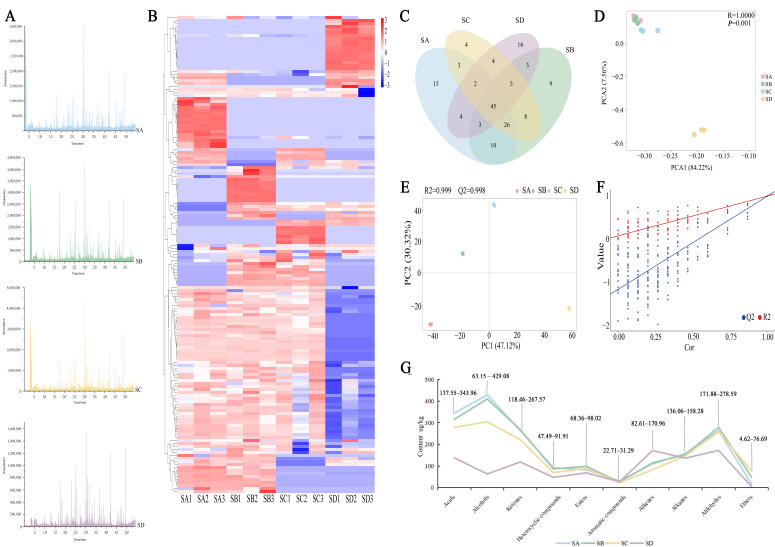
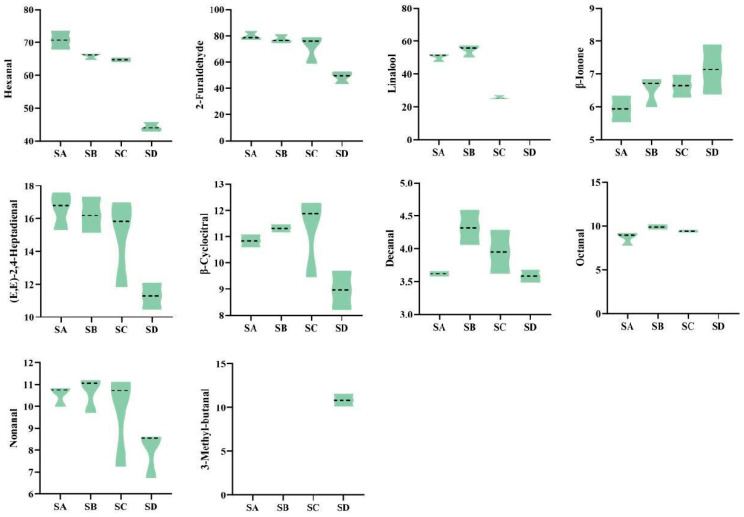
Wuyi Shuixian tea, a premium oolong tea known for its complex floral-fruity aroma, exhibits significant quality variations across different grades. This study systematically analyzed the aroma characteristics and key fragrant compounds of four grades (Grand Prize SA, First Prize SB, Outstanding Award SC, and Non-award SD) using headspace solid-phase microextraction-gas chromatography-mass spectrometry (HS-SPME-GC-MS), odor activity value (OAV) analysis, and multivariate statistical methods. A total of 159 volatile compounds were identified, with similar compound categories but distinct concentration gradients between grades. OAV-splitting analysis (based on OAV ≥ 1 as the threshold for aroma activity) identified β-ionone (fruity), octanal (fatty), and linalool (floral) as core aroma-active contributors, as their OAV values significantly exceeded 10 in awarded grades (SA, SB, SC), indicating dominant roles in sensory perception. Notably, linalool, a floral marker, showed a concentration gradient (SA > SB > SC) and was absent in SD, serving as a critical determinant of grade differentiation. Orthogonal partial least squares-discriminant analysis (OPLS-DA) further distinguished awarded grades (SA, SB, SC) by balanced fruity, floral, and woody notes, while SD lacked floral traits and exhibited burnt aromas. This classification was supported by hierarchical clustering analysis (HCA) of volatile profiles and principal component analysis (PCA). Electronic nose data validated these findings, showing strong correlations between sensor responses (W5S/W2W) and key compounds like hexanal and β-ionone. This study elucidates the molecular basis of aroma-driven quality grading in Wuyi Shuixian tea, providing a scientific framework for optimizing processing techniques and enhancing quality evaluation standards. The integration of chemical profiling with sensory attributes advances precision in tea industry practices, bridging traditional grading with objective analytical metrics.
Keywords: Wuyi Shuixian tea; aroma profiling; flavor-active compounds; odor activity value (OAV); quality grading.
Conflict of interest statement
The authors declare that they have no conflicts of interest.
Figures




References
-
- Lin Y., Huang Y., Liu X., Pan Y., Feng X., Guo H., Li X., Tao Y., Chen P., Chu Q. Uncovering the Shuixian tea grades hierarchy in Chinese national standard: From sensory evaluation to microstructure and volatile compounds analysis. Food Chem. 2024;459:140342. doi: 10.1016/j.foodchem.2024.140342. - DOI - PubMed
Grants and funding
- 2021J011137, 2024N0009 and 2024J01861/Natural Science Foundation of Fujian Province
- S202210397033, 202310397003 and 202410397014/the Innovation and Entrepreneurship Training Program for College Students
- NP2021KTS06, NP2021KTS05, N2021Z012/Nanping City Science and Technology Plan Project
- YJ201909/Scientific Research Project of Introducing Talents, Wuyi University
- 2021-SSTD-01 and2021-SSTD-05/the faculty and students co-creation team of Wuyi University
LinkOut - more resources
Full Text Sources
Miscellaneous
