


A Refined Vestibular Romberg Test to Differentiate Somatosensory from Vestibular-Induced Disequilibrium
- PMID: 40647620
- PMCID: PMC12248627
- DOI: 10.3390/diagnostics15131621
A Refined Vestibular Romberg Test to Differentiate Somatosensory from Vestibular-Induced Disequilibrium
Abstract
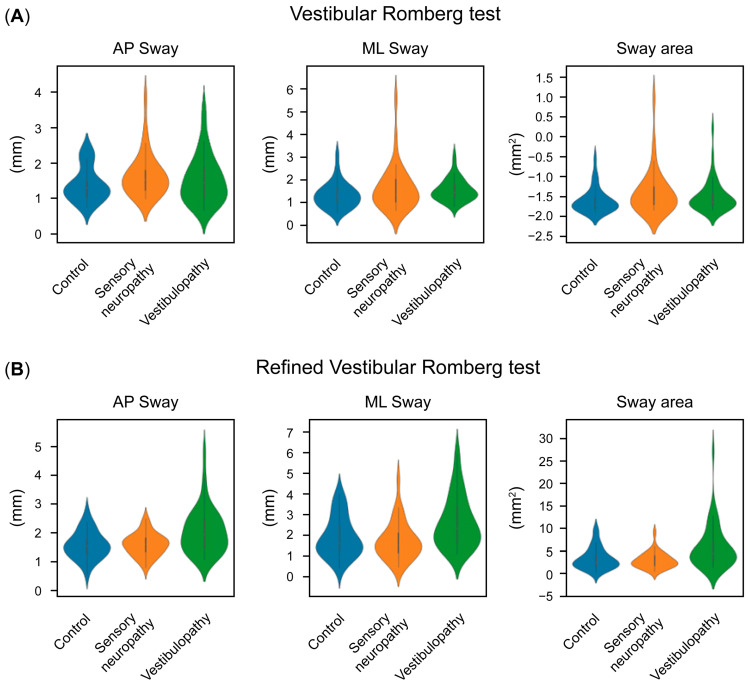
Background: The vestibular Romberg test, which assesses the deterioration of balance while standing on rubber foam with closed eyes, is a well-established method in the physical neurological assessment of patients with peripheral vestibulopathy. This study aims to determine whether it can differentiate peripheral vestibulopathy from its main differential diagnosis, namely sensory ataxia, as both conditions typically present with a positive classical Romberg test. Methods: Static balance was assessed in three groups: patients with peripheral vestibulopathy, patients with pure sensory neuropathy, and healthy age-matched controls. Participants stood quietly on a force platform under varying visual and proprioceptive feedback conditions. Conventional and advanced postural sway metrics were investigated to establish a quantitative analogy to both the clinical Romberg and vestibular Romberg tests. Results: Posturographic analysis revealed that, in contrast to healthy controls, patients with vestibular disorders exhibited higher vestibular Romberg quotient values. However, the classical vestibular Romberg quotient did not show diagnostic discrimination between vestibulopathy and sensory neuropathy patients. This lack of discrimination was mainly due to the increased body sway observed in all patient groups under the "eyes open" condition. Nevertheless, a refined vestibular Romberg quotient-comparing standing on foam versus standing on firm support with eyes closed-was able to reliably distinguish vestibulopathy from sensory ataxia. This distinction was evident in both conventional linear sway and spectral postural sway metrics. Conclusions: We conclude that a refined Romberg test, performed solely under conditions of visual deprivation, offers valuable classification potential in differentiating peripheral vestibulopathy not only from healthy controls but also from patients with disequilibrium due to sensory loss.
Keywords: Romberg’s test; ataxia; posturography; sensory neuropathy; vestibulopathy.
Conflict of interest statement
The authors declare no conflicts of interest.
Figures

References
-
- Anagnostou E., Kouvli M., Karagianni E., Gamvroula A., Kalamatianos T., Stranjalis G., Skoularidou M. Romberg’s test revisited: Changes in classical and advanced sway metrics in patients with pure sensory neuropathy. Neurophysiol. Clin. 2024;54:102999. doi: 10.1016/j.neucli.2024.102999. - DOI - PubMed
-
- Fujimoto C., Murofushi T., Chihara Y., Ushio M., Sugasawa K., Yamaguchi T., Yamasoba T., Iwasaki S. Assessment of diagnostic accuracy of foam posturography for peripheral vestibular disorders: Analysis of parameters related to visual and somatosensory dependence. Clin. Neurophysiol. 2009;120:1408–1414. doi: 10.1016/j.clinph.2009.05.002. - DOI - PubMed
LinkOut - more resources
Full Text Sources
