


The Effects of Frost and Fire on the Traits, Resources, and Floral Visitors of a Cerrado Plant, and Their Impact on the Plant-Visitor Interaction Network and Fruit Formation
- PMID: 40647986
- PMCID: PMC12252403
- DOI: 10.3390/plants14131977
The Effects of Frost and Fire on the Traits, Resources, and Floral Visitors of a Cerrado Plant, and Their Impact on the Plant-Visitor Interaction Network and Fruit Formation
Erratum in
-
Correction: Porto et al. The Effects of Frost and Fire on the Traits, Resources, and Floral Visitors of a Cerrado Plant, and Their Impact on the Plant-Visitor Interaction Network and Fruit Formation. Plants 2025, 14, 1977.Plants (Basel). 2025 Sep 30;14(19):3027. doi: 10.3390/plants14193027. Plants (Basel). 2025. PMID: 41095258 Free PMC article.
Abstract
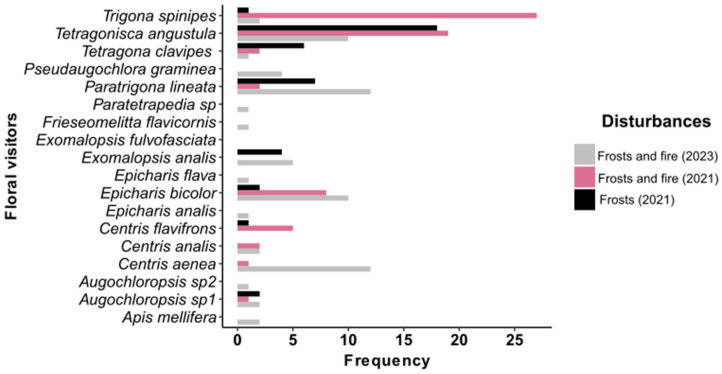
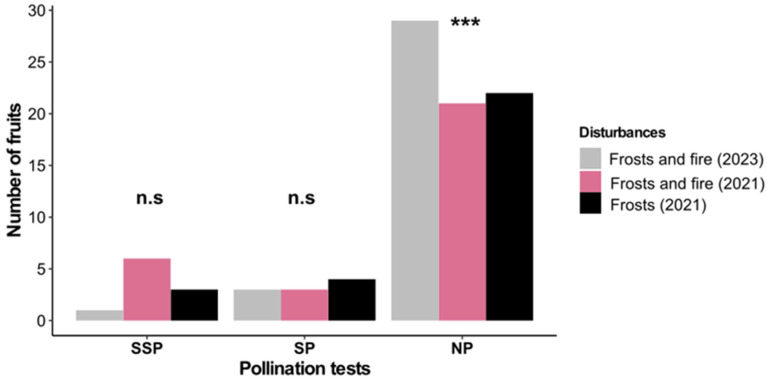
The Cerrado, the world's most diverse savanna, has several adaptations to fire. However, intense and frequent fires, especially after frosts, can severely impact this ecosystem. Despite this, few studies have evaluated the combined effects of frost followed by fire. We investigated how these disturbances affect plant traits, floral resources, floral visitor richness, and the structures of plant-pollinator interaction networks by using Byrsonima intermedia, a common Malpighiaceae shrub, as a model. We compared areas affected by frost alone and frost followed by fire and the same fire-affected area two years later. We examined pollen, oil volume, buds, and racemes and recorded floral visitors. Our main hypothesis was that fire-affected areas would exhibit higher floral visitor richness, more conspicuous plant traits, and greater fruit production than areas affected by frost only, which would show higher interaction generalization due to stronger negative impacts. The results confirmed that frost drastically reduced floral traits, visitor richness, and reproductive success. In contrast, fire facilitated faster recovery, triggering increased floral resource quantities, richer pollinator communities, more specialized interactions, and greater fruit production. Our findings highlight that fire, despite its impact, promotes faster ecosystem recovery compared to frost, reinforcing its ecological role in the Cerrado's resilience.
Keywords: mutualism; plant–insect interactions; pollination; tropical savanna.
Conflict of interest statement
The authors declare no conflicts of interest.
Figures




References
-
- Pivello V.R. The Use of Fire in the Cerrado and Amazonian Rainforests of Brazil: Past and Present. Fire Ecol. 2011;7:24–39. doi: 10.4996/fireecology.0701024. - DOI
-
- February E.C., Coetsee C., Cook G.D. Savanna Woody Plants and Large Herbivores. Blackwell Publishing Ltd.; Oxford, UK: 2019. Physiological Traits of Savanna Woody Species; pp. 309–329. - DOI
-
- Lazarina M., Sgardelis S.P., Tscheulin T., Kallimanis A.S., Devalez J., Petanidou T. Bee Response to Fire Regimes in Mediterranean Pine Forests: The Role of Nesting Preference, Trophic Specialization, and Body Size. Basic Appl. Ecol. 2016;17:308–320. doi: 10.1016/j.baae.2016.02.001. - DOI
LinkOut - more resources
Full Text Sources
