


Difficulties in Emotion Regulation and Stress in Intensive Care Unit Nurses During COVID-19: Exploring the Mediating Role of Psychological Inflexibility and the Moderating Effect of Work Experience
- PMID: 40648600
- PMCID: PMC12249951
- DOI: 10.3390/healthcare13131575
Difficulties in Emotion Regulation and Stress in Intensive Care Unit Nurses During COVID-19: Exploring the Mediating Role of Psychological Inflexibility and the Moderating Effect of Work Experience
Abstract
Background/objectives: The COVID-19 pandemic has placed intensive care unit (ICU) nurses under intense psychological pressure, increasing emotional and psychological stress. Two constructs-difficulties in emotion regulation and psychological inflexibility (i.e., low contact with the present moment and a lack of committed action based on personal values)-have been associated with increased perceived stress levels but remain underexplored in this population.
Aims: This study investigated whether psychological inflexibility mediates the relationship between emotion regulation difficulties and perceived stress in ICU nurses. It also examined whether years of ICU work experience moderate the direct relationship between emotion regulation difficulties and perceived stress.
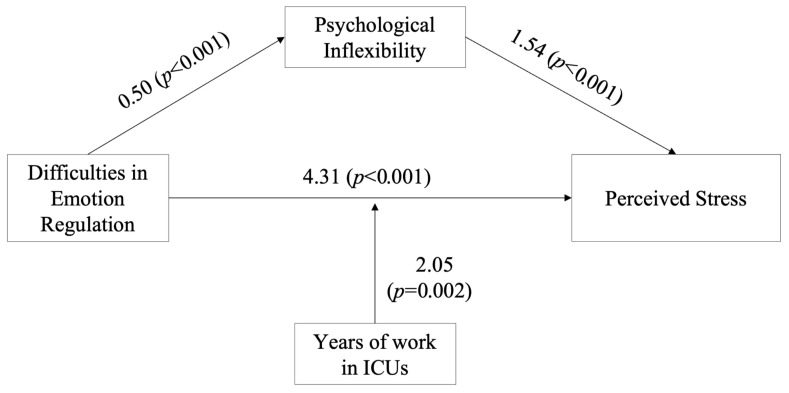
Methods: A cross-sectional study was conducted with 210 ICU nurses (65.2% women; 34.8% men; mean age = 40.25 years ± 11.36) from Italian public hospitals. The participants completed the Difficulties in Emotion Regulation Scale, the Acceptance and Action Questionnaire-II, and the Perceived Stress Scale. A moderated mediation model was tested to examine whether psychological inflexibility mediates the relationship between emotion regulation difficulties and perceived stress and whether years of ICU work experience moderate the path between these variables.
Results: Higher difficulties in emotion regulation predicted greater psychological inflexibility, which, in turn, predicted higher perceived stress. Psychological inflexibility fully mediated the relationship between emotion regulation difficulties and perceived stress. Additionally, years of ICU work experience significantly moderated the direct link between emotion regulation difficulties and perceived stress. This relationship was strongest for nurses with 1-15 years of ICU experience. The model explained 33% of the variance in perceived stress.
Conclusions: This study highlights the importance of the novel construct of psychological inflexibility in the context of healthcare professionals and its role in shaping perceived stress. Addressing psychological inflexibility through targeted interventions may help mitigate stress and promote well-being among ICU nurses.
Keywords: emotion regulation; healthcare workers; moderated mediation model; perceived stress; psychological inflexibility.
Conflict of interest statement
The authors declare no conflicts of interest.
Figures
References
-
- Maniaci G., La Cascia C., Giammanco A., Maria C., Ferraro L., Tripoli G., Scaglione A., Sartorio C., Seminerio F., Toia F., et al. Latent burnout profiles in a sample of frontline healthcare professionals after the peak of the Italian COVID-19 pandemic. Mediterr. J. Clin. Psychol. 2022;10:1–19. doi: 10.13129/2282-1619/mjcp-3292. - DOI
LinkOut - more resources
Full Text Sources
