


Enhancing Healthcare for People with Disabilities Through Artificial Intelligence: Evidence from Saudi Arabia
- PMID: 40648640
- PMCID: PMC12250346
- DOI: 10.3390/healthcare13131616
Enhancing Healthcare for People with Disabilities Through Artificial Intelligence: Evidence from Saudi Arabia
Abstract
Background/objectives: Artificial intelligence (AI) offers opportunities to enhance healthcare accessibility for people with disabilities (PwDs). However, their application in Saudi Arabia remains limited. This study explores PwDs' experiences with AI technologies within the Kingdom's Vision 2030 digital health framework to inform inclusive healthcare innovation strategies.
Methods: Semi-structured interviews were conducted with nine PwDs across Riyadh, Al-Jouf, and the Northern Border region between January and February 2025. Participants used various AI-enabled technologies, including smart home assistants, mobile health applications, communication aids, and automated scheduling systems. Thematic analysis following Braun and Clarke's six-phase framework was employed to identify key themes and patterns.
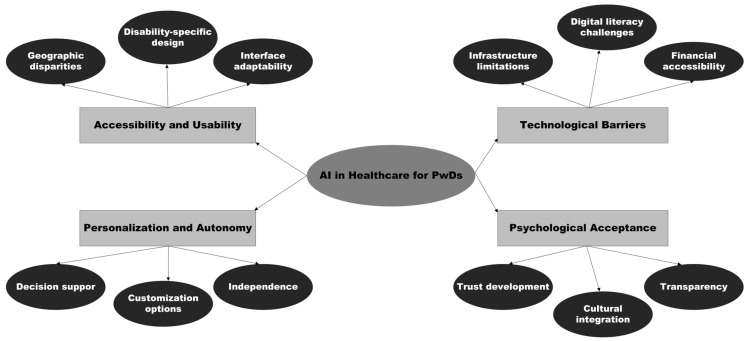
Results: Four major themes emerged: (1) accessibility and usability challenges, including voice recognition difficulties and interface barriers; (2) personalization and autonomy through AI-assisted daily living tasks and medication management; (3) technological barriers such as connectivity issues and maintenance gaps; and (4) psychological acceptance influenced by family support and cultural integration. Participants noted infrastructure gaps in rural areas, financial constraints, limited disability-specific design, and digital literacy barriers while expressing optimism regarding AI's potential to enhance independence and health outcomes.
Conclusions: Realizing the benefits of AI for disability healthcare in Saudi Arabia requires culturally adapted designs, improved infrastructure investment in rural regions, inclusive policymaking, and targeted digital literacy programs. These findings support inclusive healthcare innovation aligned with Saudi Vision 2030 goals and provide evidence-based recommendations for implementing AI healthcare technologies for PwDs in similar cultural contexts.
Keywords: Saudi Arabia; Vision 2030; artificial intelligence; assistive technologies; digital health; disability; healthcare accessibility.
Conflict of interest statement
The authors declare no conflicts of interest.
Figures
References
-
- Hermes S., Riasanow T., Clemons E.K., Böhm M., Krcmar H. The digital transformation of the healthcare industry: Exploring the rise of emerging platform ecosystems and their influence on the role of patients. Bus. Res. 2020;13:1033–1069. doi: 10.1007/s40685-020-00125-x. - DOI
-
- World Health Organization Disability and Health. [(accessed on 15 January 2025)]. Available online: https://www.who.int/news-room/fact-sheets/detail/disability-and-health.
LinkOut - more resources
Full Text Sources
