


The Impact of Total Hip Arthroplasty on the Incidence of Hip Fractures in Romania
- PMID: 40649009
- PMCID: PMC12249852
- DOI: 10.3390/jcm14134636
The Impact of Total Hip Arthroplasty on the Incidence of Hip Fractures in Romania
Abstract
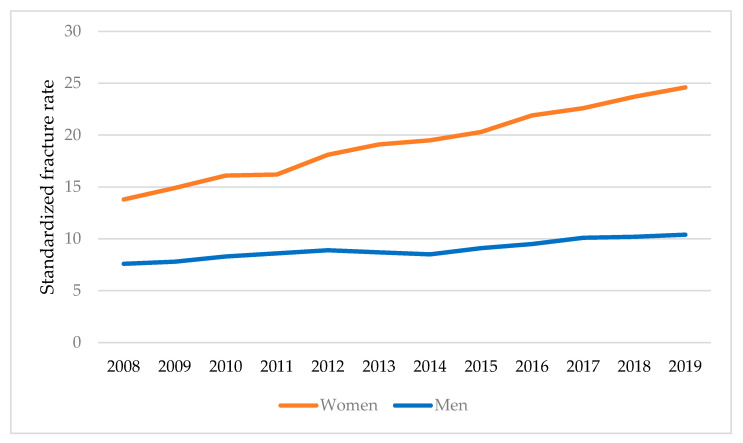
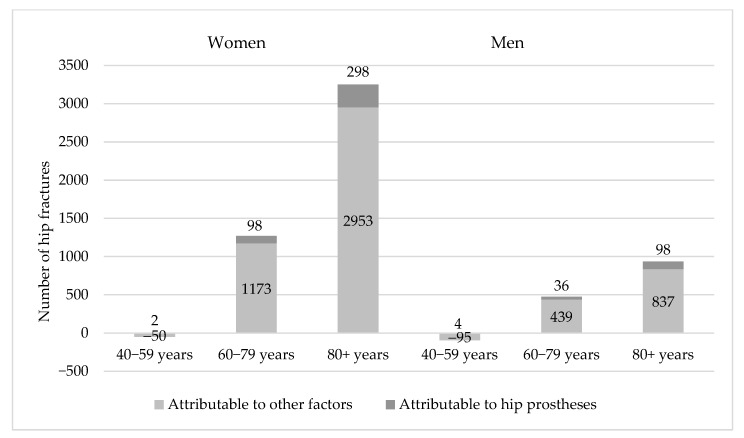
Background/Objectives: The increase in life expectancy and the share of the elderly population has the effect of increasing the number of osteoporotic hip fractures. At the same time, the number of total hip arthroplasty (THA) interventions is continuously increasing. The objective of this study is to investigate the incidence rates of hip fractures during the period 2008-2019, in Romania, among people who are at least 40 years old, as well as to determine the extent to which the increase in the prevalence of people who have undergone THA has affected the incidence of hip fractures, given that the operated hip no longer presents a risk of fracture. Methods: We extracted the information, between 2008 and 2019, from nationwide retrospective studies about the incidence and time trend of hip fractures in Romania. Information on primary THA interventions during the period 2001-2019 was obtained from the Romanian Arthroplasty Register (RAR). We obtained the population size, by gender and age groups, from the reports of the National Institute of Statistics. For the period 2008-2019, we calculated the standardized annual hip fracture incidence rates by sex and by age. Given that each person has two hips at risk of fracture, we calculated hip fracture rates in a scenario without THA interventions. For this, we subtracted 0.5 people from the at-risk population for each prevalent hip prosthesis. Thus, we revealed the effects of decreasing fracture rates due to having hip prostheses. Results: From 2008 to 2019, age-standardized incidence rates of hip fractures increased by 10.8% in women, and by 2.8% in men. By excluding hips being replaced with prostheses in the at-risk population, we obtained higher hip fracture incidence rates. These recorded values were considerably higher for the elderly population. The variation in hip fracture rates during the observed period was 10.16% (9.76% in women and 11.68% in men) lower due to the increased prevalence of hip prostheses. Conclusions: Although the incidence of hip fractures has continued to rise, the growing number of people who have undergone THA and are living with hip prostheses has helped to blunt this increase.
Keywords: epidemiology; hip fracture; implants; orthopedics surgery; osteoporosis; public health; total hip arthroplasty.
Conflict of interest statement
The authors declare no conflicts of interest.
Figures
References
-
- Sing C.W., Lin T.C., Bartholomew S., Bell J.S., Bennett C., Beyene K., Bosco-Levy P., Bradbury B.D., Chan A.H.Y., Chandran M., et al. Global Epidemiology of Hip Fractures: Secular Trends in Incidence Rate, Post-Fracture Treatment, and All-Cause Mortality. J. Bone Miner. Res. 2023;38:1064–1075. doi: 10.1002/jbmr.4821. - DOI - PubMed
-
- Kanis J.A., Odén A., McCloskey E.V., Johansson H., Wahl D.A., Cooper C., IOF Working Group on Epidemiology and Quality of Life A systematic review of hip fracture incidence and probability of fracture worldwide. Osteoporos. Int. 2012;23:2239–2256. doi: 10.1007/s00198-012-1964-3. - DOI - PMC - PubMed
LinkOut - more resources
Full Text Sources
