


The Potential Advantages of Remimazolam for Awakening in Deep Brain Stimulation Surgery: A Retrospective Analysis of Cases
- PMID: 40649098
- PMCID: PMC12251503
- DOI: 10.3390/jcm14134724
The Potential Advantages of Remimazolam for Awakening in Deep Brain Stimulation Surgery: A Retrospective Analysis of Cases
Abstract
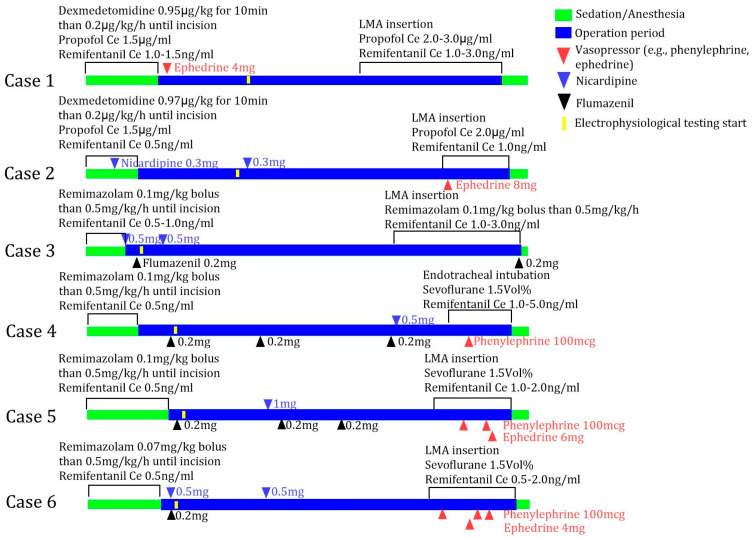
Background and Objectives: Deep brain stimulation (DBS) requires sedation strategies that enable rapid and reliable awakening during intraoperative electrophysiological testing. Although propofol and dexmedetomidine are commonly used, their lack of pharmacological antagonists might delay recovery. In this retrospective case series, we assessed the effects of using remimazolam, a short-acting benzodiazepine that is reversible with flumazenil. No existing research has determined whether this may represent a clinically advantageous alternative. Materials and Methods: Six patients who underwent DBS surgery with monitored anesthetic care between May and August 2024 were included. Two patients received dexmedetomidine and propofol combined, whereas four received remimazolam for initial sedation. The time from sedation discontinuation to intraoperative electrophysiological examination, postoperative hospital stays, and perioperative complications were evaluated. Results: Patients who received remimazolam had shorter awakening intervals (median 17 min) compared to those who received dexmedetomidine and propofol (median 50 min), with a large effect size difference (Cliff's delta -1.00). In all cases of remimazolam, patients were administered flumazenil to facilitate awakening, and transient hypertension requiring nicardipine was observed in some patients. Among the patients who underwent unilateral DBS, those who received remimazolam had shorter postoperative hospital stays (5-7 days) than the patient who received dexmedetomidine and propofol (9 days). No patient had complications. Conclusions: This small retrospective case series indicated that remimazolam, when reversed with flumazenil, was associated with rapid awakening compared with dexmedetomidine and propofol in patients undergoing DBS surgery. However, these findings require validation in larger prospective studies due to the small sample size.
Keywords: Flumazenil; Remimazolam; anesthesia; deep brain stimulation; neuroanesthesia.
Conflict of interest statement
The authors declare no conflicts of interest.
Figures
References
-
- Vinke R.S., Geerlings M., Selvaraj A.K., Georgiev D., Bloem B.R., Esselink R.A.J., Bartels R.H.M.A. The role of microelectrode recording in deep brain stimulation surgery for Parkinson’s disease: A systematic review and meta-analysis. J. Park. Dis. 2022;12:2059–2069. doi: 10.3233/JPD-223333. - DOI - PMC - PubMed
-
- Janssen M.L.F., Bos M.J. Microelectrode assisted deep brain stimulation: Considerations for anesthesia. Deep Brain Stimul. 2024;4:13–23. doi: 10.1016/j.jdbs.2023.12.006. - DOI
Publication types
LinkOut - more resources
Full Text Sources
