


Closed-Loop Valorization of Annatto Seed Waste into Biochar: A Sustainable Platform for Phosphorus Adsorption and Safe Nutrient Recycling in Agro-Industries
- PMID: 40649356
- PMCID: PMC12250773
- DOI: 10.3390/molecules30132842
Closed-Loop Valorization of Annatto Seed Waste into Biochar: A Sustainable Platform for Phosphorus Adsorption and Safe Nutrient Recycling in Agro-Industries
Abstract
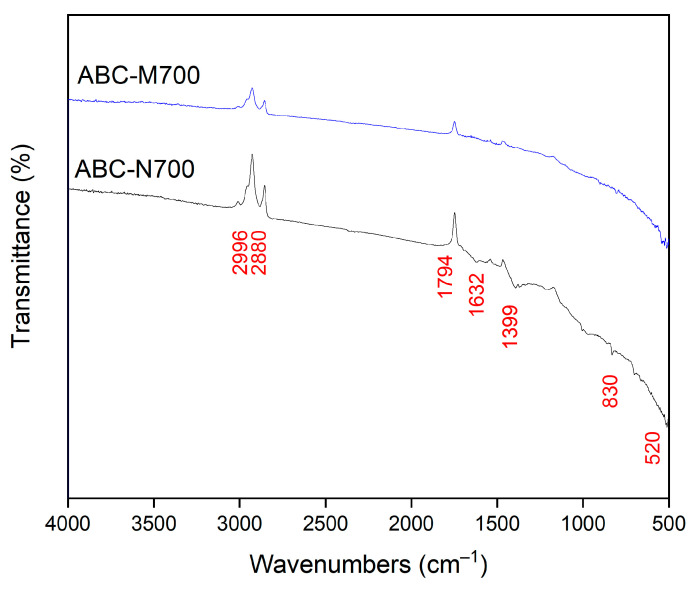
Valorizing agro-industrial waste into functional materials for environmental remediation and resource recovery is essential for advancing circular economy models. This study presents a novel closed-loop strategy to convert annatto (Bixa orellana) seed residues into biochar for phosphate recovery from aqueous solutions and real agro-industrial wastewater. A novel ternary modification with Fe, Zn, and Mn metals was applied to enhance the phosphate adsorption performance of the biochar. Materials were synthesized via pyrolysis at 600 °C and 700 °C, with ABC-M700 exhibiting the highest performance. Comprehensive characterization (FTIR, SEM-EDS, and XRF) confirmed the successful incorporation of metal (oxy)hydroxide functional groups, which facilitated phosphate binding. Adsorption studies revealed that ABC-M700 achieved a maximum phosphate removal capacity of 6.19 mg·g-1, representing a 955% increase compared to unmodified ABC-N700 (0.59 mg·g-1), and a 31% increase relative to ABC-M600 (4.73 mg·g-1). Physicochemical characterization indicated increased surface area, well-developed mesoporosity, and the formation of metal (oxy)hydroxide functionalities. ABC-M700 achieved a maximum adsorption capacity of 73.22 mg·g-1 and rapid kinetics, removing 95% of phosphate within 10 min and reaching equilibrium at 30 min. The material exhibited notable pH flexibility, with optimal performance in the range of pH 6-7. Performance evaluations using real wastewater from the same agro-industry confirmed its high selectivity, achieving 80% phosphate removal efficiency despite the presence of competing ions and organic matter. Phosphate fractionation revealed that 78% of adsorbed phosphate was retained in stable, metal-associated fractions. Although the material showed limited reusability, it holds potential for integration into nutrient recycling strategies as a slow-release fertilizer. These findings demonstrate a low-cost, waste-derived adsorbent with strong implications for circular economy applications and sustainable agro-industrial wastewater treatment. This study establishes a scalable model for agro-industries that not only reduces environmental impact but also addresses phosphorus scarcity and promotes resource-efficient waste management.
Keywords: annatto; circular economy; metal-modified biochar; nutrient recovery; waste valorization; wastewater treatment.
Conflict of interest statement
The authors declare no conflicts of interest.
Figures




References
-
- Masud M.A.A., Shin W.S., Sarker A., Septian A., Das K., Deepo D.M., Iqbal M.A., Islam A.R.M.T., Malafaia G. A Critical Review of Sustainable Application of Biochar for Green Remediation: Research Uncertainty and Future Directions. Sci. Total Environ. 2023;904:166813. doi: 10.1016/j.scitotenv.2023.166813. - DOI - PubMed
-
- Jayakumar M., Hamda A.S., Abo L.D., Daba B.J., Prabhu S.V., Rangaraju M., Jabesa A., Periyasamy S., Suresh S., Baskar G. Comprehensive Review on Lignocellulosic Biomass Derived Biochar Production, Characterization, Utilization and Applications. Chemosphere. 2023;345:140515. doi: 10.1016/j.chemosphere.2023.140515. - DOI - PubMed
MeSH terms
Substances
Grants and funding
LinkOut - more resources
Full Text Sources
