


Exploring Molecular Signatures Associated with Inflammation and Angiogenesis in the Aqueous Humor of Patients with Non-Proliferative Diabetic Retinopathy
- PMID: 40650239
- PMCID: PMC12250313
- DOI: 10.3390/ijms26136461
Exploring Molecular Signatures Associated with Inflammation and Angiogenesis in the Aqueous Humor of Patients with Non-Proliferative Diabetic Retinopathy
Abstract
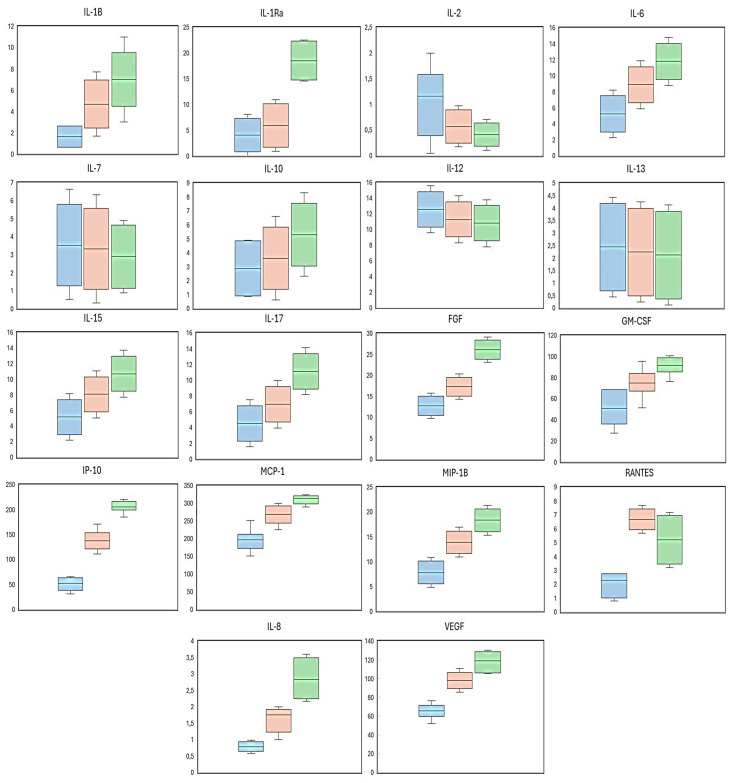
Type 2 diabetes mellitus (T2DM) is a major public health concern that significantly increases the risk of diabetic retinopathy (DR), a leading cause of visual impairment worldwide. This study aimed to identify molecular markers of inflammation (INF) and angiogenesis (ANG) in the aqueous humor (AH) of patients with non-proliferative diabetic retinopathy (NPDR). We conducted an observational, multicenter, case-control study including 116 participants classified into T2DM with NPDR, T2DM without DR, and non-diabetic controls (SCG) undergoing cataract surgery. AH samples were collected intraoperatively and analyzed for 27 cytokines using multiplex immunoassay. Eighteen immune mediators were detected in AH samples, and several were significantly elevated in the NPDR group, including the interleukins (IL) -1β, -6, -8, -15, -17, as well as the granulocyte-macrophage colony stimulating factor (GM-CSF), basic fibroblast growth factor (bFGF), interferon gamma-induced protein (IP-10), macrophage inflammatory protein 1 beta (MIP-1b), monocyte chemoattractant protein-1 (MCP-1), regulated on activation, normal T cell-expressed and -secreted protein (RANTES), and the vascular endothelial growth factor (VEGF). These molecules are involved in retinal INF, blood-retinal barrier breakdown, and pathological neovascularization. Our findings reveal a distinct pro-INF and pro-ANG profile in the AH of NPDR patients, suggesting that these cytokines may serve as early diagnostic/prognostic biomarkers for DR. Targeting these molecules could provide novel therapeutic strategies to mitigate retinal damage and vision loss in diabetic patients.
Keywords: angiogenesis; aqueous humor; biomarkers; inflammation; multiplex bead-based immunoassay; non-proliferative diabetic retinopathy; retina; type 2 diabetes mellitus.
Conflict of interest statement
The authors declare no conflicts of interest.
Figures

References
-
- Teo Z.L., Tham Y.C., Yu M., Chee M.L., Rim T.H., Cheung N., Bikbov M.M., Wang Y.X., Tang Y., Lu Y., et al. Global Prevalence of Diabetic Retinopathy and Projection of Burden through 2045: Systematic Review and Meta-analysis. Ophthalmology. 2021;128:1580–1591. doi: 10.1016/j.ophtha.2021.04.027. - DOI - PubMed
-
- Wilkinson C.P., Ferris F.L., Klein R.E., Lee P.P., Agardh C.D., Davis M., Dills D., Kampik A., Pararajasegaram R., Verdaguer J.T., et al. Proposed international clinical diabetic retinopathy and diabetic macular edema disease severity scales. Ophthalmology. 2003;110:1677–1682. doi: 10.1016/S0161-6420(03)00475-5. - DOI - PubMed
Publication types
MeSH terms
Substances
LinkOut - more resources
Full Text Sources
Medical
Research Materials
Miscellaneous
