


Contemporary pharmacological management of patients after hip fracture: a population-based cohort of over 120,000 patients in Spain
- PMID: 40650742
- PMCID: PMC12373669
- DOI: 10.1007/s00198-025-07564-4
Contemporary pharmacological management of patients after hip fracture: a population-based cohort of over 120,000 patients in Spain
Abstract
Treatment with antiosteoporotics is recommended after a hip fracture to reduce the risk of a new fracture or death. In our study, we found a slight increase in treatment rates over time, but an important treatment gap in the contemporary secondary prevention of hip fracture is still present.
Introduction: The pharmacological management of patients after hip fracture is likely to have changed due to the availability of denosumab during the last decade, but the extent of its use and potential improvement in treatment rates in routine clinical practice is largely unknown.
Methods: We constructed a population-based retrospective cohort of all patients aged 65 years + , discharged alive following hip fracture hospitalization (Jan 2008 to Dec 2021) in several regions of Spain, accounting for one third of the country's population. The proportion of patients prescribed any antiosteoporotic (AO) medication and specific classes in the first 90 days after discharge was evaluated. Temporal trends of treatment prescription per month were plotted. All analyses were performed also by age, sex, and region.
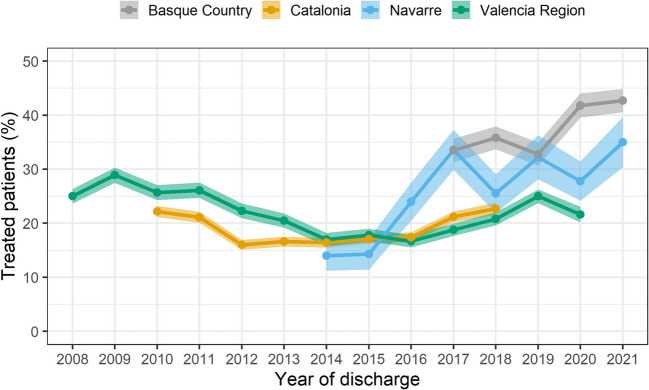
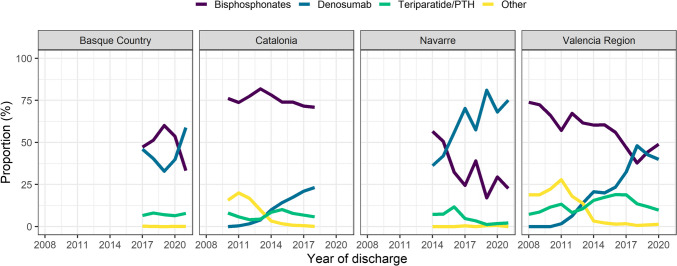
Results: In a cohort of over 120,000 patients, we found an important treatment gap in the secondary prevention of hip fracture (78% of patients untreated). Bisphosphonates and denosumab accounted for 60% and 20% of the AO prescriptions, respectively. Treatment gaps were most pronounced among patients aged 85 and over, and males: 26% of patients aged ≤ 84 were treated, in contrast to 18% of those aged 85 + . The proportion of females treated nearly doubled that of males (24% vs 14%). Differences by region were observed. Regarding time trends, despite finding an increase over time, prescription rates remained highly suboptimal. By drug class, treatment with bisphosphonates dropped, whereas denosumab treatment rose along the study period. Concerning management by sex, the Mediterranean regions showed a persistent gap over time, whereas in the Northern regions, the gap was gradually reduced. Treatment patterns by age groups were consistent over time.
Conclusions: Our study offers evidence to identify current gaps of care in secondary prevention of hip fracture and implement adequate strategies to reduce recurrent fractures in this frail population.
Keywords: Bisphosphonates; Denosumab; Drug use; Health service research; Hip fracture; Osteoporosis.
© 2025. The Author(s).
Conflict of interest statement
Declarations. Conflicts of interest: None.
Figures

References
-
- van Oostwaard MM (2018) Osteoporosis and the nature of fragility fracture: an overview. In: Hertz K, Santy-Tomlinson J (eds) Fragility fracture nursing: Holistic care and management of the orthogeriatric patient. Springer, Cham, pp 1–13
-
- Hernlund E, Svedbom A, Ivergård M, Compston J, Cooper C, Stenmark J, McCloskey EV, Jönsson B, Kanis JA (2013) Osteoporosis in the European Union: medical management, epidemiology and economic burden. A report prepared in collaboration with the International Osteoporosis Foundation (IOF) and the European Federation of Pharmaceutical Industry Associations (EFPIA). Arch Osteoporos 8:136 - PMC - PubMed
-
- Johnell O, Kanis JA (2006) An estimate of the worldwide prevalence and disability associated with osteoporotic fractures. Osteoporos Int 17(12):1726–1733 - PubMed
-
- Sanfélix-Genovés J, Sanfélix-Gimeno G, Peiró S, Hurtado I, Fluixà C, Fuertes A, Campos JC, Giner V, Baixauli C (2013) Prevalence of osteoporotic fracture risk factors and antiosteoporotic treatments in the Valencia region, Spain. The baseline characteristics of the ESOSVAL cohort. Osteoporos Int 24(3):1045–1055 - PubMed
MeSH terms
Substances
Grants and funding
LinkOut - more resources
Full Text Sources
Medical
Research Materials
Miscellaneous
