Review
. 2025 Oct;21(7):1931-1954.
doi: 10.1007/s12015-025-10933-5. Epub 2025 Jul 12.

Stem Cell for Cancer Immunotherapy: Current Approaches and Challenges

Affiliations
Review

Stem Cell for Cancer Immunotherapy: Current Approaches and Challenges

Zainab Alali et al. Stem Cell Rev Rep. 2025 Oct.

Abstract

Stem cell-based immunotherapy represents a groundbreaking advancement in cancer treatment, leveraging the immune system's inherent capacity to target and eradicate cancer cells. This review explores some of the examples of stem cells used in cancer immunotherapy, including hematopoietic, mesenchymal, and induced pluripotent stem cells (IPSCs). It also describes stem cell functionalities like modifying tumor microenvironment (TME) and developing engineered immune cells like chimeric antigen receptor (CAR)-T cells and natural killer (NK) cells. Additionally, the clinical applications of stem cells for improving cancer immunotherapies and delivering drugs directly to solid tumors are discussed. However, several challenges limit the effectiveness of stem cell technology, including safety risks, tumor avoidance by the immune system, and regulatory protocols as well as manufacturing barriers. This article reviews current advancements to overcome these challenges, such as CRISPR-based gene editing and targeted drug delivery systems and provides an outlook on emerging trends, such as the progress of personalized stem cell therapies and the increasing effectiveness of treatment by combining them with other cancer treatments.

Keywords: CAR-T cells; CRISPR; Cancer; Immunotherapy; Microenvironment; Stem cells.


Conflict of interest statement

Declarations. Competing interest: The authors affirm that they do not have any competing interests.

Figures
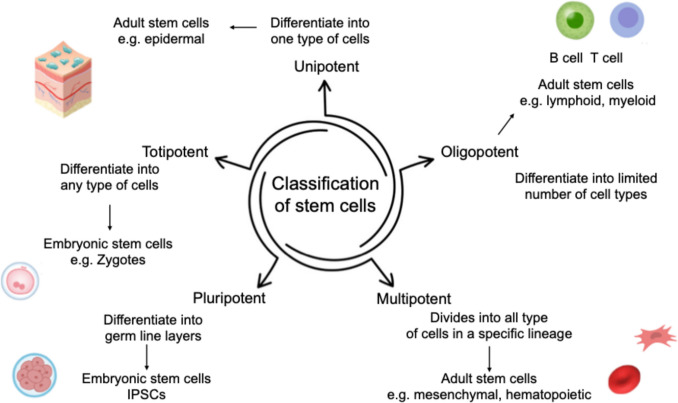
Fig. 1
Fig. 1
Classification of stem cells based on their differentiation (Created with BioRender)
Fig. 2
Fig. 2
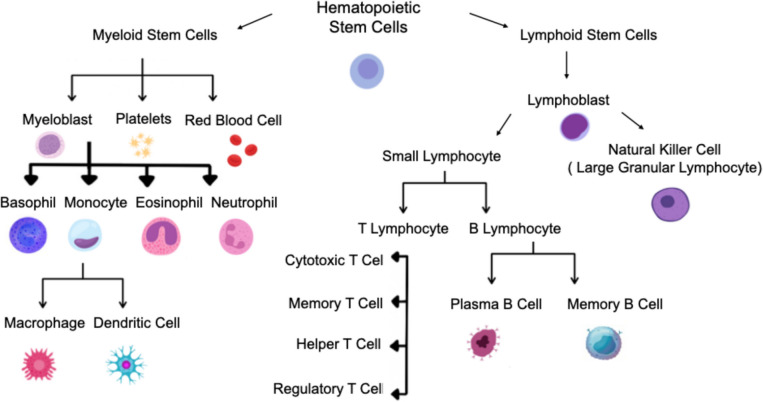
Cells produced from hematopoietic stem cells (Created with BioRender)
Fig. 3
Fig. 3
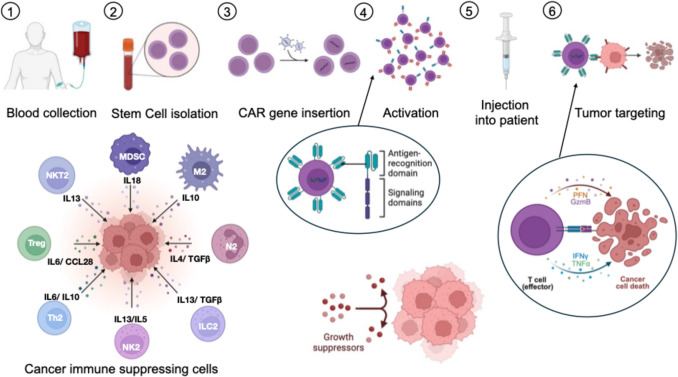
A summary of stem cell-based immunotherapy for cancer treatment. (1) Blood collection: blood is drawn from the patient. (2) Stem cell isolation: cells, including T cells, are isolated from the collected blood. (3) CAR gene insertion: T cells are genetically engineered to express a Chimeric Antigen Receptor (CAR) targeting specific tumor antigens. The CAR typically consists of an antigen-recognition domain (e.g., scFv) and one or more signaling domains for T cell activation. (4) Activation: The CAR T cells are expanded ex vivo to obtain sufficient numbers for therapeutic use. (5) Injection into patient: Activated CAR T cells are infused back into the patient. (6) Tumor targeting: CAR T cells recognize and bind to tumor cells, leading to their elimination. The effector mechanism involves the release of cytotoxic molecules such as perforin (PFN) and granzyme B (GzmB), and pro-inflammatory cytokines like interferon gamma (IFN-γ) and tumor necrosis factor alpha (TNF-α), ultimately inducing cancer cell death. The lower panel illustrates various cancer immune suppressing cells involved in TME: Myeloid-Derived Suppressor Cells (MDSC), M2 macrophages (M2), Regulatory T cells (Treg), T helper 2 cells (TH2), NKT2 cells (NKT2), N2 neutrophils (N2), Group 2 innate lymphoid cells (ILC2), and Natural Killer cells (NK2). These cells secrete various cytokines and chemokines, including interleukin (IL)−6, IL-10, IL-13, IL-5, transforming growth factor beta (TGF-β), and CCL2, which contribute to immune suppression. Growth suppressors are also depicted, indicating their role in inhibiting cell proliferation (Created with BioRender)
Fig. 4
Fig. 4
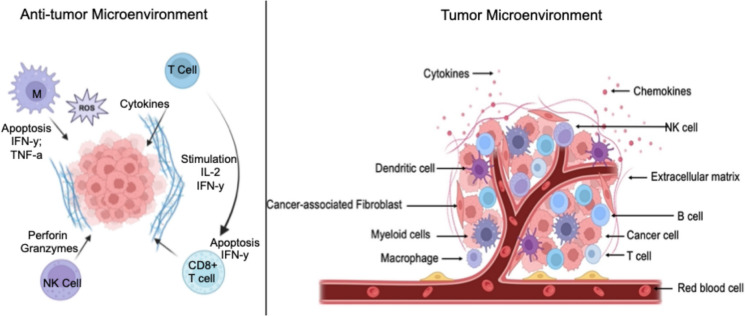
Illustration of the tumor microenvironment (TME) along with anti-tumor microenvironment. In the left panel, activated immune cells, such as T cells, CD8 + T cells, and Natural Killer (NK) cells, interact with cancer cells. These cells induce apoptosis in cancer cells through mechanisms involving the release of Perforin and Granzymes, and the production of Reactive Oxygen Species (ROS). Cytokines such as Interleukin-2 (IL-2), Interferon gamma (IFN-γ), and Tumor Necrosis Factor alpha (TNF-α) are involved in stimulating and mediating anti-tumor responses. In the right panel, a comprehensive representation of the cellular and structural components of the TME (Created with BioRender)
Fig. 5
Fig. 5
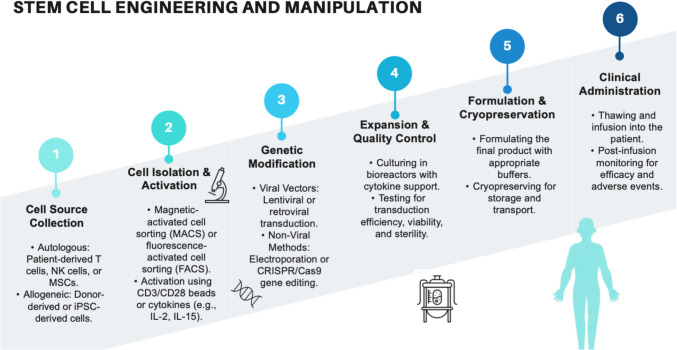
Core stages in stem cell engineering and manipulation
Fig. 6
Fig. 6
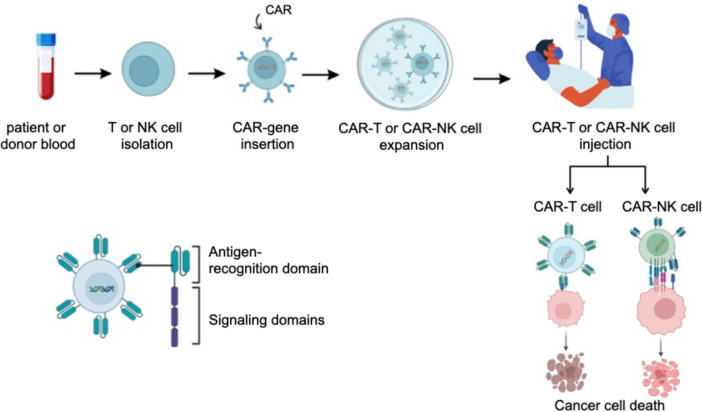
Treatment using chimeric antigen receptor T cells (CAR-T) or natural killer cells (CAR-NK). The treatment starts with isolating T or NK cells from the patient's or donor's blood. Then, cells are genetically modified to express CARs. After that, CAR-T or CAR-NK cells are expanded to a desired number. Finally, CAR-T or CAR-NK cells are injected into the patient’s body to kill cancer cells (Created with BioRender)
Fig. 7
Fig. 7
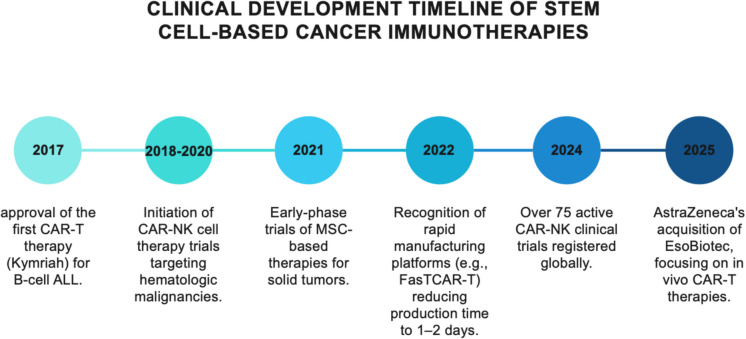
Clinical development timeline of cell-based cancer immunotherapies
Fig. 8
Fig. 8
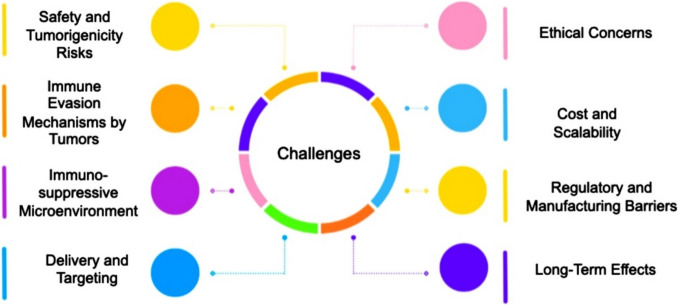
Challenges in stem cell-based immunotherapy for cancer (Created with BioRender)
Fig. 9
Fig. 9
A) The difference between conventional drug delivery systems and targeted drug delivery systems. Conventional drug delivery system has poor bio-disruption and severe side effects. Targeted drug delivery system shows better results as anti-cancer agents interact and eliminate cancer cells. B) External and internal drug release stimuli (Created with BioRender)
Fig. 10
Fig. 10
Stem cell engineering process. A) Engineering stem cells from a healthy donor: Target cells are activated, followed by expansion and isolation of cellular products. These cells then undergo Gene engineering, which can involve Knockout of some genes or Over-expression of Chimeric Antigen Receptors (CARs) or T-Cell Receptors (TCRs). B) Engineering stem cells from the patient. C) Gene editing using CRISPR-Cas9 where A single guide RNA (sgRNA) with a Matching Sequence guides the Cas9 protein to a specific site in the Genomic DNA. (Created with BioRender)

References

    1. Yin, W., Wang, J., Jiang, L., & James Kang, Y. (2021). Cancer and stem cells. Experimental Biology and Medicine. SAGE Publications Inc. 10.1177/15353702211005390 - PMC - PubMed
    1. Siegel, R. L., Giaquinto, A. N., & Jemal, A. (2024). Cancer statistics, 2024. CA: A Cancer Journal for Clinicians,74(1), 12–49. 10.3322/caac.21820 - PubMed
    1. Zheng, R., Wang, S., Zhang, S., Zeng, H., Chen, R., Sun, K., & Wei, W. (2023). Global, regional, and national lifetime probabilities of developing cancer in 2020. Science Bulletin,68(21), 2620–2628. 10.1016/j.scib.2023.09.041 - PMC - PubMed
    1. International Agency for Research on Cancer (IARC). (2024). Global Cancer Observatory: Cancer Tomorrow. International Agency for Research on Cancer (IARC).
    1. Rahib, L., Wehner, M. R., Matrisian, L. M., & Nead, K. T. (2021). Estimated Projection of US Cancer Incidence and Death to 2040. JAMA Network Open,4(4), e214708. 10.1001/jamanetworkopen.2021.4708 - PMC - PubMed

Substances

LinkOut - more resources