. 2025 Sep:85:103764.
doi: 10.1016/j.redox.2025.103764. Epub 2025 Jul 10.

Association between redox biomarkers, DNA damage and aerobic capacity before and after physical stress in young men

Affiliations

Association between redox biomarkers, DNA damage and aerobic capacity before and after physical stress in young men

Daniela Weber et al. Redox Biol. 2025 Sep.

Abstract

The interaction of reactive molecules with proteins, lipids and carbohydrates results in the formation of compounds generally called redox biomarkers. It is widely recognized that high intensity exercise results in an increase of oxidative stress which in turn induces DNA damage. However, aerobic trained individuals seem to be less affected than untrained individuals. We previously showed that exercise-induced DNA damage is indeed higher in untrained individuals compared with trained individuals. But to which extent redox biomarkers are associated with DNA damage and how both are associated with aerobic capacity remains unclear. Therefore, we measured well-established redox biomarkers in plasma from young healthy volunteers before and after exhaustive exercise. We found that aerobic capacity, as measured by the level of VO2 peak, is negatively associated with glyoxal, methylglyoxal and 3-deoxyglucosone concentration in plasma before and after exhaustive physical exercise. In contrast, protein carbonyls, 3-nitrotyrosine and malondialdehyde were not associated with aerobic capacity. Interestingly, glyoxal was positively associated with DNA strand breaks in immune cells before but not after exhaustive exercise, indicating a beneficial effect of a high aerobic capacity on DNA integrity. These results provide a potential mechanism of how exercise protects against cardiovascular diseases, diabetes and cancer development.

Keywords: Aerobic capacity; DNA damage; Reactive dicarbonyls; Redox biomarkers.


Conflict of interest statement

Declaration of competing interest I certify that all authors have participated sufficiently in the work to take public responsibility for the content. Furthermore, each author certifies that has reviewed the manuscript and her/his stated contribution to the manuscript is accurate. The authors declare no conflict of interest. All authors declare no financial and personal relationships with other people or organizations that could inappropriately influence (bias) their work. All authors have approved the manuscript and agree with its submission to Biomolecules.

Figures
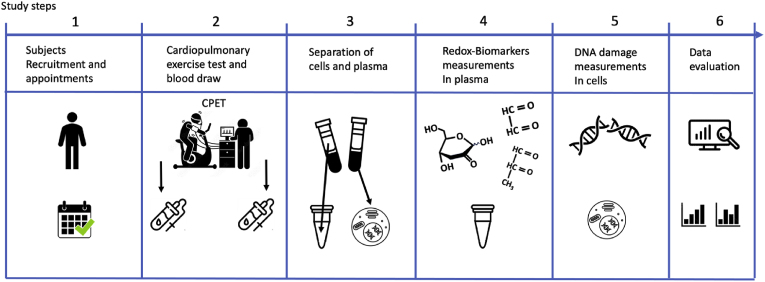
Fig. 1
Fig. 1
Schematic representation of the study design.
Fig. 2
Fig. 2
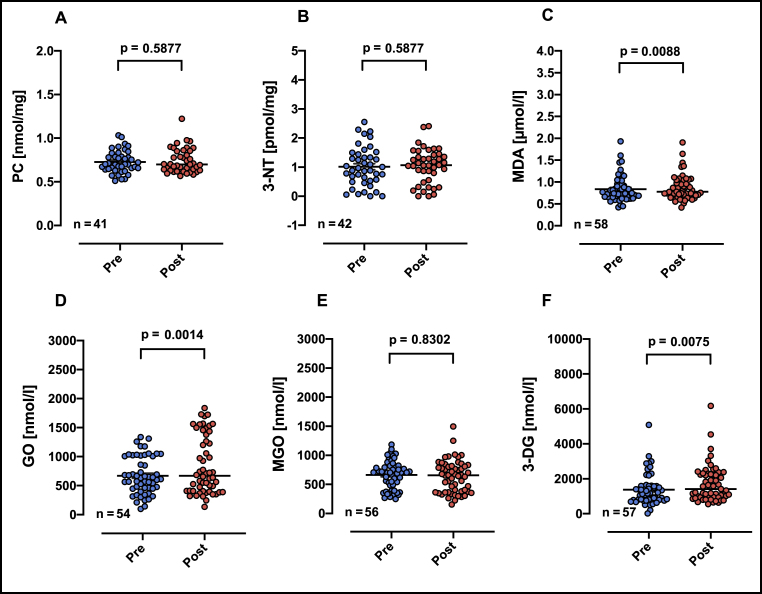
Plasma concentration of redox biomarkers in individuals before (blue dots) and after (red dots) CPET. PC = protein carbonyls; 3-NT = 3-Nitrotyrosine; MDA = malondialdehyde; GO = Glyoxal; MGO = methyglyoxal; 3-DG = 3-deoxyglucosone. Normality tests indicate not normal distribution for all biomarkers with exception of 3-NT. Therefore, p value represents statistical significance calculated from non-parametric Wilcoxon matched-pairs signed rank test, n means number of pairs included in analyses. Horizontal lines represent the median of each group.
Fig. 3
Fig. 3
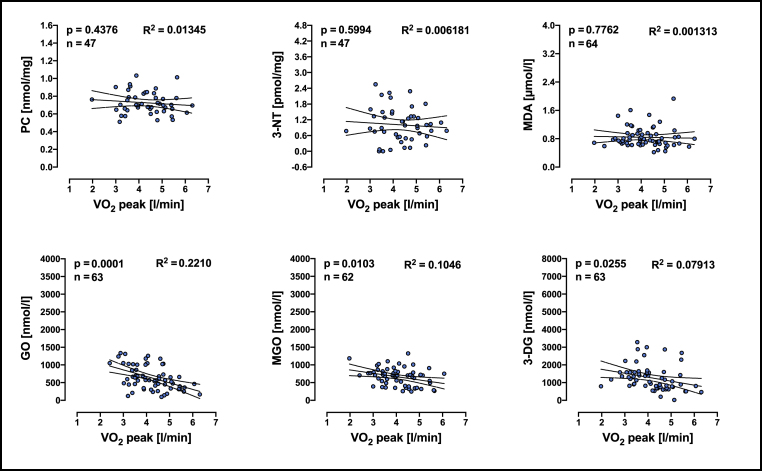
Linear regression analyses of VO2 peak and redox biomarkers in plasma from individuals before performing exhaustive exercise (CPET). R2 means goodness of fit, n means number of individuals included in the analyses. PC = protein carbonyls; 3-NT = 3-Nitrotyrosine; MDA = malondialdehyde; GO = Glyoxal; MGO = methyglyoxal; 3-DG = 3-deoxyglucosone. Linear relationship between two variables was determined by a significance test for the slope of the regression model and n means number of pairs included in analyses.
Fig. 4
Fig. 4
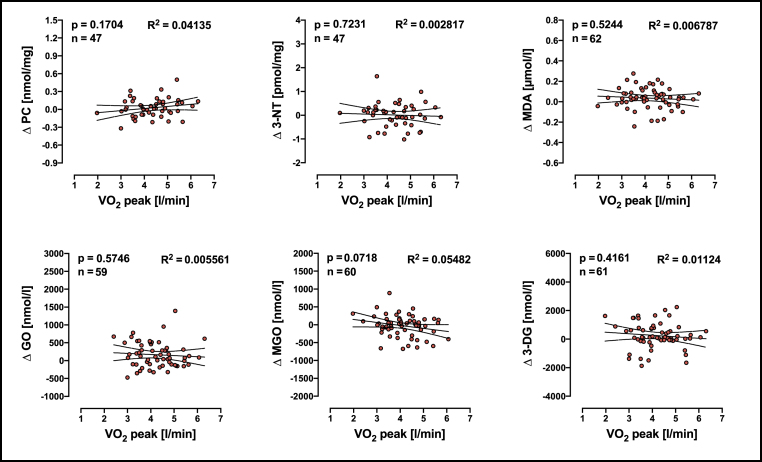
Linear regression analyses of VO2 peak and Δ redox biomarkers. R2 means goodness of fit, n means number of individuals included in the analyses. PC = protein carbonyls; 3-NT = 3-Nitrotyrosine; MDA = malondialdehyde; GO = Glyoxal; MGO = methyglyoxal; 3-DG = 3-deoxyglucosone. Linear relationship between two variables was determined by a significance test for the slope of the regression model and n means number of pairs included in analyses. Δ redox biomarkers means the difference in the redox values between before and after exhaustive exercise for each individual.
Fig. 5
Fig. 5
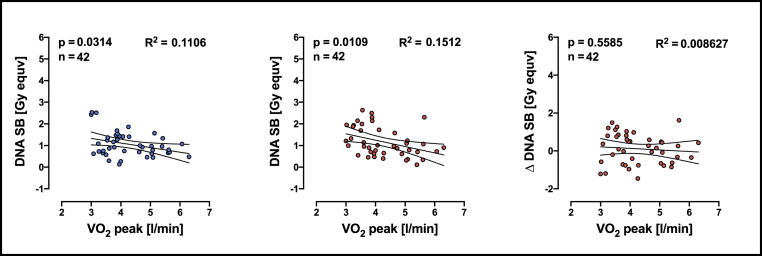
Linear regression analyses of VO2 peak and the number of DNA strand breaks. R2 means goodness of fit, n means number of individuals included in the analyses. Left panel: DNA strand breaks before performing CPET (exhaustive exercise). Middle panel: DNA strand breaks after performing CPET (exhaustive exercise). Right panel: Difference between before and after CPET in DNA strand breaks. Linear relationship between two variables was determined by a significance test for the slope of the regression model and n means number of pairs included in analyses. DNA SB means DNA strand breaks, Δ DNA SB means the difference in the DNA SB before and after exhaustive exercise for each individual (plots contained part of published data from Moreno-Villanueva et al., 2019) [42].
Fig. 6
Fig. 6
Linear regression analyses of DNA-SB and redox biomarkers measured in immune cells from individuals before performing exhaustive exercise (CPET). R2 means goodness of fit, n means number of individuals included in the analyses. PC = protein carbonyls; 3-NT = 3-Nitrotyrosine; MDA = malondialdehyde; GO = Glyoxal; MGO = methyglyoxal; 3-DG = 3-deoxyglucosone; DNA-SB = DNA strand breaks. Linear relationship between two variables was determined by a significance test for the slope of the regression model and n means number of pairs included in analyses.
Fig. 7
Fig. 7
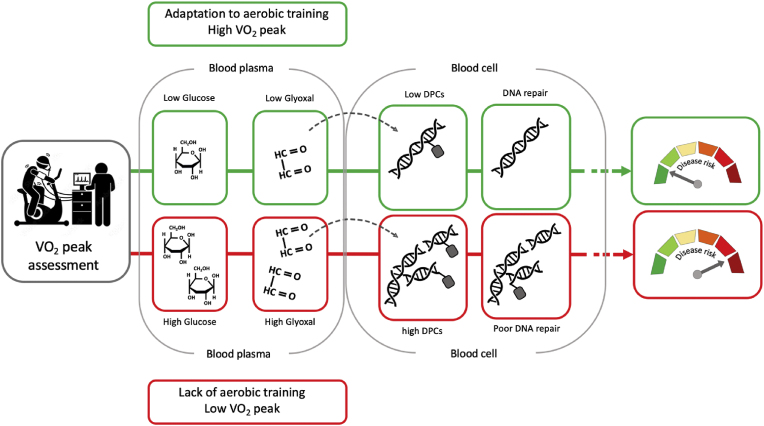
Schematic representation of study outcomes and potential mechanisms. Glyoxal can cross cells' membranes inducing DNA-SB and DNA-protein crosslinks. Individuals with high aerobic capacity (green frames) have a low concentration of glyoxal in blood and therefore a low level of DNA damage which can be successfully repaired. Whereas, individuals with low aerobic capacity (red frames) have a high concentration of glyoxal in blood and therefore a high level of DNA damage which can be poorly repaired increasing the risk of developing diseases.

References

    1. Pedersen B.K., Saltin B. Evidence for prescribing exercise as therapy in chronic disease. Scand. J. Med. Sci. Sports. Feb 2006;16(Suppl 1):3–63. doi: 10.1111/j.1600-0838.2006.00520.x. - DOI - PubMed
    1. Anderson E., Durstine J.L. Physical activity, exercise, and chronic diseases: a brief review. Sports Med. Health Sci. Dec 2019;1(1):3–10. doi: 10.1016/j.smhs.2019.08.006. - DOI - PMC - PubMed
    1. Usmani D., Ganapathy K., Patel D., Saini A., Gupta J., Dixit S. The role of exercise in preventing chronic diseases: current evidence and recommendations. Georgian Med. News. Jun 2023;339:137–142. - PubMed
    1. Colberg S.R., Sigal R.J., Fernhall B., et al. Exercise and type 2 diabetes: the American college of sports medicine and the American diabetes association: joint position statement. Diabetes Care. Dec 2010;33(12):e147–e167. doi: 10.2337/dc10-9990. - DOI - PMC - PubMed
    1. Syeda U.S.A., Battillo D., Visaria A., Malin S.K. The importance of exercise for glycemic control in type 2 diabetes. Am. J. Med. Open. Jun 2023;9 doi: 10.1016/j.ajmo.2023.100031. - DOI - PMC - PubMed