


This is a preprint.
Continuous Monitoring of Head Turns: Compliance, Kinematics, and Reliability of Wearable Sensing
- PMID: 40654751
- PMCID: PMC12247721
- DOI: 10.1101/2025.04.29.650670
Continuous Monitoring of Head Turns: Compliance, Kinematics, and Reliability of Wearable Sensing
Update in
-
Continuous Monitoring of Head Turns: Compliance, Kinematics, and Reliability of Wearable Sensing.IEEE Trans Neural Syst Rehabil Eng. 2025;33:4374-4385. doi: 10.1109/TNSRE.2025.3622072. IEEE Trans Neural Syst Rehabil Eng. 2025. PMID: 41091607 Free PMC article.
Abstract
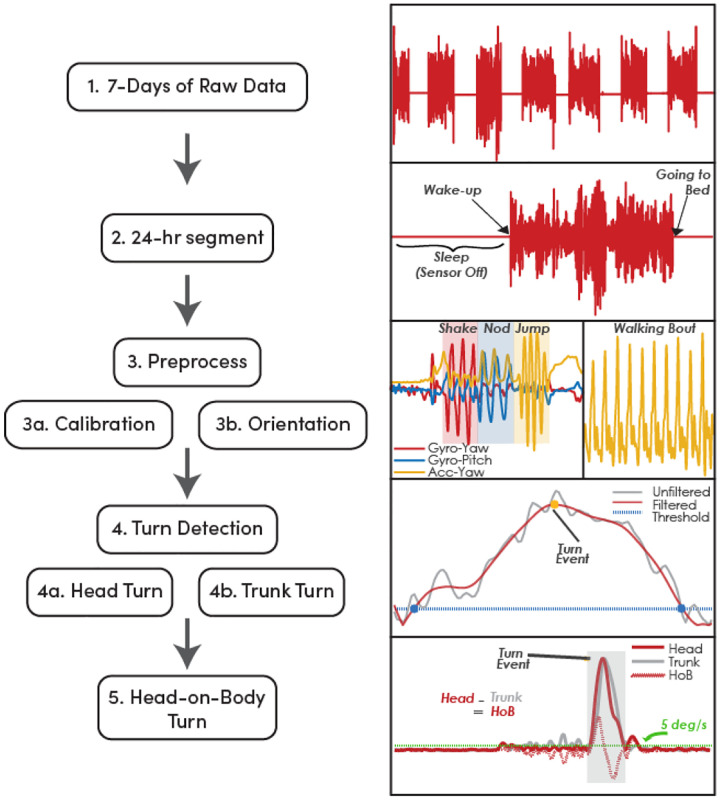
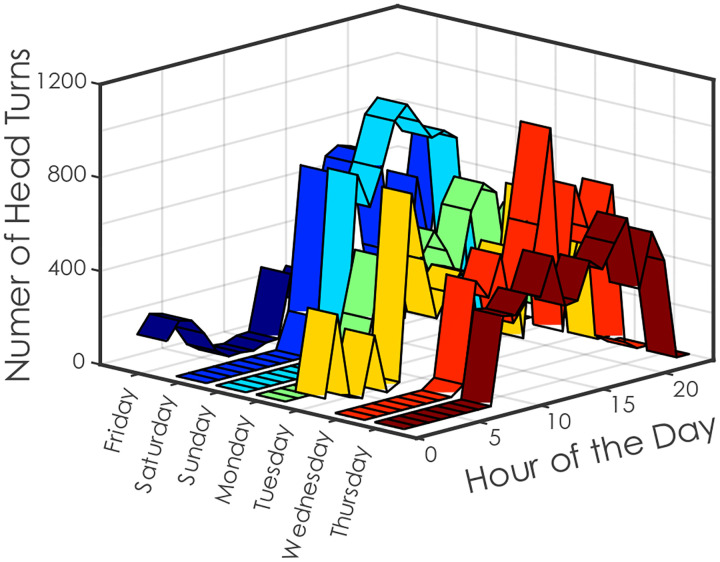
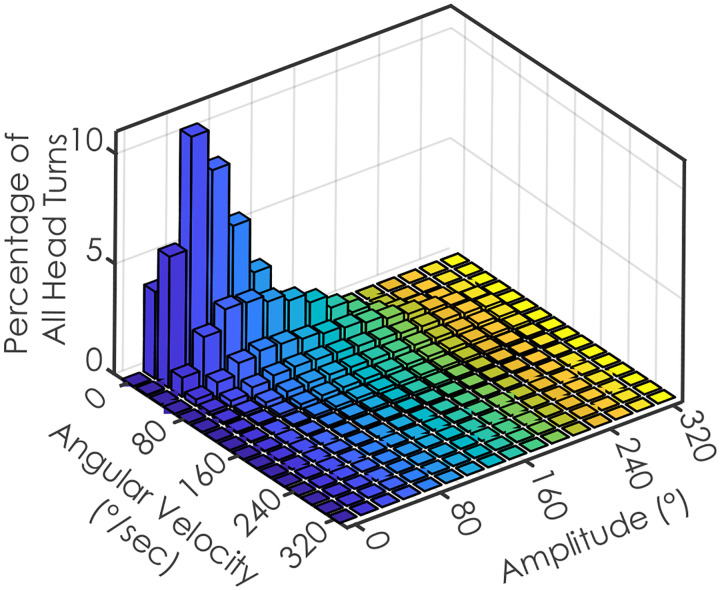
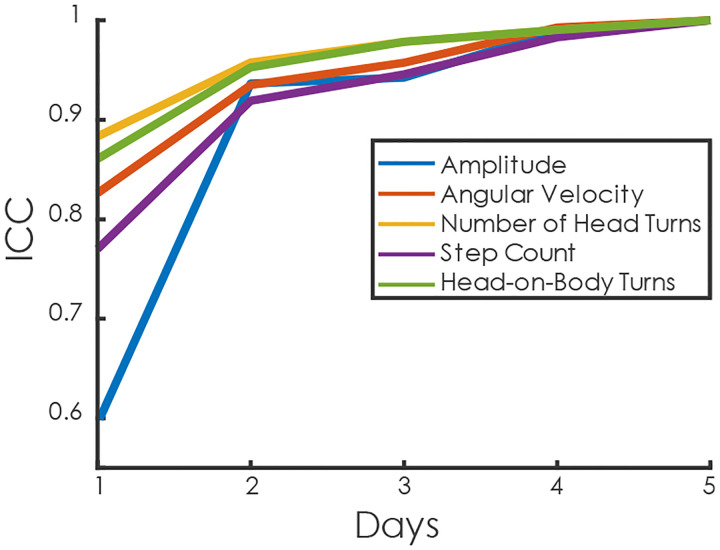
Wearable devices offer objective mobility metrics for continuous monitoring but often focus on traditional measures like step count or gait speed. Other quantitative metrics such as head kinematics may provide valuable insights into mobility, balance, and sensory integration, given the head's central role in coordinating vestibular, ocular, and postural control. Yet, basic knowledge about capturing daily living head turns, including participant compliance, algorithms, normative data, and reliability, is not yet established. This study aimed to resolve this knowledge gap by capturing head and trunk movement kinematics over a 7-day period and to establish normative data in healthy adults. Participants (n = 24) wore head-mounted sensors for an average of 16.38 hours per day (SD = 4.43), completing 5,163 (SD = 1,466) head turns daily, with 72% occurring independently of trunk motion. Head turn amplitude (M = 58.18°, SD = 4.26°) was comparable to lumbar turns, while peak velocity was higher for head turns (M = 104.49°/s, SD = 12.08°/s). By the second day, all head turn metrics achieved excellent reliability (ICC > 0.9), supporting the feasibility of multi-day monitoring. Additionally, we examined the relationship between head motion and other mobility metrics and established recommendations for implementing similar protocols for capturing future studies, including the minimum number of days required for reliable data collection. Findings from this study provide a foundation for future multi-day continuous monitoring of head kinematics in both healthy and clinical populations.
Keywords: free-living mobility; head kinematics; inertial sensors; physical activity; remote monitoring.
Figures
References
-
- de Leeuwerk M. E., Bor P., van der Ploeg H. P., de Groot V., van der Schaaf M., and van der Leeden M., “The effectiveness of physical activity interventions using activity trackers during or after inpatient care: a systematic review and meta-analysis of randomized controlled trials,” Int J Behav Nutr Phy, vol. 19, no. 1, p. 59, 2022. - PMC - PubMed
-
- Szeto K., Arnold J., Singh B., Gower B., Simpson C. E., and Maher C., “Interventions using wearable activity trackers to improve patient physical activity and other outcomes in adults who are hospitalized: a systematic review and meta-analysis,” JAMA Network Open, vol. 6, no. 6, pp. e2318478–e2318478, 2023. - PMC - PubMed
-
- Taraldsen K., Chastin S. F. M., Riphagen I. I., Vereijken B., and Helbostad J. L., “Physical activity monitoring by use of accelerometer-based body-worn sensors in older adults: A systematic literature review of current knowledge and applications,” (in English), Maturitas, vol. 71, no. 1, pp. 13–19, Jan 2012, doi: 10.1016/j.maturitas.2011.11.003. - DOI - PubMed
Publication types
Grants and funding
LinkOut - more resources
Full Text Sources
Miscellaneous
