


Toward improving retention in HIV care after pregnancy: lessons from a post-pandemic cohort in the United States
- PMID: 40655100
- PMCID: PMC12245896
- DOI: 10.3389/fmed.2025.1561490
Toward improving retention in HIV care after pregnancy: lessons from a post-pandemic cohort in the United States
Abstract
Introduction: People living with HIV (PLWH) often experience low rates of retention in HIV care (RIC) and suboptimal viral suppression postpartum. Understanding contemporary barriers to RIC is crucial to identify risk factors for loss to care and thereby improve support during this vulnerable transition. This work aimed to identify factors associated with adequate RIC, defined as two HIV care visits ≥90 days apart in the first year postpartum.
Methods: Electronic records were retrospectively reviewed for PLWH who delivered from 2019 to 2023 and received prenatal care within a single county health system. Variables were collected related to both maternal and neonatal HIV and obstetric or pediatric care. Variables were analyzed using descriptive statistics, and Kaplan-Meier curves were used to assess viral suppression during pregnancy and the first year postpartum. A Random Forest machine learning model was used to determine variables of relative importance for prediction of adequate RIC. Multivariable logistic regression was used to evaluate impact of identified variables on RIC.
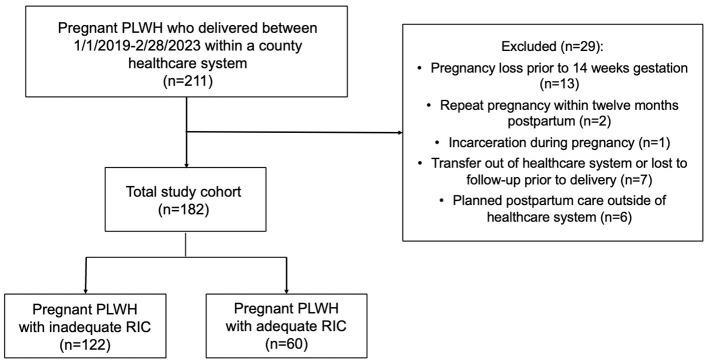
Results: Of 182 pregnancies, sixty individuals (33%) achieved adequate postpartum RIC. Adequate RIC correlated with year of delivery (p = 0.018), attending at least two obstetrical postpartum visits (p = 0.025), viral suppression at initial prenatal visit (p = 0.030), and shorter duration between pregnancy visit and HIV care visits before and after pregnancy (p < 0.001). Viral suppression was generally excellent at time of delivery (99.4%). However, viral loads rebounded after delivery, with 66.8% suppressed at 12 months postpartum. Random Forest modeling identified several clinical and social factors with relative importance for prediction of RIC. Multivariable logistic regression supported above findings with significant decreased odds of adequate RIC based on year of delivery [2021 aOR 0.306 (0.097-0.956), 2022 0.146 (0.046-0.458), 2023 0.071 (0.011-0.455)], higher viral load at initial prenatal visit [aOR 0.038 (0.002-0.889)], and longer duration between last HIV care visit and first pregnancy visit [aOR 0.419 (0.176-0.998)].
Discussion: Postpartum RIC was suboptimal in this contemporary US single-site cohort. Engagement in prenatal and postpartum obstetric care predicted improved postpartum RIC. Further qualitative research is essential to improve deeper understanding of patterns of engagement perinatally in order to develop effective interventions to improve support for individuals during this difficult transition.
Keywords: HIV; barriers; postpartum; pregnancy; retention.
Copyright © 2025 Latham, Lugo Morales, Barba Gutierrez, Jochum, Conrad, Clark, Goytia, Alam, Gerard and McKinney.
Conflict of interest statement
The authors declare that the research was conducted in the absence of any commercial or financial relationships that could be construed as a potential conflict of interest.
Figures


References
-
- HIV Surveillance Supplemental Report: Monitoring Selected National HIV Prevention and Care Objectives by Using HIV Surveillance Data United States and 6 Territories and Freely Associated States 2022 . Centers for Disease Control and Prevention. (2024). Available online at: https://stacks.cdc.gov/view/cdc/156511 (Accessed November 24, 2024).
-
- National Center for HIV/AIDS Viral Hepatitis STD and and TB Prevention: Division of HIV/AIDS Prevention . Selected National HIV Prevention and Care Outcomes in the United States. Centers for Disease Control and Prevention. (2019). Available online at: https://www.cdc.gov/hiv-data/nhss/national-hiv-prevention-and-care-outco... (Accessed January 15, 2025).
-
- Spach D. Lesson 8: Retention in HIV Care [MOOC]. In Basic HIV Primary Care Overview, 3rd Edition. The National HIV Curriculum. (2024). Available online at: https://www.hiv.uw.edu/go/basic-primary-care/retention-care/core-concept... (Accessed January 15, 2025).
LinkOut - more resources
Full Text Sources
