


Does Control Nutritional Status (CONUT) Score Predict Early and Long-Term Mortality at the Initiation of Maintenance Hemodialysis?
- PMID: 40655306
- PMCID: PMC12254193
- DOI: 10.2147/IJGM.S533080
Does Control Nutritional Status (CONUT) Score Predict Early and Long-Term Mortality at the Initiation of Maintenance Hemodialysis?
Abstract
Purpose: Controlled Nutritional Status (CONUT) score is strongly associated with mortality in various patient groups. This study aimed to assess the CONUT score's ability to predict mortality in Hemodialysis (HD) patients.
Patients and methods: Data from 243 patients who started HD between 2012 and 2020 were analyzed retrospectively. Laboratory test results within the first month after dialysis initiation were recorded and CONUT scores were calculated.
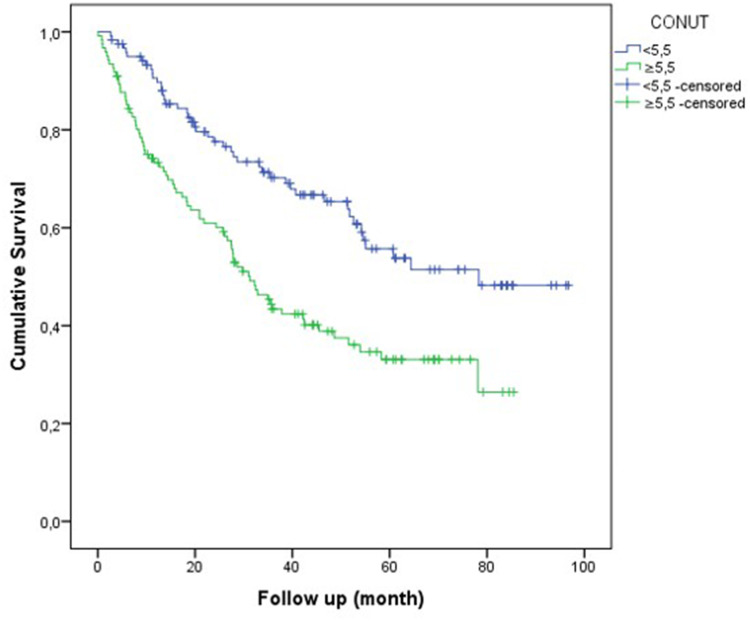
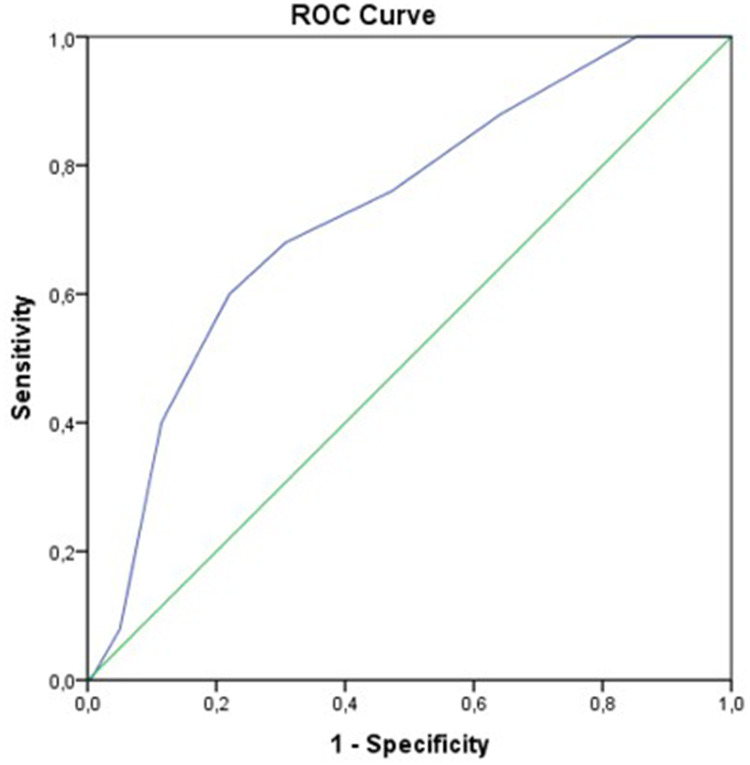
Results: Over a mean follow-up duration of 32.2 months, the association between early (within six months) and late mortality was assessed. During this period, 119 patients (48.8%) died. Non-survivors had higher CONUT scores. The optimal cut-off for the CONUT score was 5.5. Sensitivity and specificity for predicting mortality were 62.2% and 61.23%, respectively. The optimal cut-off for early mortality was 6.5. Sensitivity and specificity for predicting early mortality were 68% and 69.3%, respectively. The CONUT score demonstrated moderate predictive accuracy for mortality (AUC 0.665) and higher accuracy for early mortality (AUC 0.729), highlighting its clinical utility in risk stratification.
Conclusion: CONUT score at the beginning of HD is a reliable tool in predicting overall mortality in these patients, but it is especially useful in predicting early mortality.
Keywords: CONUT score; hemodialysis; malnutrition; mortality.
© 2025 Selen et al.
Conflict of interest statement
The authors report no conflicts of interest in this work.
Figures


References
-
- Hory B, Robino C, Albadawy M, Islam MS. NUTRIPEPA 2: impact d’une membrane adsorbante sur le syndrome PEW. Néphrol Thérap. 2014;10(5):314. doi: 10.1016/j.nephro.2014.07.062 - DOI
LinkOut - more resources
Full Text Sources
