


The association between sedentary behavior and MASLD in overweight and obese adults: investigating the role of inflammatory markers using NHANES data (2017-March 2020)
- PMID: 40655480
- PMCID: PMC12246849
- DOI: 10.3389/fnut.2025.1579453
The association between sedentary behavior and MASLD in overweight and obese adults: investigating the role of inflammatory markers using NHANES data (2017-March 2020)
Abstract
Background: Metabolic dysfunction-associated steatotic liver disease (MASLD) has been linked to sedentary behavior (SB), yet the extent to which systemic inflammation mediates this relationship remains unclear. This study aims to demonstrate the mediating function of inflammatory markers in the link between sedentary behavior and metabolic dysfunction-associated steatotic liver disease (MASLD) in overweight and obese individuals.
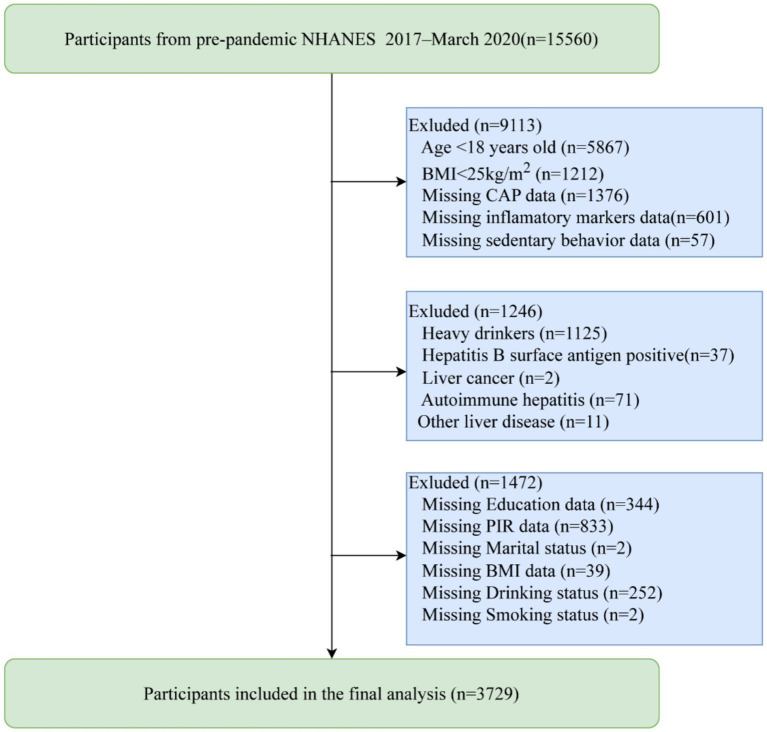
Methods: In this cross-sectional study, we analyzed pre-pandemic data (2017-March 2020) from the National Health and Nutrition Examination Survey (NHANES), including 3,729 overweight/obese adults with MASLD defined by a controlled attenuation parameter (CAP) ≥ 302 dB/m. Self-reported SB (≥480 min/day vs. <480 min/day) and vigorous recreational activity were assessed alongside inflammatory markers (high-sensitivity C-reactive protein [HSCRP], albumin [ALB], white blood cell count [WBC], and neutrophil count [NE]). And weighted multivariable logistic and linear regression models, as well as mediation analyses, were conducted to account for the complex sampling design of the NHANES data.
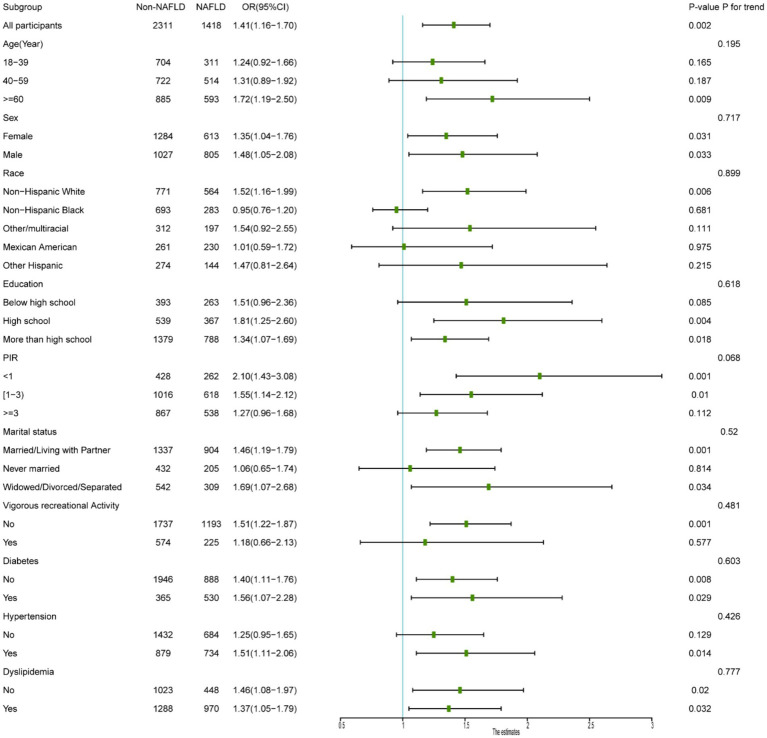
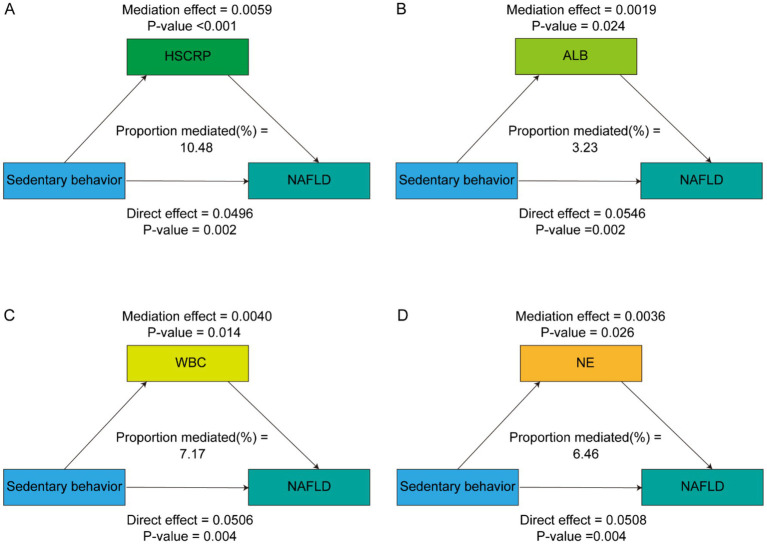
Results: Weighted logistic regression showed that severe SB was associated with higher MASLD odds (OR = 1.43, 95% CI: 1.02-1.99), which further increased (OR = 2.88, 95% CI: 1.77-4.71) in participants lacking vigorous physical activity. Independent predictors of MASLD included lower ALB (OR = 0.55) and higher WBC (OR = 1.16) and NE (OR = 1.17). Mediation analysis indicated that HSCRP, ALB, WBC, and NE, respectively, accounted for 10.48, 3.23, 7.17, and 6.46% of the SB - MASLD association.
Conclusion: Our findings suggest that severe sedentary behavior is an independent risk factor for MASLD, with some evidence suggesting that this relationship may be influenced by inflammatory markers. However, longitudinal studies are necessary to better understand the nature of these associations and to explore the underlying mechanisms involved.
Keywords: MASLD; NHANES (National Health and Nutrition Examination Survey); inflammatory markers; mediation analysis; metabolic dysfunction associated steatotic liver disease; sedentary behavior (SB).
Copyright © 2025 Zhou, Li, Wang, Li, Chen, Huang and Peng.
Conflict of interest statement
The authors declare that the research was conducted in the absence of any commercial or financial relationships that could be construed as a potential conflict of interest.
Figures
References
-
- Quek J, Chan KE, Wong ZY, Tan C, Tan B, Lim WH, et al. Global prevalence of non-alcoholic fatty liver disease and non-alcoholic steatohepatitis in the overweight and obese population: a systematic review and meta-analysis. Lancet Gastroenterol Hepatol. (2023) 8:20–30. doi: 10.1016/S2468-1253(22)00317-X, PMID: - DOI - PubMed
LinkOut - more resources
Full Text Sources
Research Materials
Miscellaneous
