


Large-scale collaborative vehicle routing
- PMID: 40656628
- PMCID: PMC12254086
- DOI: 10.1007/s10479-021-04504-3
Large-scale collaborative vehicle routing
Abstract
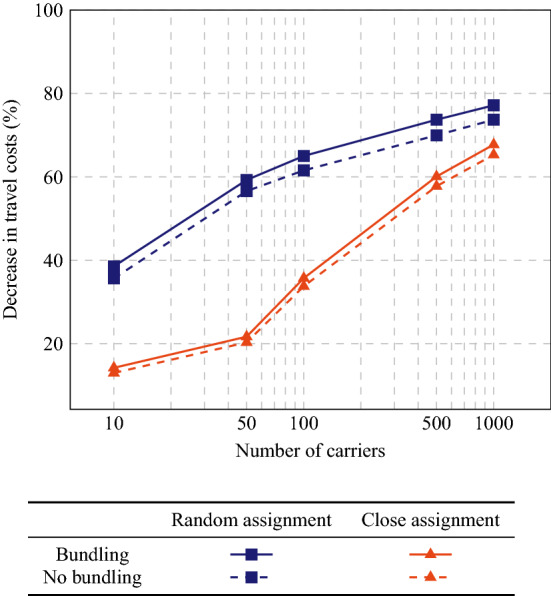
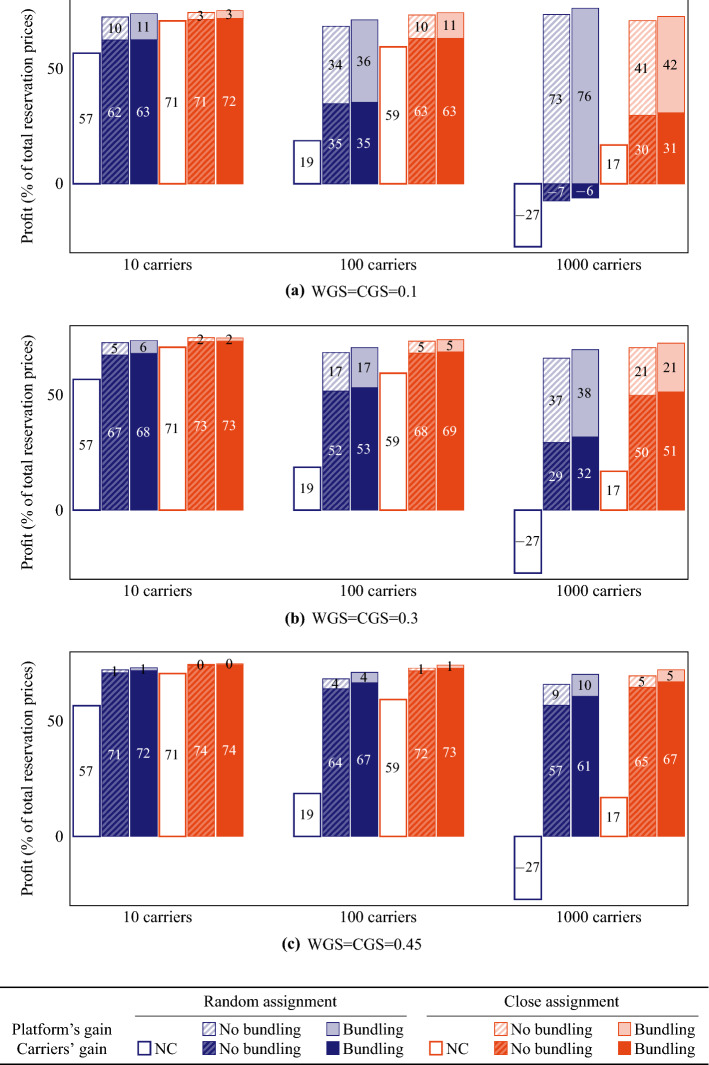
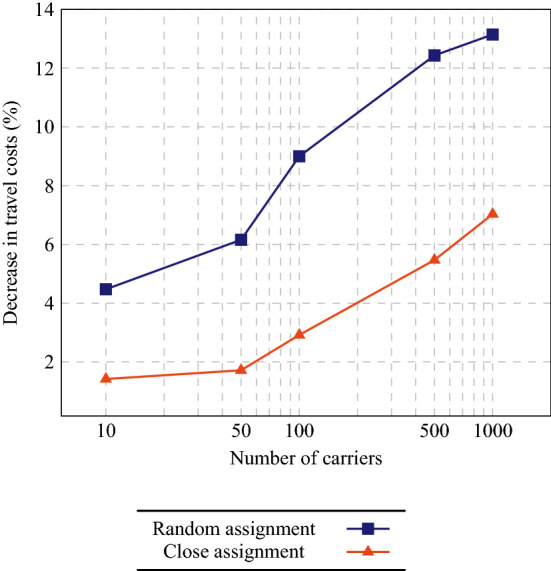
Carriers can remarkably reduce transportation costs and emissions when they collaborate, for example through a platform. Such gains, however, have only been investigated for relatively small problem instances with low numbers of carriers. We develop auction-based methods for large-scale dynamic collaborative pickup and delivery problems, combining techniques of multi-agent systems and combinatorial auctions. We evaluate our approach in terms of both solution quality and possibilities of strategic behaviour using a real-world data set of over 12,000 orders. Hence, this study is (to the best of our knowledge) the first to assess the benefits of large-scale carrier cooperation and to propose an approach for it. First, we use iterative single-order auctions to investigate possible collaboration gains for increasing numbers of carriers. Our results show that travel costs can be reduced by up to 77% when 1000 carriers collaborate, largely increasing the gains that were previously observed in smaller-scale collaboration. We also ensure that individual rationality is guaranteed in each auction. Next, we compare this approach of multiple local auctions with an established central combinatorial auction mechanism and observe that the proposed approach performs better on large-scale instances. Furthermore, to improve solution quality, we integrate the two approaches by allowing small bundle auctions in the multi-agent system. We analyze the circumstances under which bundling is beneficial in a large-scale decentralized system and demonstrate that travel cost gains of up to 13% can be obtained for 1000 carriers. Finally, we investigate whether the system is vulnerable to cheating: we show that misrepresentation of true values by individual participants sometimes can benefit them at the cost of the collective. Although such strategic behaviour is not straightforward, we also discuss different means to prevent it.
Keywords: Collaborative vehicle routing; Combinatorial auctions; Multi-agent system; Platform-based transportation.
© The Author(s) 2022.
Figures




References
-
- Berger, S., & Bierwirth, C. (2010). Solutions to the request reassignment problem in collaborative carrier networks. Transportation Research Part E,46, 627–638.
-
- Campbell, A. M., & Savelsbergh, M. (2004). Efficient insertion heuristics for vehicle routing and scheduling problems. Transportation Science,38, 369–378.
-
- Cruijssen, F. (2020). Cross-chain collaboration in logistics: Looking back and ahead. International Series in Operations Research & Management Science (Vol. 297). Springer.
-
- Dai, B., & Chen, H. (2011). A multi-agent and auction-based framework and approach for carrier collaboration. Logistics Research,3, 101–120.
-
- Dai, B., Chen, H., & Yang, G. (2014). Price-setting based combinatorial auction approach for carrier collaboration with pickup and delivery requests. Operational Research,14, 361–386.
LinkOut - more resources
Full Text Sources