. 2025 Jun 25;10(26):27883-27893.
doi: 10.1021/acsomega.5c01013. eCollection 2025 Jul 8.

Electrospun PVA/Co3O4 Nanofibers: A Sustainable Catalyst for Peroxymonosulfate-Mediated Degradation of Tetracycline

Affiliations

Electrospun PVA/Co3O4 Nanofibers: A Sustainable Catalyst for Peroxymonosulfate-Mediated Degradation of Tetracycline

Felipe G Kirchhoff et al. ACS Omega. .

Abstract

This study develops a poly-(vinyl alcohol) (PVA) nanofiber incorporated with cobalt oxide (Co3O4) for catalytic degradation of antibiotics using peroxymonosulfate (PMS) to generate sulfate radical (SO4 •-) (E° = 2.5-3.1 V vs NHE). These radicals efficiently degrade tetracycline through selective oxidation, offering advantages over conventional hydroxyl radical-based processes. The nanofiber fabrication involved electrospinning of PVA (8% w/v) containing cobalt oxide suspension (5 g L-1) and citric acid (15% w/w polymer). Thermal cross-linking at 160 °C for 2 h enhanced the material's aqueous stability and mechanical properties. Scanning electron microscopy revealed uniform fibers (627-645 nm diameter), while X-ray diffraction, thermal analyses, and spectroscopy confirmed increased crystallinity in PVA/Co3O4 composites. Optimization studies through factorial design identified pH and PMS concentration as key parameters, achieving 60% tetracycline degradation within 60 min. The successful integration of Co3O4 into biodegradable PVA nanofibers presents a sustainable, cost-effective approach for water treatment applications, particularly targeting emerging pharmaceutical contaminants.


Figures

1
1
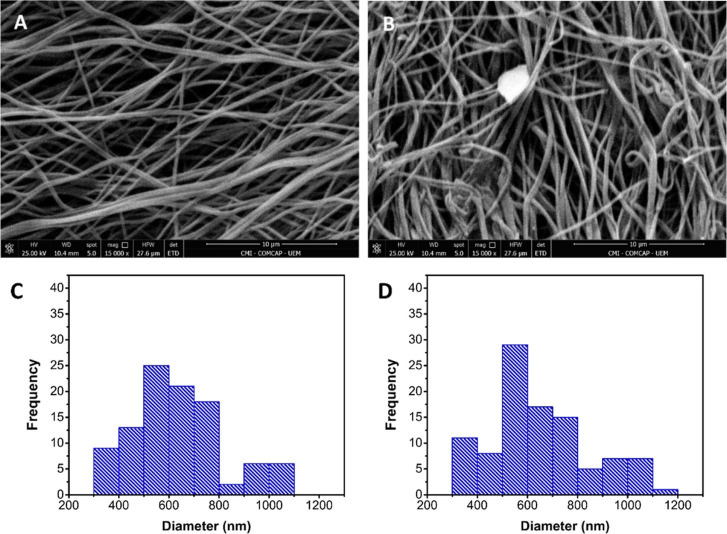
Images obtained by scanning electron microscopy (SEM) of electrospun nonwovens of PVA (A) and PVA/Co3O4 (B) at 15,000× magnification, with the average fiber diameter represented in the histogram, respectively (C,D).
2
2
Fourier-transform infrared (FTIR) spectra using the ATR module of nonwoven fabrics of poly­(vinyl alcohol) (PVA) and PVA/Co3O4, both reticulated with citric acid.
3
3
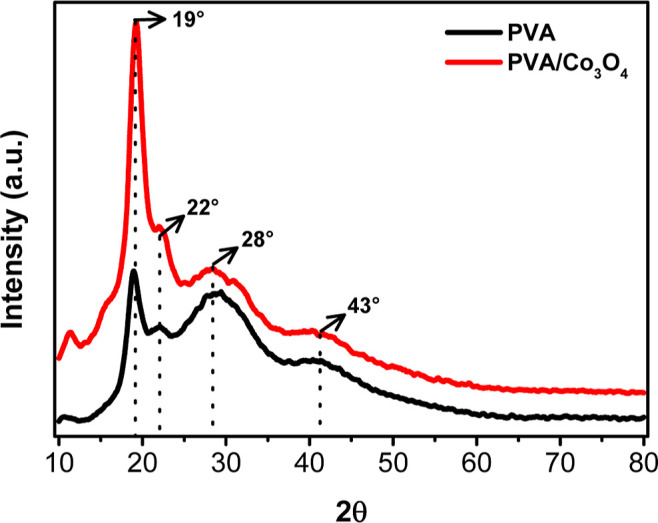
X-ray diffractograms (XRD) for PVA and PVA/Co3O4 electrospun nonwovens, both reticulated with citric acid.
4
4
(a) Thermogravimetric analysis (TGA) curves and (b) derivative thermogravimetric analysis (DTG) curves of poly­(vinyl alcohol) nonwovens (PVA), and poly­(vinyl alcohol) incorporated with a 10% (v/v) cobalt oxide suspension nonwovens (PVA/Co3O4).
5
5
Differential scanning calorimetry (DSC) analysis of poly­(vinyl alcohol) nonwoven (PVA) and poly­(vinyl alcohol) incorporated with cobalt oxide nonwoven material (PVA/Co3O4).
6
6
Stress–strain curves for PVA and PVA/Co3O4 nonwoven fabrics.
7
7
Graph of (final pHinitial pH) versus initial pH for the determination of pHpzc (point of zero charge): (a) for PVA and (b) for PVA/Co3O4.
8
8
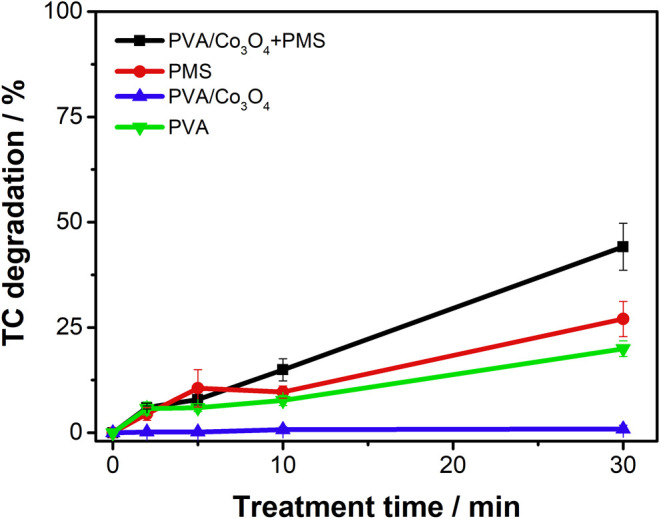
Degradation of TC versus treatment time for: (−■−) PVA/Co3O4 in the presence of PMS and (−▲−) without PMS; (−●−) just PMS, and (−▼−) PVA in the presence of PMS. Conditions:16.8 mg L–1 TC solution, pH 6, [PMS] = 1.1 mmol L–1, under constant stirring.
9
9
Pareto chart relating the significance of the variables pH and PMS concentration in the % degradation of tetracycline using nonwoven poly­(vinyl alcohol) incorporated with cobalt oxide (PVA/Co3O4). Conditions: 16.8 mg L–1 TC solution, under constant stirring.
10
10
Influence of scavengers on the degradation of tetracycline hydrochloride by the PVA/Co3O4 + PMS system using sodium azide (SA), methyl alcohol (MeOH), and tert-butyl alcohol (TBA) in the proportion of 50 × [PMS] = 5.6 × 10⁻² mol L–1. Conditions: 16.8 mg L–1 TC solution, pH 9, [PMS] = 0.567 mmol L–1, under constant stirring.
11
11
A proposed mechanism for the system containing the electrospun PVA/Co3O4 nanomaterial activating PMS to generate reactive species via radical (OH and SO4 •–) and nonradical (1O2) pathways for tetracycline (TC) degradation.
12
12
Reusability analysis of the PVA/Co3O4 nanomaterial showing TC degradation efficiency over five consecutive degradation cycles. Conditions: 16.8 mg L–1 TC solution, pH 9, [PMS] = 0.567 mmol L–1, under constant stirring.

References

    1. Khan S., Naushad M., Govarthanan M., Iqbal J., Alfadul S. M.. Emerging Contaminants of High Concern for the Environment: Current Trends and Future Research. Environ. Res. 2022;207(December 2021):112609. doi: 10.1016/j.envres.2021.112609. - DOI - PubMed
    1. Petrie B., Barden R., Kasprzyk-Hordern B.. A Review on Emerging Contaminants in Wastewaters and the Environment: Current Knowledge, Understudied Areas and Recommendations for Future Monitoring. Water Res. 2015;72:3–27. doi: 10.1016/j.watres.2014.08.053. - DOI - PubMed
    1. Qiao M., Ying G. G., Singer A. C., Zhu Y. G.. Review of Antibiotic Resistance in China and Its Environment. Environ. Int. 2018;110:160–172. doi: 10.1016/j.envint.2017.10.016. - DOI - PubMed
    1. Li S., Wu Y., Zheng H., Li H., Zheng Y., Nan J., Ma J., Nagarajan D., Chang J. S.. Antibiotics Degradation by Advanced Oxidation Process (AOPs): Recent Advances in Ecotoxicity and Antibiotic-Resistance Genes Induction of Degradation Products. Chemosphere. 2023;311:136977. doi: 10.1016/j.chemosphere.2022.136977. - DOI - PubMed
    1. Xu L., Zhang H., Xiong P., Zhu Q., Liao C., Jiang G.. Occurrence, Fate, and Risk Assessment of Typical Tetracycline Antibiotics in the Aquatic Environment: A Review. Sci. Total Environ. 2021;753:141975. doi: 10.1016/j.scitotenv.2020.141975. - DOI - PubMed

LinkOut - more resources