


Enteroaggregative Escherichia coli foodborne outbreak in Shandong Province, China (2023): comprehensive epidemiology and genomic resistance profiling
- PMID: 40657497
- PMCID: PMC12245808
- DOI: 10.3389/fmicb.2025.1577277
Enteroaggregative Escherichia coli foodborne outbreak in Shandong Province, China (2023): comprehensive epidemiology and genomic resistance profiling
Abstract
Introduction: Enteroaggregative Escherichia coli (EAEC) is an emerging and intricate diarrheagenic bacterial pathogen responsible for acute and persistent diarrhea in children, adults, and travelers. Despite its clinical significance, the global understanding of EAEC outbreaks and pathogen characteristics remains limited due to its complex epidemiological profile.
Methods: This study presented a retrospective analysis of a foodborne diarrheal outbreak caused by EAEC in a county school in Shandong Province, China in 2023 by using epidemiological investigation and comprehensive genomic analysis techniques.
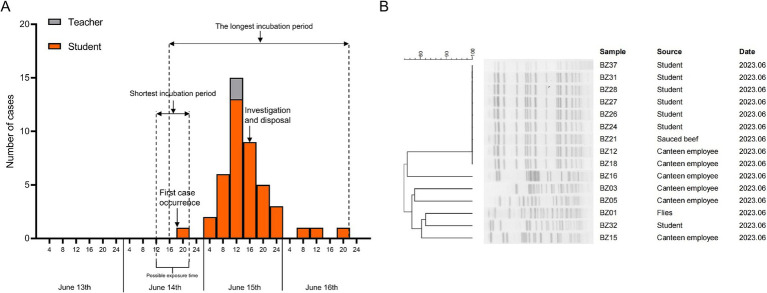
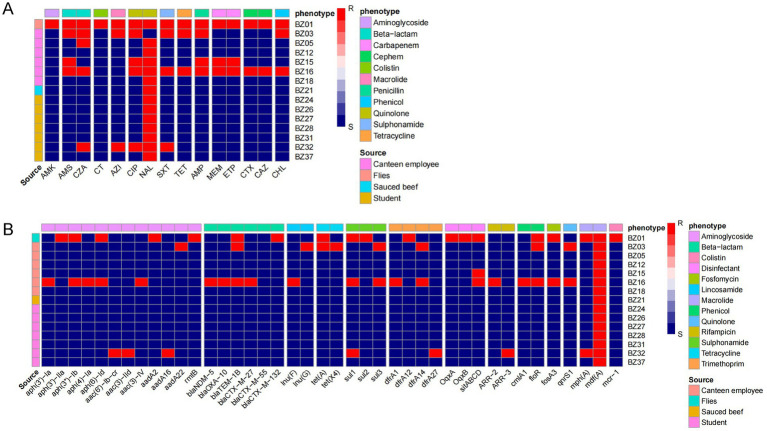
Results: A total of 15 EAEC isolates were identified, including 13 from stool samples, one from sauced beef, and one from flies. Epidemiological and phylogenetic analyses pinpointed the EAEC isolates from sauced beef as the primary causative agent of the outbreak. Genomic comparisons revealed significant genetic consistency across nine outbreak-associated strains, particularly in virulence gene profiles, antimicrobial resistance gene profiles, molecular typing, and genetic evolution.
Discussion: These findings underscored the utility of whole-genome sequencing in elucidating the genetic diversity of EAEC within specific environments and tracing its origins, thereby supporting targeted interventions such as infection control and prevention strategies. Notably, the study also identified an extensively drug-resistant (XDR) EAEC strain from flies in the canteen, harboring both the mcr-1 and blaCTX-M-132 resistance genes. This unexpected discovery highlighted the critical importance of applying the "One Health" approach, emphasizing the need for continuous surveillance of antibiotic-resistant bacteria in animals and environmental sources to mitigate potential public health risks.
Keywords: Enteroaggregative Escherichia coli (EAEC); antimicrobial resistance; foodborne outbreaks; whole-genome sequencing; “One Health” approach.
Copyright © 2025 Liu, Wang, Yu, Chen, Chen, Sun, Liu, Cheng, Zhang and Kou.
Conflict of interest statement
The authors declare that the research was conducted in the absence of any commercial or financial relationships that could be construed as a potential conflict of interest.
Figures



References
-
- Akhtar M., Basher S. R., Nizam N. N., Hossain L., Bhuiyan T. R., Qadri F., et al. (2023). T helper cell responses in adult diarrheal patients following natural infection with enterotoxigenic Escherichia coli are primarily of the Th17 type. Front. Immunol. 14:1220130. doi: 10.3389/fimmu.2023.1220130, PMID: - DOI - PMC - PubMed
-
- Akwongo C. J., Borrelli L., Houf K., Fioretti A., Peruzy M. F., Murru N. (2025). Antimicrobial resistance in wild game mammals: a glimpse into the contamination of wild habitats in a systematic review and meta-analysis. BMC Vet. Res. 21:14. doi: 10.1186/s12917-024-04462-5, PMID: - DOI - PMC - PubMed
LinkOut - more resources
Full Text Sources
