


Applying large language models to stratify suicide risk using narrative clinical notes
- PMID: 40657592
- PMCID: PMC12244004
- DOI: 10.1016/j.xjmad.2025.100109
Applying large language models to stratify suicide risk using narrative clinical notes
Abstract
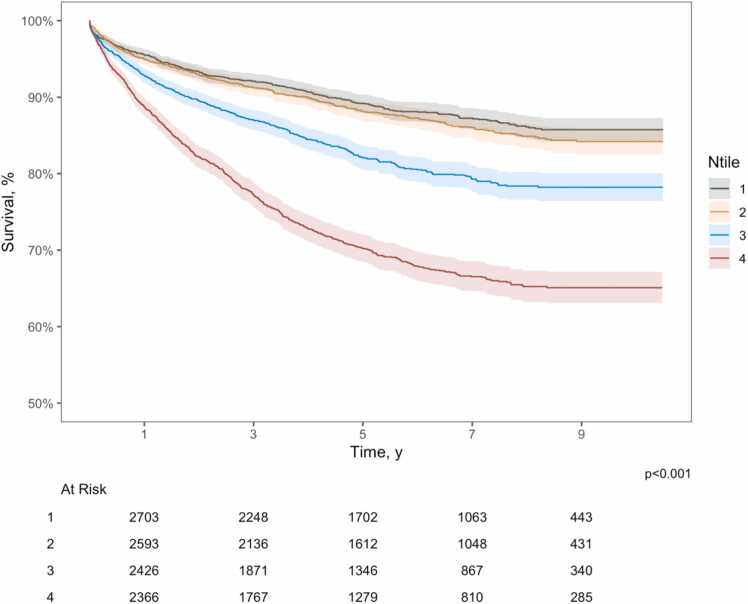
We investigated whether large language models can stratify risk for suicide following hospital discharge. We drew on a very large cohort of 458,053 adults discharged from two academic medical centers between January 4, 2005 and January 2, 2014, linked to administrative vital status data. From this sample, each of the 1995 individuals who died by suicide or accident was matched with 5 control individuals on the basis of age, sex, race and ethnicity, admitting hospital, insurance, comorbidity index, and discharge year. We applied a HIPAA-compliant large language model (gpt-4-1106-preview) to estimate risk for suicide based on narrative discharge summaries. In the resulting cohort (n = 11,970), median age was 57 (IQR 44 -76); 4536 (38 %) were women; 348 (3 %) had a primary psychiatric admission diagnosis. For the model-predicted risk, time to 90 % survival was 1588 days (IQR 1374-1905) in the lowest-risk quartile, 1432 (IQR 1157-1651) in the 2nd quartile, 661 (IQR 538-820) in the 3rd quartile, and 302 (IQR 260-362) in the top quartile (p < .001). In Fine and Gray competing risk regression, predicted hazard was significantly associated with observed risk (unadjusted HR 7.66 [95 % CI 6.40-9.27]; adjusted for sociodemographic features and utilization, HR 8.86 (7.00-11.2)). Estimated risks were significantly greater scores among individuals who were Black or Hispanic (p < .005 for each, versus white individuals). Overall, a large language model (LLM) was able to stratify risk for suicide and accidental death among individuals discharged from academic medical centers beyond that afforded by simple sociodemographic and clinical features medical centers.
Keywords: Accident; Artificial Intelligence; Machine learning; Mortality; Self-harm; Suicide.
© 2025 The Authors.
Conflict of interest statement
The authors declare the following financial interests/personal relationships which may be considered as potential competing interests Roy Perlis reports financial support was provided by National Institutes of Health. Roy Perlis reports a relationship with Genomind Inc that includes: consulting or advisory. Roy Perlis reports a relationship with Circular Genomics that includes: consulting or advisory and equity or stocks. Roy Perlis reports a relationship with Alkermes Inc that includes: consulting or advisory. Roy Perlis reports a relationship with Psy Therapeutics that includes: consulting or advisory and equity or stocks. Dr. Perlis is Editor in Chief of JAMA + AI and an associate editor for JAMA Network Open but was not involved in the editorial review or decision process for this manuscript. If there are other authors, they declare that they have no known competing financial interests or personal relationships that could have appeared to influence the work reported in this paper.
Figures

References
-
- Perlis R.H., Fihn S.D. Hard truths about suicide prevention. JAMA Netw Open. 2020;3(10) - PubMed
-
- Belsher B.E., Smolenski D.J., Pruitt L.D., Bush N.E., Beech E.H., Workman D.E., et al. Prediction models for suicide attempts and deaths: a systematic review and simulation. JAMA Psychiatry. 2019;76(6):642–651. - PubMed
LinkOut - more resources
Full Text Sources