


Long-term prognosis of preserved hearing function after surgery in patients with cerebellopontine angle tumors other than vestibular schwannoma
- PMID: 40658140
- PMCID: PMC12259732
- DOI: 10.1007/s00701-025-06507-6
Long-term prognosis of preserved hearing function after surgery in patients with cerebellopontine angle tumors other than vestibular schwannoma
Abstract
Background: In our previous study on vestibular schwannomas (VSs), we found that preserved useful hearing function in patients immediately after surgery gradually deteriorated in long-term period, and was lost in 13% of patients 5 years after surgery. In this retrospective study, we aimed to investigate the long-term hearing prognosis of patients with cerebellopontine angle (CPA) tumors other than VSs, and clarify whether the phenomenon of hearing deterioration after surgery occurs only in patients with VSs.
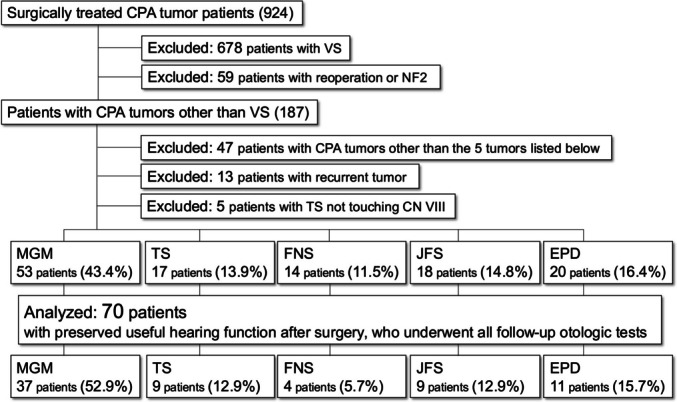
Method: Patient backgrounds and otologic data were investigated in 70 patients (meningioma: 37; trigeminal schwannoma: 9; facial nerve schwannoma: 4; jugular foramen schwannoma: 9; and epidermoid cysts: 11) with preserved useful hearing function after surgery (American Academy of Otolaryngology-Head and Neck Surgery classification Class A or B).
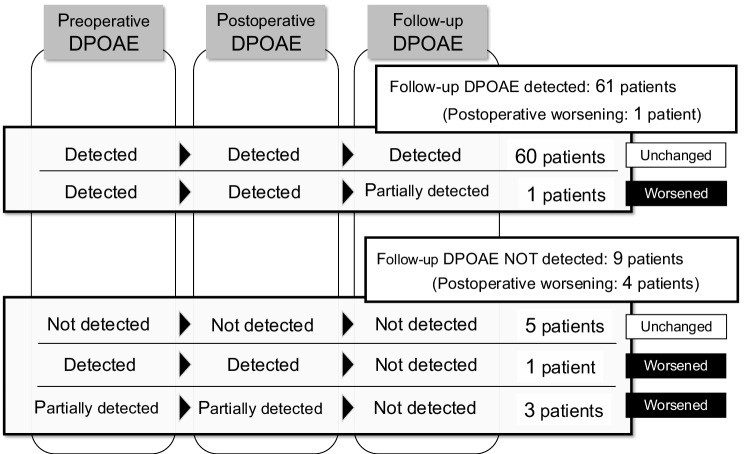
Results: Of the 70 patients (average age: 44 years; tumor diameter: 35 mm; resection rate: 96%; follow-up period: 62 months; 61 patients in Class A and 9 patients in Class B immediately after surgery), 60 patients (86%) had unchanged, 5 patients (7%) had improved, and 5 patients (7%) had worsened hearing class during the follow-up period. Only 1 patient (facial nerve schwannoma) experienced a change from Class B to C, and was out of useful-hearing range at the final follow-up (the useful hearing preservation rate: 99%). Distortion product otoacoustic emissions (DPOAEs) reflecting inner ear function were detected in 61 patients (87%) at the final follow-up, and only 4 patients (6%) demonstrated a worsening of DPOAEs during the postoperative follow-up period.
Conclusions: Useful hearing function after surgery was preserved at a high rate during a long-term postoperative period in patients with typical CPA tumors other than VSs. Compared with patients with VSs, in whom hearing loss owing to inner ear dysfunction is not rare in the long-term after surgery, patients with CPA tumors demonstrated a apparently lower incidence of inner ear dysfunction and a more favorable long-term hearing prognosis. In patients with CPA tumors, not only hearing improvement by the surgery but also its long-term preservation can be expected. In this study, we confirmed that the phenomenon of postoperative hearing deterioration occurs only in patients with VSs among all CPA tumors.
Keywords: CP angle; Hearing prognosis; Jugular foramen; Meningioma; Postoperative hearing function; Transpetrosal approach.
© 2025. The Author(s).
Conflict of interest statement
Declarations. Ethical approval: All procedures performed in studies involving human participants were in accordance with the ethical standards of the institutional and/or national research committee and with the 1964 Helsinki declaration and its later amendments or comparable ethical standards. Informed consent: Informed consent was obtained from all individual participants included in the study. Human ethics and consent to participate declarations: Not applicable. Conflict of interest: The authors declare no competing interests.
Figures

References
MeSH terms
LinkOut - more resources
Full Text Sources
Medical
Miscellaneous
