


A holistic adaptive ageing framework (HAAF) to address complex challenges in ageing
- PMID: 40658192
- PMCID: PMC12321668
- DOI: 10.1007/s00391-025-02467-9
A holistic adaptive ageing framework (HAAF) to address complex challenges in ageing
Abstract
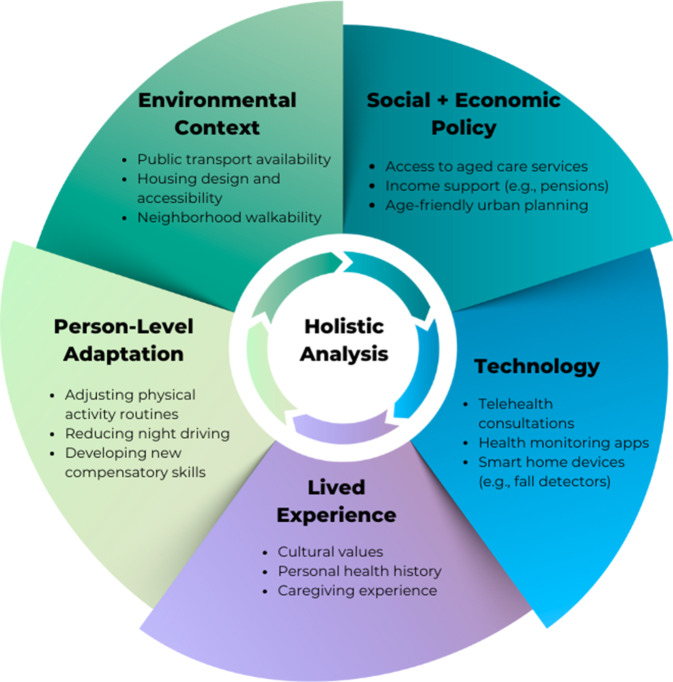
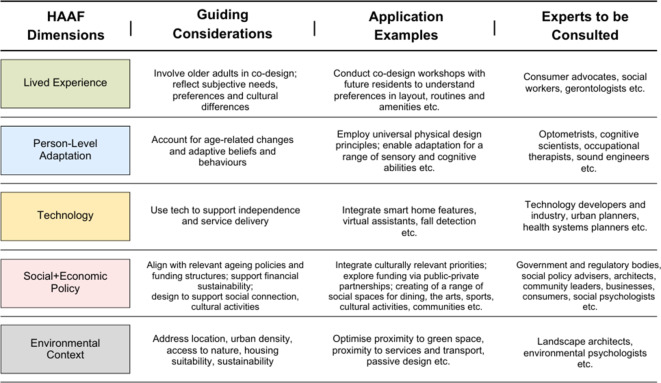
Many of the challenges facing ageing societies involve an interaction of factors from many domains and levels, including person-level age-related changes in function through to the physical environment, economy, urban design and social policies. The pace of change in our societies is accelerated by climate change and the rapid introduction of artificial intelligence and other technologies. When presented with practical challenges or problems to solve that are inherently due to an ageing society, it is not possible for any individual to have the expertise and capacity to address all the dimensions involved. Therefore, developing a multidisciplinary framework that signals the dimensions of influence that need to be considered in adaptive ageing, may assist in optimizing how complex issues in ageing are tackled. This paper proposes a holistic adaptive ageing framework (HAAF) as a starting point for multidisciplinary and multisectoral approaches to develop optimal solutions to complex problems. The five dimensions of the framework include lived experience, person-level adaptation, environmental context, technology and social and economic policy. Future research is needed to operationalize the framework and evaluate its application to complex problems.
Viele der Herausforderungen, mit denen sich alternde Gesellschaften konfrontiert sehen, beinhalten ein Zusammenspiel von Faktoren aus vielen Bereichen und auf zahlreichen Ebenen, von altersbedingten Funktionsänderungen des alternden Menschen bis hin zu Umwelt, Wirtschaft, Stadtplanung und Sozialpolitik. Das Tempo des Wandels in unseren Gesellschaften wird durch den Klimawandel und die rasche Einführung von künstlicher Intelligenz und anderen Technologien beschleunigt. Bei der Bewältigung praktischer Herausforderungen oder Probleme, die sich aus der Alterung der Gesellschaft ergeben, kann ein Einzelner nicht über das Fachwissen und die Fähigkeit verfügen, alle damit verbundenen Aspekte zu berücksichtigen. Die Entwicklung eines multidisziplinären Frameworks, das die Einflussdimensionen aufzeigt, die beim adaptiven Altern berücksichtigt werden müssen, kann dazu beitragen, die Bewältigung dieser komplexer Fragen zu optimieren. In diesem Beitrag wird ein ganzheitliches Rahmenprogramm für adaptives Altern als Ausgangspunkt für multidisziplinäre und sektorübergreifende Ansätze zur Entwicklung optimaler Lösungen vorgeschlagen. Zu den fünf Dimensionen gehören die Lebenserfahrung, die Anpassung auf der Ebene des Einzelnen, der Umweltkontext, die Technologie sowie die Sozial- und Wirtschaftspolitik. Zukünftige Forschung ist erforderlich, um den Rahmen zu operationalisieren und seine Anwendung auf komplexe Probleme zu bewerten.
Keywords: Adaptive ageing; Framework; Multidisciplinary approaches; Social policy; Technology.
© 2025. The Author(s).
Conflict of interest statement
Declarations. Conflict of interest: K. J. Anstey declares that she has no competing interests. This article does not contain any studies on human or animal subjects.
Figures
References
-
- Atchley RC (1989) A continuity theory of normal aging. Gerontologist 29(2):183–190 - PubMed
-
- Baltes PB (1991) The many faces of human ageing: toward a psychological culture of old age. Psychol Med 21(4):837–854 - PubMed
-
- Baltes PB (1997) On the incomplete architecture of human ontogeny. Selection, optimization, and compensation as foundation of developmental theory. Am Psychol 52(4):366–380 - PubMed
Publication types
MeSH terms
LinkOut - more resources
Full Text Sources
Medical
