


doi: 10.1073/pnas.2315909122.
Epub 2025 Jul 14.
Nature-based solutions for urban sustainability
Affiliations
- PMID: 40658854
- PMCID: PMC12304908
- DOI: 10.1073/pnas.2315909122
Item in Clipboard
Nature-based solutions for urban sustainability
Proc Natl Acad Sci U S A.
.
No abstract available
Conflict of interest statement
Competing interests statement:The authors declare no competing interest.
Figures

Examples of urban NbS supporting climate resilience: (A) Benjakitti Forest Park in Bangkok is a constructed wetland and green space transformed from a former industrial site (Photo courtesy of Erich Wolff). It manages stormwater, enhances biodiversity, and improves water quality. Using recycled materials and preserving existing trees, the park supports urban resilience, climate adaptation, and community well-being through sustainable, ecological design; (B) Lincoln Park in Chicago functions as a NbS through its restored ponds, wetlands, and natural areas that manage stormwater, enhance biodiversity, and reduce urban heat. Being a public park, its ecological features contribute to climate resilience and public well-being in a dense urban environment (Photo by Nancy Bourque on Pexels); (C) Wohnpark Alt-Erlaa in Vienna is an early example of urban NbS, featuring terraced green balconies that enhance air quality, reduce heat, and support resident well-being (Photo by Nick Night on Unsplash). Though not originally designed as NbS, it integrates vegetation into urban living, offering ecological and social benefits aligned with contemporary NbS principles.
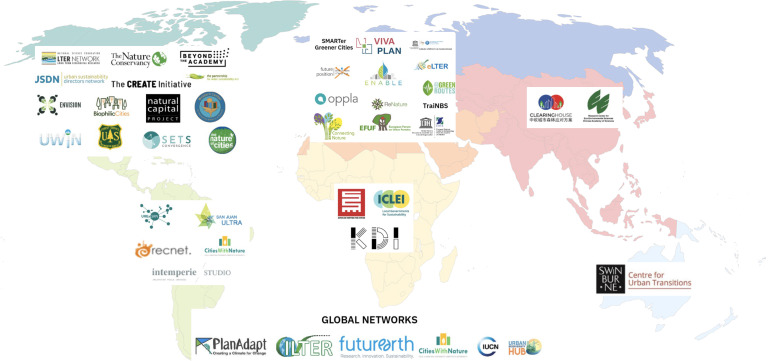
NbS networks engaged with NATURA across seven global regions.

Knowledge gaps and challenges related to urban NbS within the SETS framework as identified by NATURA members at the founding of the network of networks (2020). Circles are sized based on relative number of mentions. Responses reflected a bias in representation of Europe and North America among regions and in academia, which is consistent with the distribution of literature and an indication of the bias among network founders.
References
-
- Schaubroeck T., ‘Nature-based solutions’ is the latest green jargon that means more than you might think. Nature 541, 133–134 (2017). - PubMed
-
- Kabisch N., Korn H., Stadler J., Bonn A., "Nature-based solutions to climate change adaptation in urban areas—Linkages between science, policy and practice" in Nature-Based Solutions to Climate Change Adaptation in Urban Areas: Linkages between Science, Policy and Practice, Kabisch N., Korn H., Stadler J., Bonn A., Eds. (Springer International Publishing, 2017), pp. 1–11.
-
- Palomo I., et al. , Assessing nature-based solutions for transformative change. One Earth 4, 730–741 (2021).
-
- Kim Y., et al. , Leveraging SETS resilience capabilities for safe-to-fail infrastructure under climate change. Curr. Opin. Environ. Sustain. 54, 101153 (2022).
Grants and funding
LinkOut - more resources
Full Text Sources
