


Left ventricular myocardial functions in pediatric patients with primary nephrotic syndrome: a comprehensive evaluation using conventional echocardiography, two-dimensional speckle tracking, and three-dimensional echocardiography
- PMID: 40660324
- PMCID: PMC12261601
- DOI: 10.1186/s13052-025-02086-5
Left ventricular myocardial functions in pediatric patients with primary nephrotic syndrome: a comprehensive evaluation using conventional echocardiography, two-dimensional speckle tracking, and three-dimensional echocardiography
Abstract
Background: Nephrotic syndrome (NS) has been linked to cardiac morbidity and mortality. However, early cardiac implications in NS were studied on a limited scale using basic echocardiography (ECHO). Therefore, the study aimed to evaluate subclinical Left ventricle (LV) functional alterations using conventional and advanced ECHO modalities.
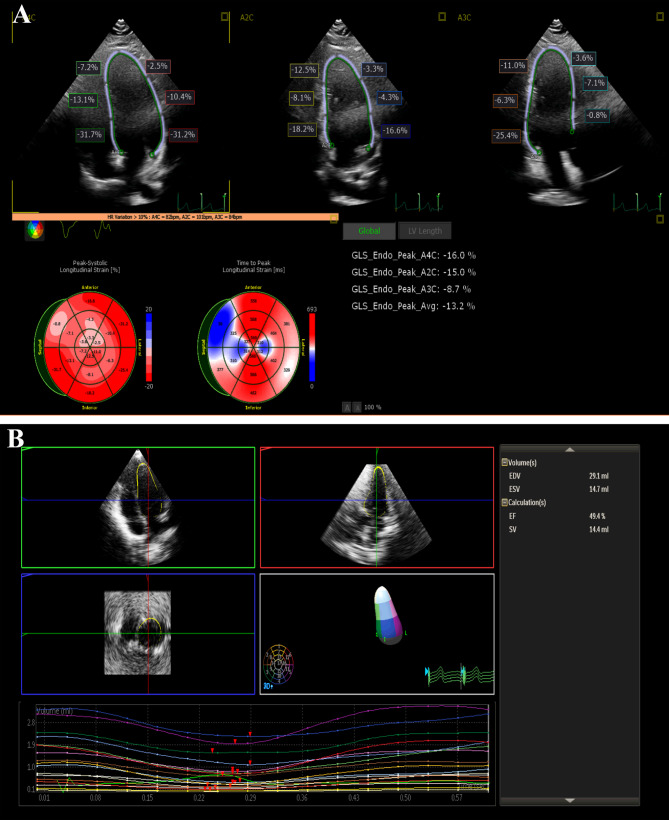
Methods: A prospective observational study was conducted from January 2022 to August 2024 on 40 primary NS patients and 40 controls. Demographic, clinical, and laboratory data were collected. ECHO was performed, including LV functional assessment using conventional ECHO, tissue Doppler, two-dimensional (2D) speckle tracking, and three-dimensional (3D) ECHO.
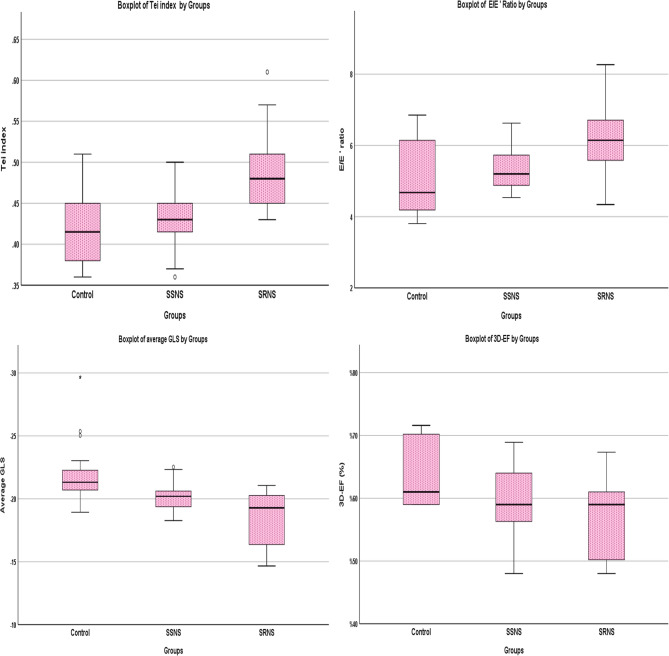
Results: NS patients, whose mean age was 10.93 ± 2.78 years, were subclassified into steroid-sensitive NS (SSNS) 15(37.5%) and steroid-resistant NS (SRNS) 25 (62.5%). Compared with controls, there was no significant difference regarding conventional ejection fraction (EF) or E/A ratio. However, E/E' ratio and tissue Doppler Tie index were significantly higher in NS ( p = 0.001, p= < 0.001, respectively), particularly SRNS. Average global longitudinal strain (GLS) was significantly lower in NS (p = < 0.001), especially SRNS, while 3D ECHO-measured EF significantly declined in NS (p = < 0.001). Tei index and E/E' were moderately correlated with current cholesterol level, while E/E' and GLS correlated with initial serum albumin. On regression analysis, current cholesterol and initial serum albumin were significant predictors for E/E'; p= 0.019 (ß: 0.014, 95% CI: 0.003-0.26) and p= 0.003 (ß:-1.41, 95% CI: -2.28- -0.53), respectively. No significant factors predicted GLS or 3D EF.
Conclusion: In addition to diastolic subclinical LV dysfunction in children with primary NS detected using Tissue Doppler, systolic alterations could be detected using 2D speckle tracking or 3D ECHO. Some of the resultant subtle LV-impaired parameters could be correlated to NS-related biochemical changes.
Keywords: 3D echocardiography; Left ventricle; Nephrotic syndrome.
© 2025. The Author(s).
Conflict of interest statement
Declarations. Ethics approval and consent to participate: this study was performed in line with the principles of the Declaration of Helsinki. Approval was granted by Mansoura Faculty of Medicine Institutional Research Board (R.24.07.2712). Informed consent was obtained for all caregivers of the included children. Consent to participate: Written informed consent was obtained from all caregivers of the included children in the study. Consent to publish: Not applicable (no identifying information about participants is available in the article). Conflicts of interest: The authors declare no competing interests.
Figures
References
Publication types
MeSH terms
LinkOut - more resources
Full Text Sources
Miscellaneous
