


Gestational Exposure to Particulate Matter and Preeclampsia Risk: Evidence from a Meta-Analysis and Mendelian Randomization Study
- PMID: 40662997
- PMCID: PMC12261971
- DOI: 10.1111/jch.70096
Gestational Exposure to Particulate Matter and Preeclampsia Risk: Evidence from a Meta-Analysis and Mendelian Randomization Study
Abstract
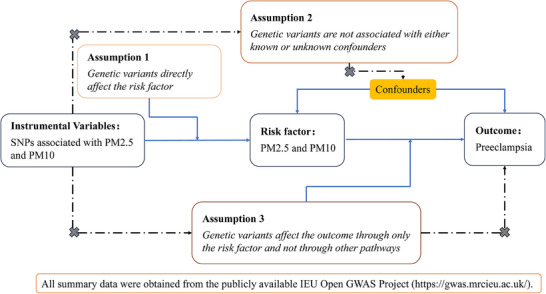
Preeclampsia (PE) is a severe hypertensive disorder that occurs during pregnancy. Exposure to particulate matter (PM), particularly fine particles such as PM2.5/PM10, has been investigated as a potential environmental risk factor for its development. In this study, we employed both meta-analysis and Mendelian randomization (MR) to investigate the relationship between PM exposure and PE risk. The meta-analysis of 26 studies (>2 million pregnancies) found modest associations between PM exposure and PE risk. In particular, PM2.5 exposure during the second trimester (OR = 1.03, 95% CI: 1.01-1.04) and PM10 exposure (OR = 1.06, 95% CI: 1.00-1.12) showed significant associations. Subgroup and meta-regression analyses revealed that regional differences, particularly between Europe and Asia, were major contributors to heterogeneity, while publication year showed minimal impact. In contrast, no significant associations were found for PM exposure during the first and third trimesters, with greater statistical uncertainty likely due to heterogeneity in study design and exposure assessment methods. The MR analysis, using genetic instruments from European genome-wide association studies data, did not support a causal relationship between PM exposure and PE risk (PM2.5: OR = 1.128, 95% CI: -0.593- 0.834; PM10: OR = 0.668, 95% CI: -1.482-0.675). These findings suggest that while PM exposure, particularly during mid-pregnancy, may be associated with increased PE risk in observational studies, the lack of a confirmed causal link in MR analysis indicates potential influence from residual confounding, exposure misclassification, and study heterogeneity. Therefore, the observed associations should be interpreted with caution.
Keywords: Mendelian randomization; maternal and perinatal health; meta‐analysis; particulate matter; preeclampsia.
© 2025 The Author(s). The Journal of Clinical Hypertension published by Wiley Periodicals LLC.
Conflict of interest statement
The authors declare no conflicts of interest.
Figures


References
-
- Mol B. W. J., Roberts C. T., Thangaratinam S., Magee L. A., de Groot C. J. M., and Hofmeyr G. J., “Pre‐Eclampsia,” Lancet (London, England) 387, no. 10022 (2016): 999–1011. - PubMed
-
- Ives C. W., Sinkey R., Rajapreyar I., Tita A. T. N., Preeclampsia‐Pathophysiology O S., and Presentations C., “JACC State‐of‐the‐Art Review,” Journal of the American College of Cardiology 76, no. 14 (2020): 1690–1702. - PubMed
-
- Dwivedi A. K., Vishwakarma D., Dubey P., and Reddy S. Y., “Air Pollution and the Heart: Updated Evidence from Meta‐Analysis Studies,” Current Cardiology Reports 24, no. 12 (2022): 1811–1835. - PubMed
Publication types
MeSH terms
Substances
Grants and funding
LinkOut - more resources
Full Text Sources
Medical
