


Preventing acute kidney injury and its longer-term impact in the critically ill
- PMID: 40663138
- PMCID: PMC12283467
- DOI: 10.1007/s00134-025-08015-8
Preventing acute kidney injury and its longer-term impact in the critically ill
Abstract
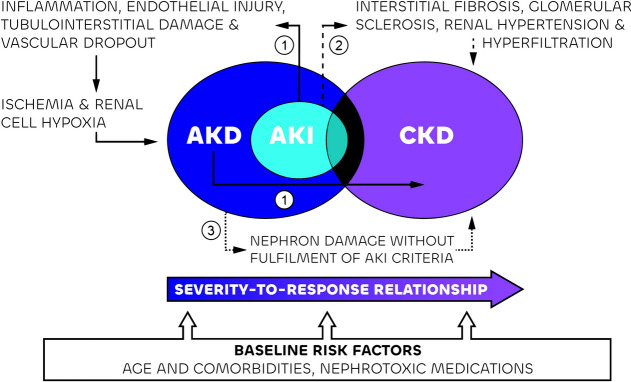
Acute kidney injury (AKI) is a heterogeneous syndrome that not only affects short-term morbidity and mortality but also influences long-term outcomes. AKI is part of acute kidney disease (AKD) that encompasses a range of different conditions and is characterized by a kidney dysfunction lasting 90 days or less after which time the term chronic kidney disease (CKD) applies. AKD may result in irreversible loss of nephrons and may lead to CKD. In this narrative review, an update on different aspects of AKI in critically ill patients will be provided. We discuss biomarkers for early diagnosis of AKI, sub-clinical AKI, as well as AKI-AKD-CKD transition. In addition, various strategies to prevent the development of AKI, including the application of amino acids, remote-ischemic preconditioning, hemoadsorption, and a kidney prevention strategy, will be discussed. Finally, the choice of adequate endpoints for AKI prevention trials will be addressed."Take home message".AKI and even subclinical AKI impact short- and long-term outcome and therefore, prevention of kidney injury is of utmost importance. As several strategies have been proven to be effective in preventing the development of AKI, these therapies should be implemented in daily practice to improve patient outcomes.
Keywords: Acute kidney disease; Acute kidney injury; Biomarkers; Chronic kidney disease; Preventive strategy.
© 2025. The Author(s).
Conflict of interest statement
Declarations. Conflicts of interest: AZ has received lecture and consultancy fees from Baxter, Fresenius, BioMerieux, Viatris, Guard Therapeutics, Novartis, Paion, AM Pharma, Alexion, Renibus, and Bayer as well as an unrestricted research grants from Baxter and BioMerieux. JLK received consulting fees from Alexion, Astute-Biomerieux, Baxter, Bioporto, Seastar, Novartis, Guard Therapeutics and research Funding from NIH, Astute Medical-Biomerieux, Bioporto, Fresenius Medical. JAK is a full-time employee of Spectral Medical and holds stock in the company. He also discloses consulting fees paid by AstraZeneca, Bayer, bioMérieux, Chugai Pharma, Mitsubishi Tenabe, and Novartis. MO has received research funding from Baxter and Biomerieux (paid to institution). LF, HG, NP, RB, and TvG have no conflict of interests.
Figures

References
-
- (2012) Kidney disease: improving global outcomes (KDIGO) acute kidney injury work group. Kdigo Clinical Practice Guideline For Acute Kidney Injury. Kidney Intsuppl 2: 1–138
-
- Bhatraju PK, Zelnick LR, Chinchilli VM, Dg M, Coca SG, Parikh CR, Garg AX, Hsu CY, Go AS, Liu KD, Ikizler TA, Siew ED, Kaufman JS, Kimmel P, Himmelfarb J, Wurfel MMW (2020) Association between early recovery of kidney function after acute kidney injury and long-term clinical outcomes. Jama Netw Open 3:e202682 - PMC - PubMed
-
- Hoste EAJ, Kellum JA, Selby NM, Zarbock A, Palevsky PM, Bagshaw SM, Goldstein SL, Cerda J, Chawla LS (2018) Global epidemiology and outcomes of acute kidney injury. Nat Rev Nephrol 14:607–625 - PubMed
-
- Mt J, Bhatt M, Pannu N, Tonelli M (2020) Long-term outcomes of acute kidney injury and strategies for improved care. Nat Rev Nephrol 16:193–205 - PubMed
Publication types
MeSH terms
Substances
Grants and funding
LinkOut - more resources
Full Text Sources
Research Materials
