


Incidence and predictors of pregnancy among reproductive-age women in an ART clinic of public health facilities in Arsi zone, southeastern ethiopia: a five-year retrospective cohort study
- PMID: 40665276
- PMCID: PMC12265138
- DOI: 10.1186/s12905-025-03876-z
Incidence and predictors of pregnancy among reproductive-age women in an ART clinic of public health facilities in Arsi zone, southeastern ethiopia: a five-year retrospective cohort study
Abstract
Introduction: According to global monitoring and UNAIDS estimates. In Sub-Saharan African (SSA) countries, the number of pregnant women living with HIV in 2020 was 1.2 million. A variety of studies revealed that people living with HIV desire reproduction in the absence of any ART administered to the mother; the rate of mother-to-child transmission (MTCT) of HIV is 25-45%. Transmission and most child deaths related to HIV can be avoided with appropriate care during pregnancy, childbirth, and breastfeeding. So far, there is limited information on the incidence of pregnancy outcomes and their predictors in Ethiopia. Therefore, this study aims to determine pregnancy incidence and associated factors among reproductive-age women living with HIV/AIDS who are on ART clinic follow-up in public health facilities of the Arsi Zone, central Ethiopia.
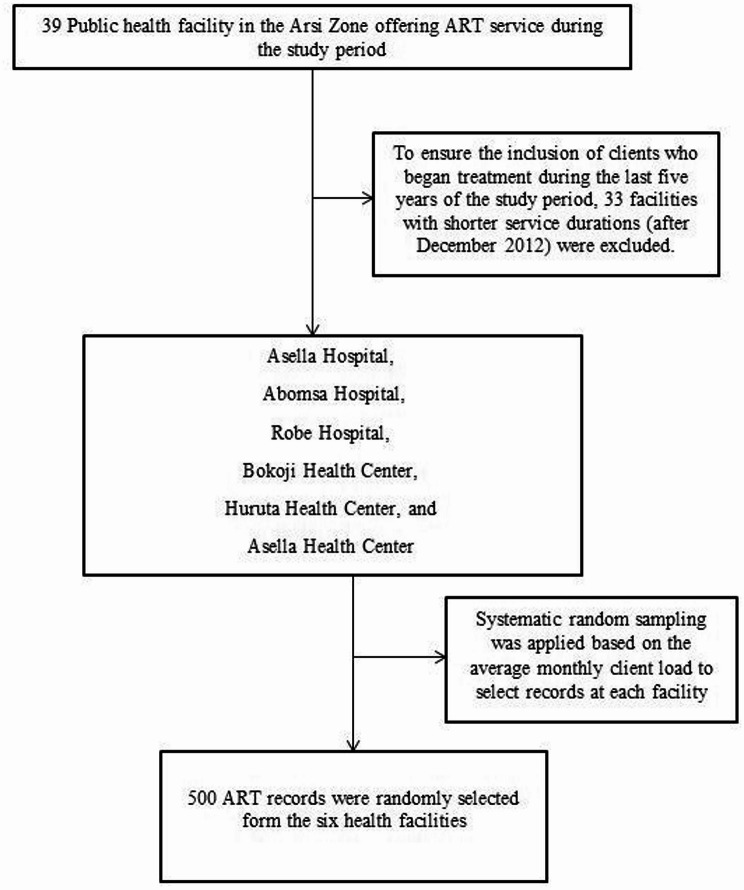
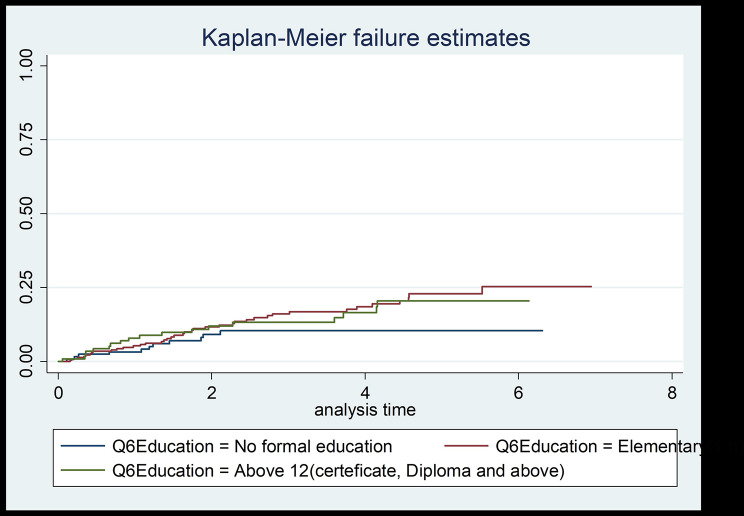
Methods: An institution-based retrospective cohort study was employed among 481 reproductive-age women from December 2013 to April 2019 in ART clinics of selected public health facilities in the Arsi Zone, Ethiopia. Systematic random sampling was used to select study subjects from each public health facility. Data were imported into Epidata version 3.2 and exported into Stata version 14.2 for analysis. The Cox proportional hazards model and Kaplan-Meier failure models were used to determine pregnancy predictors and estimate incidence, respectively. Independent predictors of pregnancy were determined by looking at variables that showed significant results (P value < 0.05) in the multivariate analysis.
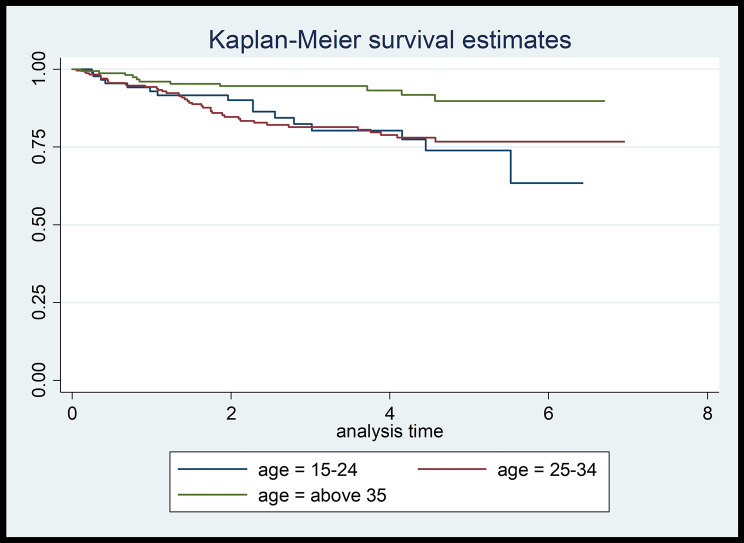
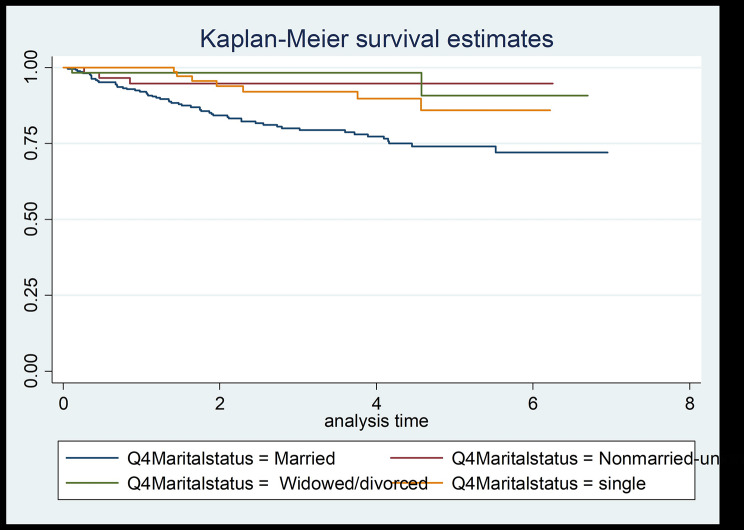
Results: The study included 481 women in total, yielding a response rate of 96.2%. The overall incidence of pregnancy was found to be 45.47 per 1000 person-years. Being 35 years of age or older (AHR: 0.29; 95% (0.13, 0.64)), being in a non-married couple (AHR: 0.14; 95% (0.04, 0.48)), being widowed or divorced (AHR: 0.20; 95% (0.05, 0.83)), and being a single mother (AHR: 0.42; 95% (0.19, 0.92)) were predictive factors of pregnancy incidence among women on ART.
Conclusion and recommendations: In this study, the incidence of pregnancy among women on ART was found to be notable. Pregnancy incidence among women on ART was found to be negatively associated with being 35 years of age or older, being in a non-married couple, being widowed or divorced, and being a single mother. To lower the risks of pregnancy, effective counseling programs must be created, with an emphasis on young and married women living with HIVAIDS.
Keywords: HIV/AIDS; Predictors; Pregnancy incidence; Reproductive-age women.
© 2025. The Author(s).
Conflict of interest statement
Declarations. Ethical approval: The study adhered to the principles of Helsinki declaration and received ethical approval from the college of health sciences ethical review committee at Arsi University with an ethical reference number of A/CHS/RC/18 and the committee waived informed consent requirements because the study used secondary data. Consent for publication: N/A. Competing interests: The authors declare no competing interests.
Figures
Similar articles
-
Antiretrovirals for reducing the risk of mother-to-child transmission of HIV infection.Cochrane Database Syst Rev. 2011 Jul 6;(7):CD003510. doi: 10.1002/14651858.CD003510.pub3. Cochrane Database Syst Rev. 2011. PMID: 21735394
-
Antiretrovirals for reducing the risk of mother-to-child transmission of HIV infection.Cochrane Database Syst Rev. 2007 Jan 24;(1):CD003510. doi: 10.1002/14651858.CD003510.pub2. Cochrane Database Syst Rev. 2007. Update in: Cochrane Database Syst Rev. 2011 Jul 06;(7):CD003510. doi: 10.1002/14651858.CD003510.pub3. PMID: 17253490 Updated.
-
Population-based interventions for reducing sexually transmitted infections, including HIV infection.Cochrane Database Syst Rev. 2004;(2):CD001220. doi: 10.1002/14651858.CD001220.pub2. Cochrane Database Syst Rev. 2004. Update in: Cochrane Database Syst Rev. 2011 Mar 16;(3):CD001220. doi: 10.1002/14651858.CD001220.pub3. PMID: 15106156 Updated.
-
Contributory factors to partial implementation of prevention of mother to child transmission policy in South Africa.BMC Pregnancy Childbirth. 2025 Jul 28;25(1):792. doi: 10.1186/s12884-025-07909-1. BMC Pregnancy Childbirth. 2025. PMID: 40721759 Free PMC article.
-
Sexual Harassment and Prevention Training.2024 Mar 29. In: StatPearls [Internet]. Treasure Island (FL): StatPearls Publishing; 2025 Jan–. 2024 Mar 29. In: StatPearls [Internet]. Treasure Island (FL): StatPearls Publishing; 2025 Jan–. PMID: 36508513 Free Books & Documents.
References
-
- Organization WH. UNAIDS: global report: UNAIDS report on the global AIDS epidemic. Geneva: WHO; 2010. p. 10.
MeSH terms
LinkOut - more resources
Full Text Sources
Medical
Research Materials
Miscellaneous
