


Enhancing dermatology education: a short-course intervention for final-year medical students
- PMID: 40665306
- PMCID: PMC12261851
- DOI: 10.1186/s12909-025-07649-y
Enhancing dermatology education: a short-course intervention for final-year medical students
Abstract
Background: Dermatological conditions are prevalent in outpatient consultations worldwide, representing up to 24% of primary care visits. However, dermatology education is often underrepresented in medical curricula, particularly in low- and middle-income countries (LMICs) like Sudan. This study aimed to evaluate the impact of a short dermatology course on final-year medical students' knowledge and confidence, with the aim of informing curriculum development in Sudan.
Methods: A mixed-methods interventional study was conducted with 50 final-year medical students at a public university in Khartoum, Sudan. Participants underwent a 15-hour dermatology course, covering essential knowledge and diagnostic skills tailored to the local disease burden. Pre- and post-course assessments were administered using a self-administered structured questionnaire. Quantitative data were analyzed using SPSS, and qualitative data from a focus group discussion were analyzed using an inductive open-coding approach.
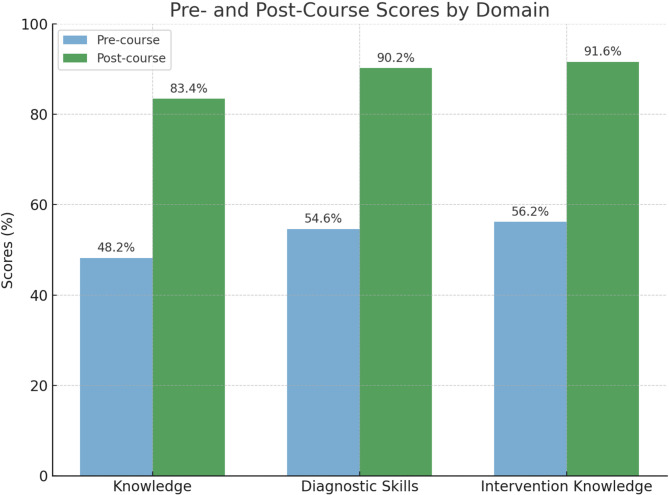
Results: The study found significant improvements in participants' knowledge and diagnostic skills. Knowledge increased from an average of 48.2-83.4% (p < 0.001), and diagnostic skills improved from 54.6 to 90.2% (p < 0.001). The course notably enhanced students' ability to identify fungal infections, malignant lesions, and dermatologic emergencies. Focus group discussions revealed high satisfaction with the course's content, structure, and delivery, with students expressing increased confidence in managing dermatologic conditions during clinical practice.
Conclusion: A short dermatology course significantly improved knowledge and diagnostic confidence among final-year medical students in Sudan. Given the limited dermatology exposure in undergraduate curricula, such targeted educational interventions can bridge knowledge gaps and better prepare students for clinical practice in resource-limited settings. Future studies should explore long-term retention and practical skill assessment to further strengthen dermatology education.
Keywords: Dermatology education; Diagnostic skills intervention strategies; Knowledge improvement; Medical students.
© 2025. The Author(s).
Conflict of interest statement
Declarations. Ethics approval and consent to participate: Ethical approval was obtained from University of Bahri Faculty of Medicine Institutional Review Board in Sudan. Each participant was asked to sign informed written consent prior to study. This study was conducted in accordance with the ethical principles of the Declaration of Helsinki. Consent for publication: Not applicable. Competing interests: The authors declare no competing interests. Clinical trial number: Not applicable.
Figures
References
-
- Lowell BA, Froelich CW, Federman DG, Kirsner RS. Dermatologyinprimarycare:Prevalenceandpatientdisposition.JAmAcadDermatol.2001;45(2):250-5.10.1067/mjd.2001.114598.PMID:11464187.
-
- Hay RJ, Johns NE, Williams HC, Bolliger IW, Dellavalle RP, Margolis DJ, Marks R, Naldi L, Weinstock MA, Wulf SK, Michaud C, Murray JL. The global burden of skin disease in 2010: an analysis of the prevalence and impact of skin conditions. J Invest Dermatol. 2014;134(6):1527–34. 10.1038/jid.2013.446. Epub 2013 Oct 28. PMID: 24166134. - DOI - PubMed
-
- Karimkhani C, Dellavalle RP, Coffeng LE, Flohr C, Hay RJ, Langan SM, Nsoesie EO, Ferrari AJ, Erskine HE, Silverberg JI, Vos T, Naghavi M. Global skin disease morbidity and mortality: an update from the global burden of disease study 2013. JAMA Dermatol. 2017;153(5):406–12. 10.1001/jamadermatol.2016.5538. PMID: 28249066; PMCID: PMC5817488. - DOI - PMC - PubMed
MeSH terms
LinkOut - more resources
Full Text Sources
