


Characterizing pre- and post-operative cerebral blood flow and transit time in pediatric moyamoya patients using multi-delay ASL and DSC MRI
- PMID: 40665679
- PMCID: PMC12267206
- DOI: 10.1177/0271678X251358979
Characterizing pre- and post-operative cerebral blood flow and transit time in pediatric moyamoya patients using multi-delay ASL and DSC MRI
Abstract
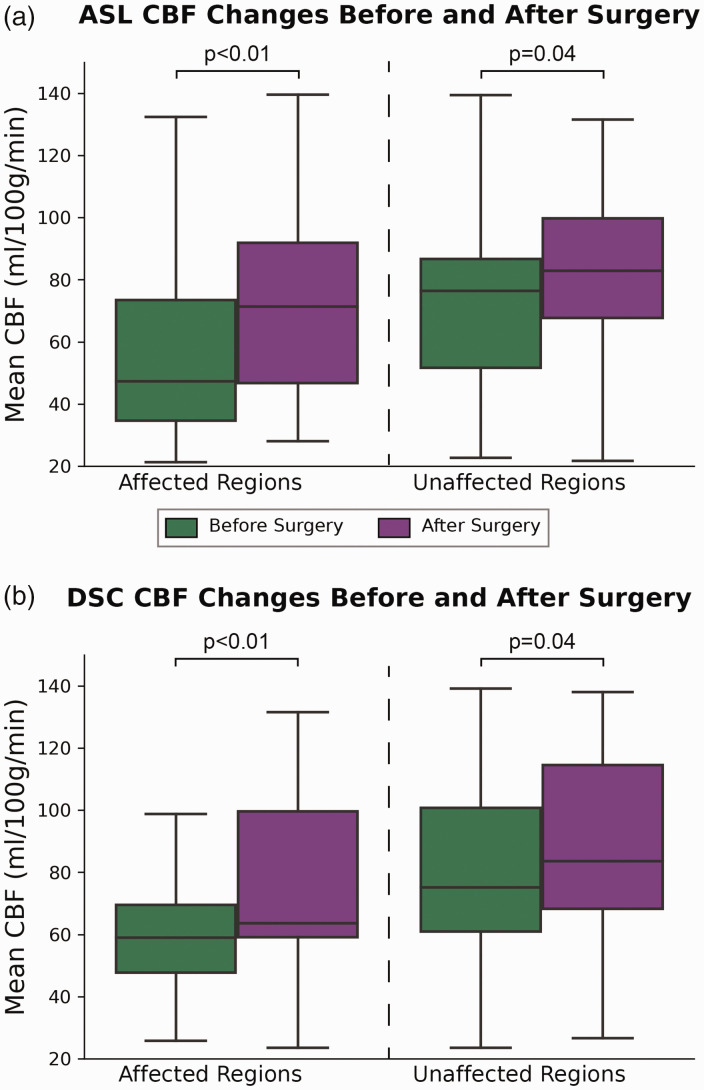
Cerebral blood flow (CBF) and transit time are essential biomarkers for assessing brain health. While dynamic susceptibility contrast (DSC) MRI has been widely applied to measure these metrics, it is limited in the pediatric population due to the need for contrast agents. Arterial spin labeling is a non-invasive and quantitative MR modality, and multi-delay ASL can measure CBF and transit time simultaneously. Although multi-delay ASL has been used in adult neuroimaging studies, its application in children requires investigation. Moyamoya disease, a progressive steno-occlusive cerebrovascular disorder, often manifests in childhood. In this work, we present a cohort study that examines multi-delay ASL and DSC MRI to characterize vascular hemodynamics in 22 pediatric patients. We evaluate CBF and transit time in different brain regions before and after revascularization surgeries. Results show that revascularization significantly increased CBF by 24% and 7.6%, respectively, as measured by ASL and DSC; it also significantly decreased transit time by 12% and 15%, indicating improved hemodynamics and metabolism. ASL and DSC results also showed significantly positive correlations in all brain regions. Thus, revascularization improved hemodynamics in pediatric moyamoya patients and shows that multi-delay ASL can effectively characterize CBF and transit time in the pediatric population.
Keywords: Cerebral blood flow; arterial spin labeling; arterial transit time; dynamic susceptibility contrast; moyamoya disease.
Conflict of interest statement
Declaration of conflicting interestsThe author(s) declared the following potential conflicts of interest with respect to the research, authorship, and/or publication of this article: Gary Steinberg is a consultant for SanBio, Zeiss, and Surgical Theater, and receives royalties from Peter Lazic, US. These potential conflicts of interest are unrelated to the current study.
Figures



References
-
- Teo M, Abhinav K, Bell-Stephens TE, et al. Short- and long-term outcomes of moyamoya patients post-revascularization. J Neurosurg 2022; 1: 1–11. - PubMed
MeSH terms
Substances
LinkOut - more resources
Full Text Sources
Medical
