


How politics affect pandemic forecasting: spatio-temporal early warning capabilities of different geo-social media topics in the context of state-level political leaning
- PMID: 40666148
- PMCID: PMC12259613
- DOI: 10.3389/fpubh.2025.1618347
How politics affect pandemic forecasting: spatio-temporal early warning capabilities of different geo-social media topics in the context of state-level political leaning
Abstract
Objectives: Due to political polarization, adherence to public health measures varied across US states during the COVID-19 pandemic. Although social media posts have been shown effective in anticipating COVID-19 surges, the impact of political leaning on the effectiveness of different topics for early warning remains mostly unexplored. Our study examines the spatio-temporal early warning potential of different geo-social media topics across republican, democrat, and swing states.
Methods: Using keyword filtering, we identified eight COVID-19-related geo-social media topics. We then utilized Chatterjee's rank correlation to assess their early warning capability for COVID-19 cases 7 to 42 days in advance across six infection waves. A mixed-effect model was used to evaluate the impact of timeframe and political leaning on the early warning capabilities of these topics.
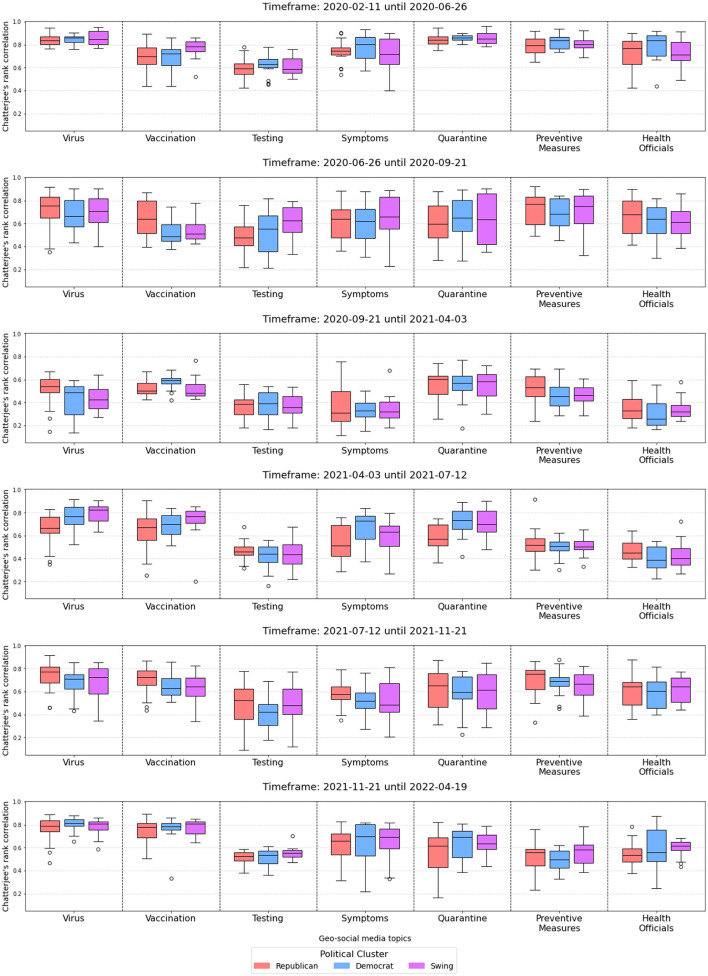
Results: Many topics exhibited significant spatial clustering over time, with quarantine and vaccination-related posts occurring in opposing spatial regimes in the second timeframe. We also found significant variation in the early warning capabilities of geo-social media topics over time and across political clusters. In detail, quarantine related geo-social media post were significantly less correlated to COVID-19 cases in republican states than in democrat states. Further, preventive measure and quarantine-related posts exhibited declining correlations to COVID-19 cases over time, while the correlations of vaccine and virus-related posts with COVID-19 infections.
Conclusion: Our results highlight the need for a dynamic spatially targeted approach that accounts for both how regional geosocial media topics of interest change over time and the impact of local political ideology on their epidemiological early warning capabilities.
Keywords: epidemiological early warning; geo-social media; political polarization; spatio-temporal epidemiology; spatio-temporal semantic analysis.
Copyright © 2025 Arifi, Resch, Santillana, Knoblauch, Lautenbach, Jaenisch and Morales.
Conflict of interest statement
The authors declare that the research was conducted in the absence of any commercial or financial relationships that could be construed as a potential conflict of interest.
Figures
References
-
- Cowan SK, Mark N, Reich JA. COVID-19 vaccine hesitancy is the new terrain for political division among Americans. Socius. (2021) 7:23780231211023657. 10.1177/23780231211023657 - DOI
MeSH terms
LinkOut - more resources
Full Text Sources
Medical
