


The effects of 8 weeks of sprint interval training on repeated sprinting and specialized ability in college volleyball players
- PMID: 40668810
- PMCID: PMC12266437
- DOI: 10.1371/journal.pone.0327561
The effects of 8 weeks of sprint interval training on repeated sprinting and specialized ability in college volleyball players
Abstract
Objective: This study aimed to investigate the effects of 8 weeks of sprint interval training (SIT) on repeated sprinting ability and specialized performance in collegiate volleyball players.
Methods: Twenty-eight male collegiate volleyball players were randomly assigned to sprint interval training (SIT, n = 14) or high-intensity interval training (HIIT, n = 14) groups. The SIT group performed all-out sprints (6 × 30m with 30s rest) twice weekly in addition to regular volleyball training, while the HIIT group underwent high-intensity interval training alongside identical regular volleyball training. Repeated sprint ability (ideal sprint time IS, total sprint time TS, and performance decrement PD), aerobic capacity (VO₂max, velocity at VO₂max [vVO₂max], ventilatory thresholds VT1 and VT2), and volleyball-specific abilities (modified agility T-test, countermovement vertical jump [CMVJ], and spike jump [SPJ]) were assessed before and after the intervention.
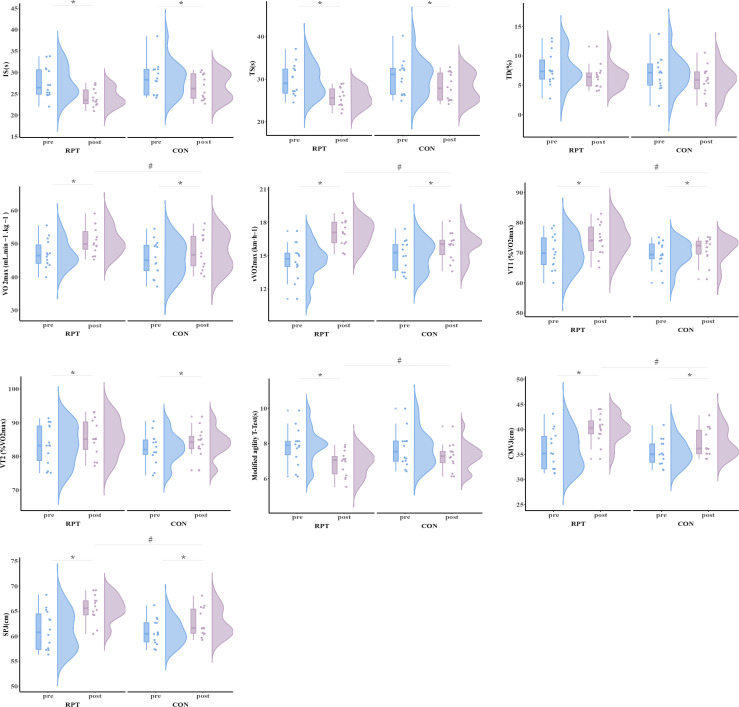
Results: Following the intervention, the SIT group showed significantly greater improvements than the HIIT group in VO₂max (46.93 ± 4.25 vs 50.90 ± 4.17 ml/min/kg, p < 0.001), vVO₂max (14.53 ± 1.61 vs 17.03 ± 1.15 km/h, p < 0.001), VT1 (69.61 ± 4.22% vs 74.43 ± 5.25%, p < 0.001), modified agility T-test (7.85 ± 1.04 vs 6.87 ± 0.71s, p < 0.001), CMVJ (35.77 ± 3.91 vs 40.14 ± 2.82 cm, p < 0.001), and SPJ (61.20 ± 3.92 vs 65.57 ± 2.64 cm, p < 0.001). Both groups demonstrated significant improvements in IS and TS (p < 0.05), with larger effect sizes observed in the SIT group (IS: 1.060 vs 0.581; TS: 1.164 vs 0.678). No significant between-group differences were found in PD and VT2.
Conclusion: Eight weeks of sprint interval training effectively enhances repeated sprinting ability, aerobic capacity, and specialized skills in collegiate volleyball players, with particularly notable improvements in vertical jumping ability and agility. These findings suggest that SIT represents an effective and time-efficient training method for improving volleyball performance.
Copyright: © 2025 Wei et al. This is an open access article distributed under the terms of the Creative Commons Attribution License, which permits unrestricted use, distribution, and reproduction in any medium, provided the original author and source are credited.
Conflict of interest statement
The authors have declared that no competing interests exist.
Figures
References
-
- Gantois P, Batista GR, Dantas M, de Sousa Fortes L, da Silva Machado DG, Mortatti AL, et al. Short-term effects of repeated-sprint training on vertical jump ability and aerobic fitness in collegiate volleyball players during pre-season. Int J Exerc Sci. 2022;15(6):1040–51. doi: 10.70252/UXOP1748 - DOI - PMC - PubMed
Publication types
MeSH terms
LinkOut - more resources
Full Text Sources
