


The criteria to classify body-proportionality of the small for gestational age newborn: a scoping review
- PMID: 40670942
- PMCID: PMC12265123
- DOI: 10.1186/s12884-025-07870-z
The criteria to classify body-proportionality of the small for gestational age newborn: a scoping review
Abstract
Purpose: To create an overview of the criteria used to classify small for gestational age (SGA) newborns according to their body-proportionality as either asymmetric SGA or symmetric SGA, and to create an overview of the clinical outcomes related to body-proportionality.
Methods: A scoping review was conducted using PubMed, Embase and the Cochrane Library databases. Studies were included if they described SGA newborns regardless of gestational age and if their classification on body-proportionality was given for both aSGA and sSGA. Data were screened and extracted by two independent reviewers.
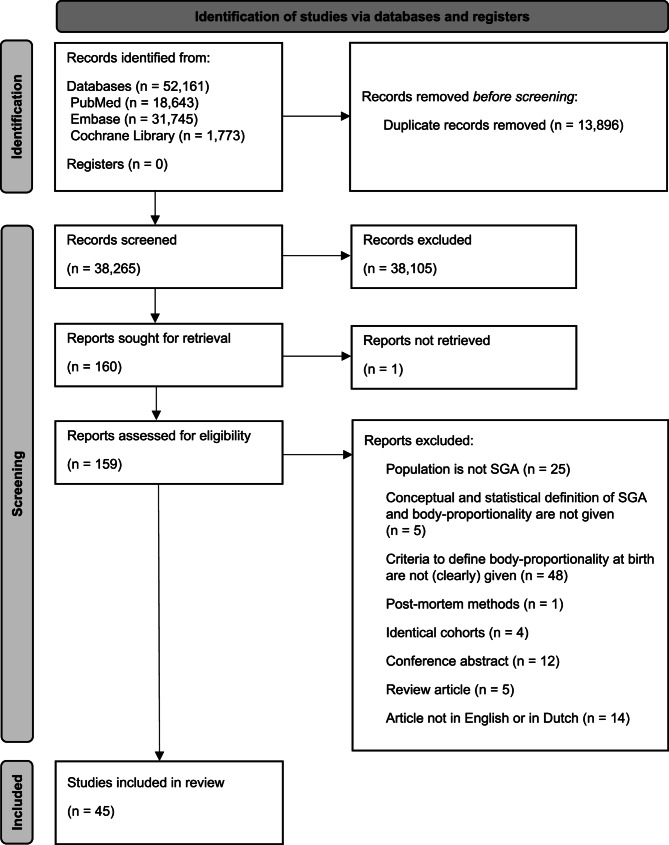
Results: Of the 38,265 studies identified after deduplication, 45 were included. Body-proportionality was classified by the ponderal index (PI) in 55.6% of studies (n = 25), head circumference (HC) in 24.4% (n = 11), birth length in 11.1% (n = 5), birth length and HC in 4.4% (n = 2), birth length and PI in 2.2% (n = 1), and PI, brain-to-body ratio and HC/length ratio in 2.2% (n = 1). The most commonly reported outcomes were asphyxia, hyperbilirubinemia, hypoglycemia, mortality and respiratory distress syndrome. The results regarding the outcomes were inconsistent and contradictory.
Conclusion: Large heterogeneity in the published classifications and clinical outcomes regarding body-proportionality in the SGA newborns exists. Consensus on terms, methods and cut-off values used for body-proportionality is needed to improve future comparison of study results.
Keywords: Asymmetry; Birth weight; Disproportionate; Neonate; Small for gestational age.
© 2025. The Author(s).
Conflict of interest statement
Declarations. Ethics approval and consent to participate: Not applicable. Consent for publication: Not applicable. Competing interests: The authors declare no competing interests.
Figures
References
-
- Vayssière C, Sentilhes L, Ego A, Bernard C, Cambourieu D, Flamant C, et al. Fetal growth restriction and intra-uterine growth restriction: guidelines for clinical practice from the French college of gynaecologists and obstetricians. Eur J Obstet Gynecol Reprod Biol. 2015;193:10–8. - PubMed
-
- Battaglia FC, Lubchenco LO. A practical classification of newborn infants by weight and gestational age. J Pediatr. 1967;71:159–63. - PubMed
-
- Beune IM, Bloomfield FH, Ganzevoort W, Embleton ND, Rozance PJ, van Wassenaer-Leemhuis AG, et al. Consensus based definition of growth restriction in the newborn. J Pediatr. 2018;196:71-6.e1. - PubMed
-
- Landmann E, Reiss I, Misselwitz B, Gortner L. Ponderal index for discrimination between symmetric and asymmetric growth restriction: percentiles for neonates from 30 weeks to 43 weeks of gestation. J Matern Fetal Neonatal Med. 2006;19:157–60. - PubMed
Publication types
MeSH terms
LinkOut - more resources
Full Text Sources
Research Materials
Miscellaneous
