


Association between KCNQ1 gene polymorphisms and gestational diabetes mellitus susceptibility in a Chinese population
- PMID: 40671906
- PMCID: PMC12263388
- DOI: 10.3389/fendo.2025.1451942
Association between KCNQ1 gene polymorphisms and gestational diabetes mellitus susceptibility in a Chinese population
Abstract
Introduction: The potassium voltage-gated channel subfamily Q member 1 (KCNQ1) gene is recognized as a type 2 diabetes mellitus (T2DM) susceptibility gene. However, there is limited data regarding the association between KCNQ1 gene polymorphisms and gestational diabetes mellitus (GDM) susceptibility in China. To explore the association between KCNQ1 gene polymorphisms and GDM susceptibility in a Chinese population.
Methods: We conducted a case-control study including 500 pregnant women with GDM and 502 pregnant women with normal glucose tolerance (as controls). Blood samples and clinical data were collected. KCNQ1 gene rs2237897, rs163184, rs151290, and rs2237892 were genotyped by SNPscan™ genotyping assay. Using SPSS V.26.0, statistical analysis was performed to explore the association of KCNQ1 gene polymorphisms with GDM and genotypes with blood glucose levels. Meta-analysis was further validated in different populations.
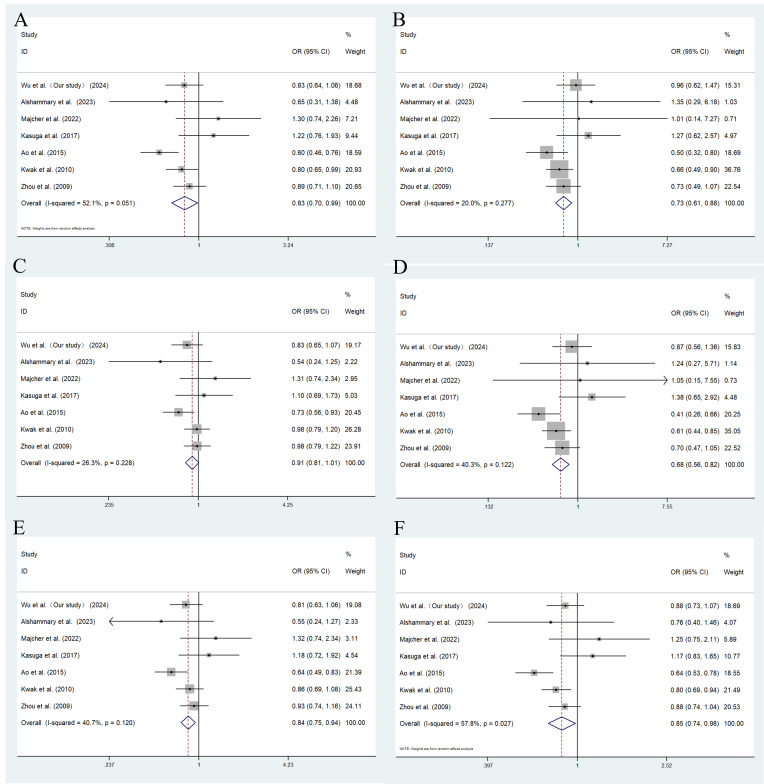
Results: After being adjusted for confounding factors (age, parity, pre-pregnancy BMI (pre-BMI) and blood pressure) and Bonferroni correction, rs2237897 showed an association with decreased GDM risk in codominant heterozygous (CT vs. CC: OR = 0.537; 95% CI: 0.354-0.816; P = 0.004) and overdominant models (CT vs. CC+TT: OR = 0.533; 95% CI: 0.355-0.801; P = 0.002) in pregnant women aged < 30 years. However, rs2237892, rs151290, and rs163184 did not found associations with GDM after Bonferroni correction. Meta-analysis showed that rs2237892 was associated with decreased GDM risk in different races in dominant (TC+TT vs. CC: OR = 0.830; 95% CI: 0.699-0.985; P = 0.033), recessive (TT vs. CT+CC: OR = 0.733; 95% CI: 0.612-0.877; P = 0.001), codominant homozygous (TT vs. CC: OR = 0.679; 95% CI: 0.562-0.820; P < 0.001), codominant heterozygous (TC vs. CC: OR = 0.843; 95% CI: 0.753-0.945; P = 0.003) and allele models (T vs. C: OR = 0.852; 95% CI: 0.740-0.982; P = 0.027).
Conclusion: KCNQ1 rs2237897 is associated with decreased GDM risk in a Chinese population. Although rs2237892 did not found association with GDM risk in our subjects, meta-analysis confirmed that rs2237892 is associated with reduced GDM risk across different populations. Further studies are needed to confirm these findings and elucidate the mechanisms.
Keywords: gestational diabetes mellitus; potassium voltage-gated channel subfamily Q member 1; rs151290; rs163184; rs2237892; rs2237897; single nucleotide polymorphism.
Copyright © 2025 Wu, Zhang, Liu, Liu, He, Wei, Zeng and Guo.
Conflict of interest statement
The authors declare that the research was conducted in the absence of any commercial or financial relationships that could be construed as a potential conflict of interest.
Figures
References
-
- Sacks DA, Hadden DR, Maresh M, Deerochanawong C, Dyer AR, Metzger BE, et al. Frequency of gestational diabetes mellitus at collaborating centers based on IADPSG consensus panel-recommended criteria: the Hyperglycemia and Adverse Pregnancy Outcome (HAPO) Study. Diabetes Care. (2012) 35:526–8. doi: 10.2337/dc11-1641 - DOI - PMC - PubMed
MeSH terms
Substances
Supplementary concepts
LinkOut - more resources
Full Text Sources
