


Simply cut out - Combining CRISPR/Cas9 RNPs and transiently selected telomere vectors for marker free-gene deletion in Trichoderma atroviride
- PMID: 40672045
- PMCID: PMC12263576
- DOI: 10.3389/fgeed.2025.1623963
Simply cut out - Combining CRISPR/Cas9 RNPs and transiently selected telomere vectors for marker free-gene deletion in Trichoderma atroviride
Abstract
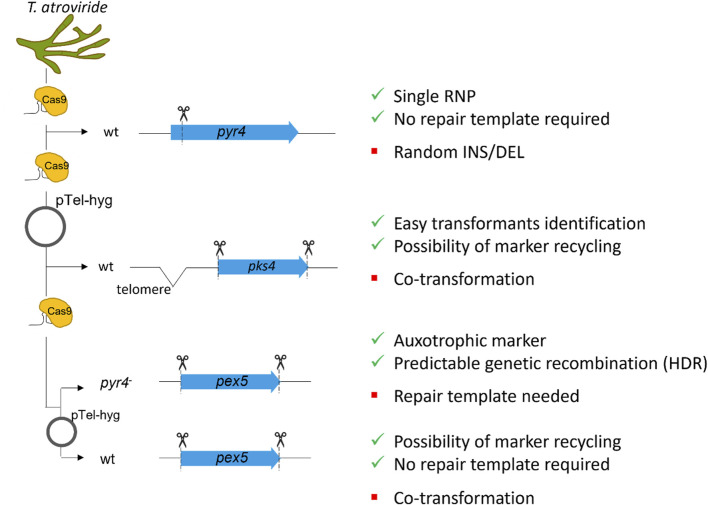
Trichoderma atroviride is a well-known mycoparasitic fungus widely used for the biological control of fungal plant pathogens. However, genetic manipulation in this organism remains challenging due to the limited availability of versatile and efficient molecular tools. Here, we present a CRISPR/Cas9-based method for targeted gene manipulation using ribonucleoprotein (RNP) complexes combined with a transiently stable telomere vector. We successfully inactivated three genes-pks4 (spore pigment production), pyr4 (pyrimidine biosynthesis), and pex5 (peroxisomal matrix protein import receptor)-to demonstrate the system's utility. Although double-strand breaks induced by Cas9 can be repaired via homology-directed repair (HDR), using donor templates, the most effective gene inactivations in our case were achieved via non-homologous end joining (NHEJ), by co-transforming the transiently stable telomere vector carrying the hygromycin-resistance gene (hph), which was rapidly lost under non-selective conditions. This strategy enables marker-free genetic manipulation, supports vector recycling, and simplifies successive transformations. Overall, our method expands the genetic toolbox for T. atroviride, offering a fast and reliable approach for reverse genetics in this agriculturally important fungus.
Keywords: CRISPR/Cas9; Trichoderma atroviride; marker-free; telomeric vector; transient resistance.
Copyright © 2025 Gründlinger, Ellensohn, Drechsel, Schreiner, Pierson, Baldin and Zeilinger.
Conflict of interest statement
The authors declare that the research was conducted in the absence of any commercial or financial relationships that could be construed as a potential conflict of interest. The author(s) declared that they were an editorial board member of Frontiers, at the time of submission. This had no impact on the peer review process and the final decision.
Figures
References
-
- Atanasova L., Gruber S., Lichius A., Radebner T., Abendstein L., Münsterkötter M., et al. (2018). The Gpr1-regulated Sur7 family protein Sfp2 is required for hyphal growth and cell wall stability in the mycoparasite Trichoderma atroviride. Sci. Rep. 8, 12064. 10.1038/s41598-018-30500-y - DOI - PMC - PubMed
LinkOut - more resources
Full Text Sources
