Evolving survival patterns in pancreatic adenocarcinoma: a 23-year retrospective observational analysis
- PMID: 40672068
- PMCID: PMC12260940
- DOI: 10.21037/jgo-2024-942
Evolving survival patterns in pancreatic adenocarcinoma: a 23-year retrospective observational analysis
Abstract
Background: Pancreatic adenocarcinoma (PA) remains one of the most lethal malignancies. However, treatment options have expanded. Since 2011, FOLFIRINOX (fluorouracil, leucovorin, oxaliplatin, and irinotecan) and nab-paclitaxel plus gemcitabine have demonstrated superior outcomes over gemcitabine for advanced disease and have become standard chemotherapy regimens. This study aimed to analyze 23-year survival trends in PA at a Brazilian cancer center, focusing on comparisons between the pre- and post-FOLFIRINOX eras.
Methods: This retrospective study analyzed patients diagnosed and treated at a large cancer center from 2000 to 2023, examining survival trends and changes in clinicopathological features and treatment across two 12-year periods: Period 1 (2000-2011), before FOLFIRINOX, and Period 2 (2012-2023), after FOLFIRINOX incorporation. The primary objective was to compare overall survival rates between the two time periods. The secondary objective was to evaluate changes in clinicopathological characteristics and treatment modalities.
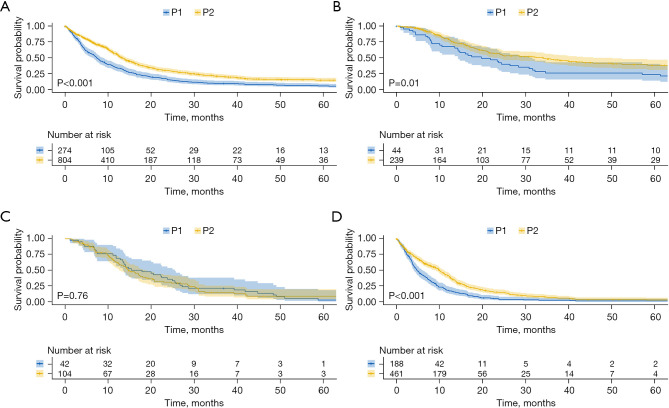
Results: A total of 1,078 patients were included in this analysis, with 274 patients in Period 1 and 804 patients in Period 2. The proportion of female patients increased in Period 2 (43.8% in Period 1 vs. 50.9% in Period 2, P=0.051), and the median age at diagnosis rose from 62.5 to 66 years (P<0.001). Early-stage tumors (stages I-II) were more frequently diagnosed in Period 2 (16% vs. 29.8%, P<0.001). Chemotherapy use increased from 70.1% (192 patients) in Period 1 to 83.2% (669 patients) in Period 2 (P<0.001), while multimodal therapy (surgery + chemotherapy) rose from 11.3% to 16.7% (P<0.001). Median overall survival (mOS) improved from 7.29 months in Period 1 to 13.24 months in Period 2 (P<0.001), with the 5-year survival increasing from 5.2% to 14.3%. Among the early-stage patients, mOS increased from 19.7 to 34.4 months (P=0.01). No survival difference was observed for stage III disease (mOS: 16.7 vs. 14.8 months, P=0.76), while outcomes for stage IV improved (mOS: 4.76 vs. 9.99 months, P<0.001).
Conclusions: This 23-year analysis highlights the evolving treatment landscape and improved outcomes in PA with the introduction of more effective therapies.
Keywords: Pancreatic cancer; adenocarcinoma; prognosis; survival.
Copyright © 2025 AME Publishing Company. All rights reserved.
Conflict of interest statement
Conflicts of Interest: All authors have completed the ICMJE uniform disclosure form (available at https://jgo.amegroups.com/article/view/10.21037/jgo-2024-942/coif). The authors have no conflicts of interest to declare.
Figures
Comment in
-
Investigating survival patterns in pancreatic adenocarcinoma over two decades after introducing FOLFIRINOX.J Gastrointest Oncol. 2025 Oct 31;16(5):2499-2501. doi: 10.21037/jgo-2025-630. Epub 2025 Oct 15. J Gastrointest Oncol. 2025. PMID: 41220729 Free PMC article. No abstract available.
References
LinkOut - more resources
Full Text Sources