The significance of lymph node metastasis in pT1-2 colorectal cancer
- PMID: 40672073
- PMCID: PMC12260982
- DOI: 10.21037/jgo-2024-982
The significance of lymph node metastasis in pT1-2 colorectal cancer
Abstract
Background: The prognosis of stage IIIA colorectal cancer (CRC) is much better than that of stage II CRC in Japan. This study aimed to investigate the clinical implications of lymph node metastasis (LNM) in patients with pT1-2 CRC and explore the potential for downstaging pT1-2N+ CRC.
Methods: This retrospective cohort study took place at Saitama Medical University International Medical Center in Japan. We stratified patients with pT1-2 CRC (n=1,288) by presence (LNM+) or absence (LNM-) of LNM, assessing overall survival (OS), cancer-specific survival (CSS), and relapse-free survival (RFS) in both groups before and after propensity score matching (PSM). Cox multivariate analysis served for screening of prognostic risk factors.
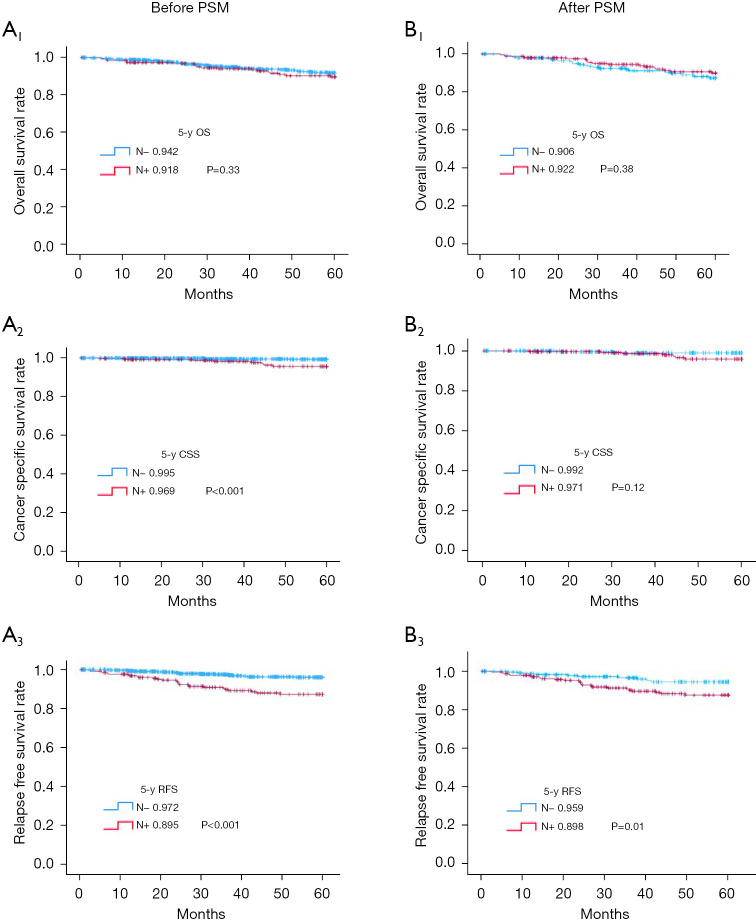
Results: LNM+ was ultimately confirmed in 256 study subjects (19.9%). Before matching, tumors of the LNM+ (vs. LNM-) group were more inclined to be large (≥2 cm: 76.6% vs. 61.2%; P<0.001), with greater propensity for infiltrating or ulcerative features (55.1% vs. 36.2%; P<0.001) and histotypes of lesser differentiation (moderately differentiated adenocarcinoma/poorly differentiated adenocarcinoma/signet-ring carcinoma/mucinous carcinoma: 65.6% vs. 45.8%; P<0.001). Likewise, they showed greater tendency for aggressive growth (91.0% vs. 81.1%; P<001), lymphatic (44.5% vs. 19.4%; P<0.001) or vascular (59.0% vs. 35.1%; P<0.001) invasion, and prolific lymph node harvesting (23.6±12.2 vs. 21.7±12.3; P=0.02). Although similar in terms of OS (LNM-, 94.2%; LNM+, 91.8%; P=0.33), the LNM- (vs. LNM+) group displayed significantly better CSS (99.5% vs. 96.9%; P<0.001) and RFS (97.2% vs. 89.5%; P<0.001). After matching, RFS still proved significantly better in the LNM- (vs. LNM+) group (95.9% vs. 89.8%; P=0.01), with multivariate analysis identifying LNM+ as an independent risk factor for RFS before and after PSM. A higher recurrence rate was also evident in the LNM+ (vs. LNM-) group [before matching: 10.5% vs. 2.8% (P<0.001); after matching: 10.2% vs. 4.1% (P=0.008)], involving liver and lymph nodes primarily. Neither OS nor CSS differed significantly by group.
Conclusions: LNM+ pT1-2 CRC patients had a higher risk of hepatic and nodal recurrence, but long-term OS and CSS were unaffected. Perhaps an appropriate downstaging of pT1-2N+ CRC from stage IIIA is a reasonable prospect.
Keywords: lymph node metastasis (LNM); pT1-2 colorectal cancer (pT1-2 CRC); propensity score matching (PSM).
Copyright © 2025 AME Publishing Company. All rights reserved.
Conflict of interest statement
Conflicts of Interest: All authors have completed the ICMJE uniform disclosure form (available at https://jgo.amegroups.com/article/view/10.21037/jgo-2024-982/coif). The authors have no conflicts of interest to declare.
Figures

References
LinkOut - more resources
Full Text Sources
Miscellaneous