


Two-stage wood decay by Grifola frondosa
- PMID: 40672142
- PMCID: PMC12260386
- DOI: 10.47371/mycosci.2024.10.006
Two-stage wood decay by Grifola frondosa
Abstract
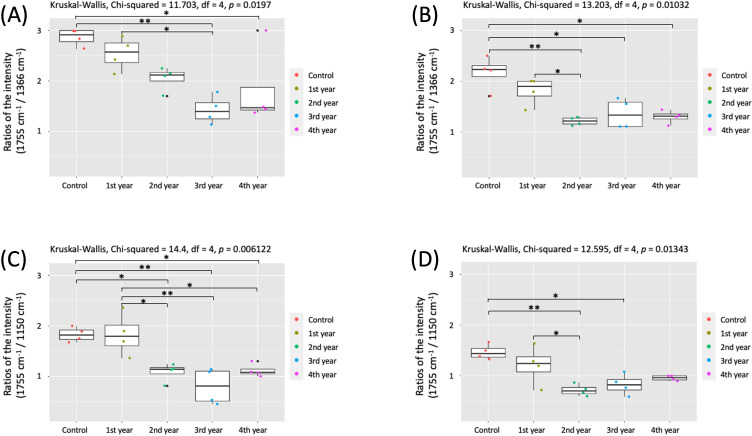
In nature, only white-rot fungi can completely decompose wood biomass in the environmental carbon cycle. However, their degradation strategy is still unclear. Despite many studies on the lab-scale wood-decay process, investigations on the open-field process have been limited by their difficulty. Here, we aimed to elucidate the degradation strategy of white-rot fungi in nature by monitoring the chemical composition changes of logs exposed to the white-rot fungus, Grifola frondosa, over 4 y of cultivation using Fourier transform infrared spectroscopy. Grifola frondosa began to decompose lignin and deacetylate hemicellulose in the first 2 y and then degraded polysaccharides in the next 1 y. Finally, lignin decomposition recurred after the third year. Thus, our study revealed that G. frondosa decayed wood in a repetitive two-stage process: lignin and polysaccharide degradation. The switching cycle may promote efficient degradation.
Keywords: Fourier transform infrared spectroscopy; deacetylation; delignification; white-rot fungi; wood-log cultivation.
2025, by The Mycological Society of Japan.
Conflict of interest statement
The authors declare that they have no conflicts of interest.
Figures


References
-
- Alonso, D. M., Hakim, S. H., Zhou, S., Won, W., Hosseinaei, O., Tao, J., Garcia-Negron, V., Motagamwala, A. H., Mellmer, M. A., Huang, K., Houtman, C. J., Labbé, N., Harper, D. P., Maravelias, C., Runge, T., & Dumesic, J. A. (2017). Increasing the revenue from lignocellulosic biomass: Maximizing feedstock utilization. Science Advances, 3, e1603301. https://doi.org/10.1126/sciadv.1603301 - PMC - PubMed
-
- Bouveng, H. O. (1961). Phenylisocyanate derivatives of carbohydrates. Acta Chemica Scandinavica, 15, 87-95. https://doi.org/10.3891/acta.chem.scand.15-0087
-
- Bugg, T. D. H., Ahmad, M., Hardiman, E. M., & Rahmanpour, R. (s2011). Pathways for degradation of lignin in bacteria and fungi. Natural Product Reports, 28, 1883-1896. https://doi.org/10.1039/c1np00042j - PubMed
-
- Chen, F.-C., Motoda, T., Kamei, I., & Kijidani, Y. (2023). Characterization of microbial communities during Grifola frondosa (maitake) wood log cultivation. Journal of Wood Science, 69, 39. https://doi.org/10.1186/s10086-023-02111-3
-
- Hägglund, E., Lindberg, B., & McPherson, J. (1956). Dimethylsulphoxide, a solvent for hemicelluloses. Acta Chemica Scandinavica, 10, 1160-1164. https://doi.org/10.3891/acta.chem.scand.10-1160
LinkOut - more resources
Full Text Sources
Miscellaneous