[Preprint]. 2025 Jul 8:2025.07.04.663211.
doi: 10.1101/2025.07.04.663211.

Musculoskeletal architecture of the shoulder: A comparative anatomy study in bats and mice informing human rotator cuff function

Affiliations

Musculoskeletal architecture of the shoulder: A comparative anatomy study in bats and mice informing human rotator cuff function

Iden Kurtaliaj et al. bioRxiv. .

Abstract

Overhead motion in humans often leads to shoulder injuries, a consequence of the evolutionary trade-off in glenohumeral joint anatomy that balances stability with mobility. Bats consistently engage in overhead motion during flight, subjecting their shoulders to substantial loading throughout their relatively long lifespan. Remarkably, despite the demands placed on a bat's shoulder, instability and rotator cuff tears, which could be fatal to bats in short order, are not observed in nature. We were thus inspired to study functional adaptations in the shoulders of bats that enable this overhead motion. Comparative anatomical studies of the shoulders of bats and mice, similarly-sized quadrupeds, were performed and interpreted using a mathematical model. Scapular anatomy indicated a more prominent role for the infraspinatus muscle in the bat compared to the mouse. Measurements of bat and mice shoulders revealed that the bat glenoid had a larger curvature and arc length than that of mice, providing a larger articulating surface area with and deeper enclosing surface of the humeral head. Modeling results predicted that the bat shoulder is stable over a dramatically larger range of angles compared to the mouse shoulder. These results suggested that adaptations to constraints imposed by the bony anatomy and rotator cuff tendons of the shoulder may contribute to the ability of bats to sustain overhead motion in a high stress, repeated loading environment without injury. Results suggest that bats have evolved unique adaptations in their glenohumeral bony anatomy that reduce stress on the supraspinatus, enhance joint stability, and optimize strength across a broad range of motion.


Conflict of interest statement

Competing interest statement All authors declare no competing interests.

Figures
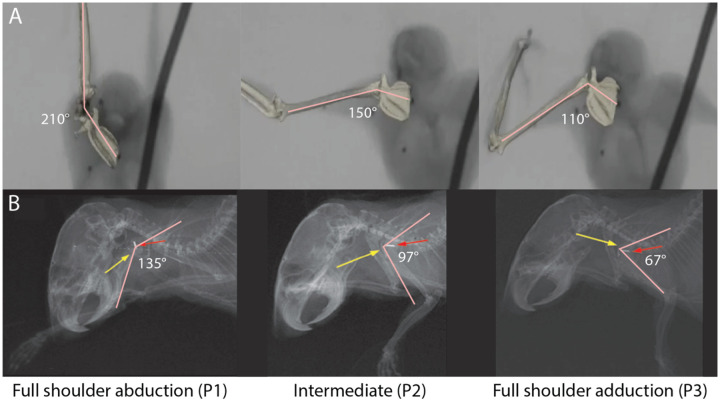
Figure 1.
Figure 1.. Angle between the humerus and spine of the scapula of C. perspicillata (A) and mice (B).
Glenohumeral joints, rotator cuff muscles, and other surrounding tissue were dissected and then fixed in three different positions: full shoulder extension (“P1”), intermediate position (“P2”), and full shoulder flexion (“P3”). To consistently identify the angle between the scapular spine and the humerus for each fixation position, gait (mouse) and flight (bat) analyses were used. Adapted, with permission, from Soslowsky et al. [31] and from Konow et al. [68].
Figure 2.
Figure 2.
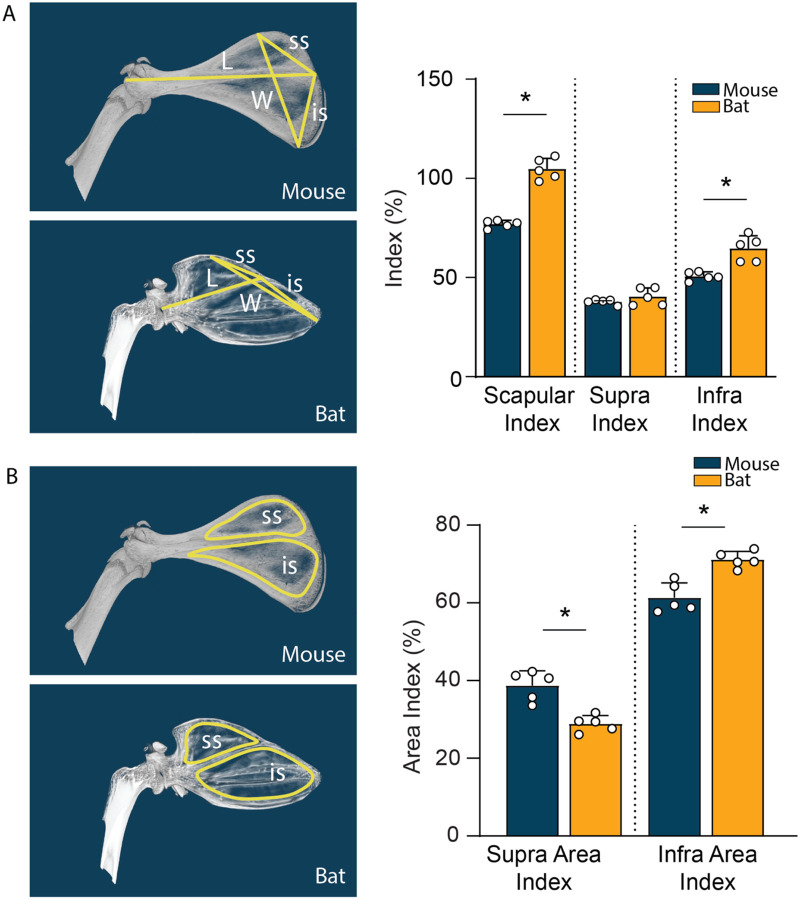
(A) Scapular, supraspinatus and infraspinatus indices. The scapular and infraspinatus indices were significantly larger in bats than in mice. There was no significant difference in the supraspinatus index between species. (B) Supraspinatus and infraspinatus area indices. Bats showed significantly larger infraspinatus area index and significantly lower supraspinatus area index compared to mice.
Figure 3.
Figure 3.
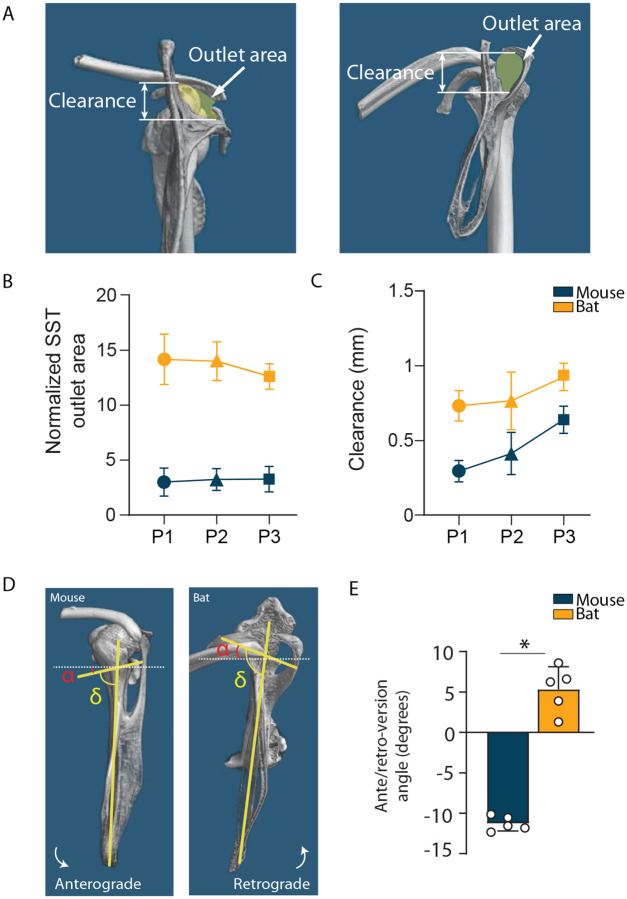
(A) Representative 3D microCT images of the glenohumeral joint of the C. perspicillata and mouse showing supraspinatus outlet area and clearance measurements. (B) Supraspinatus outlet area (yellow in A) normalized by supraspinatus attachment area. The normalized supraspinatus outlet area was significantly greater in C. perspicillata compared to mice, suggesting more space in bats for the supraspinatus to pass through to the humeral attachment. (C) Clearance, measured as the height of the outlet area (white double-headed arrow in A). The supraspinatus clearances of bats and mice were measured across three defined shoulder positions:. As the shoulder transitions from full shoulder flexion to extension (i.e from full shoulder extension [“P1”] to intermediate [“P2”] to full shoulder flexion [“P3”]) there was an increase in the supraspinatus-acromion clearance for both C. perspicillata and mice. (D) Representative 3D microCT images of the glenohumeral joint of C. perspicillata and mouse showing glenoid version measurements. (E) Glenoid ante/retroversion α angle; α=δ90 for mice and C. perspicillata. The glenoid was retroverted in C. perspicillata and anteverted in mice.
Figure 4.
Figure 4.
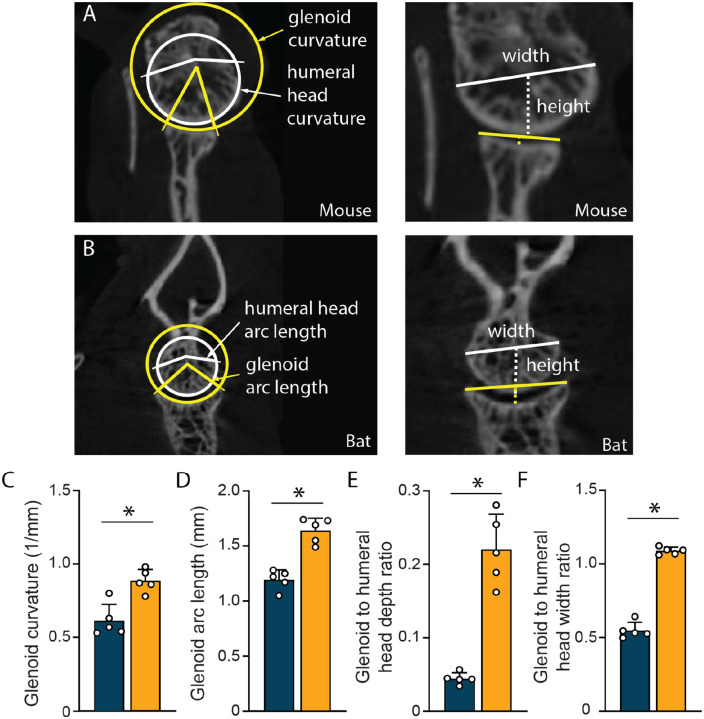
(A-B) Representative 3D microCT images of the glenohumeral joint of C. perspicillata and mouse showing glenoid curvature and arc length measurements, and glenoid to humeral head depth and width ratios. (C-D) Glenoid curvature and arc length for mouse and C. perspicillata. Glenoid curvature and arc length were significantly higher in bats than in mice. (E-F) Glenoid to humeral head depth and width ratio. Both ratios were significantly greater in C. perspicillata compared to mice.
Figure 5.
Figure 5.
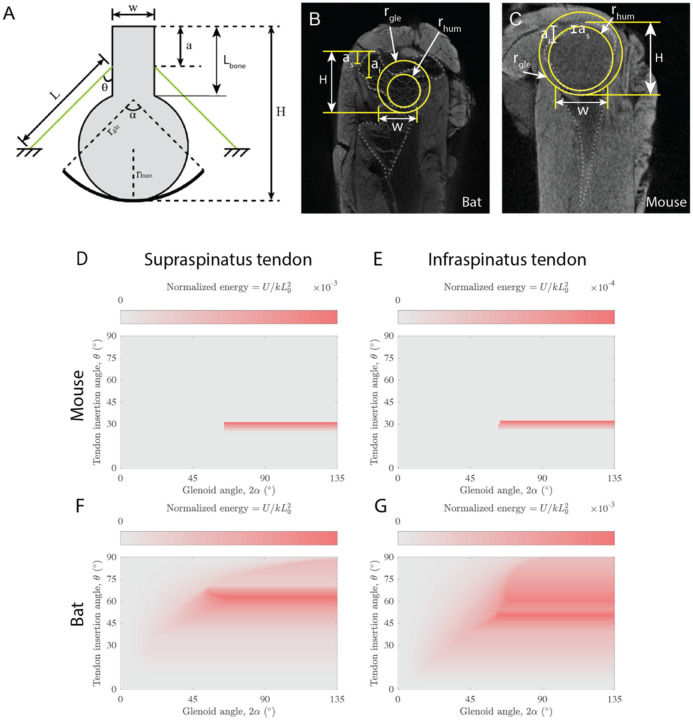
(A) Schematic representation of the shoulder instability model. The two-dimensional model considers a humeral head, with a radius rhum that interfaces with a glenoid with an arc with radius rgle and angle α. (B-C) Enhanced micro-CT imaging of C. perspicillata and mouse shoulders. Enhanced micro-CT imaging allowed muscle fibers to be visible, making the supraspinatus and infraspinatus attachments easy to visualize. Each of the modeling parameters mentioned above was measured in the transverse plane using IMAGEJ. Each measurement was repeated three times, and an average measurement was taken. (D-G) Phase diagram representing the energy barrier that must be overcome for instability of the model shoulder to occur. The energy barrier that resists instability (red) was substantial in bats (F,G) over a larger range than in mice (D,E).
Figure 6.
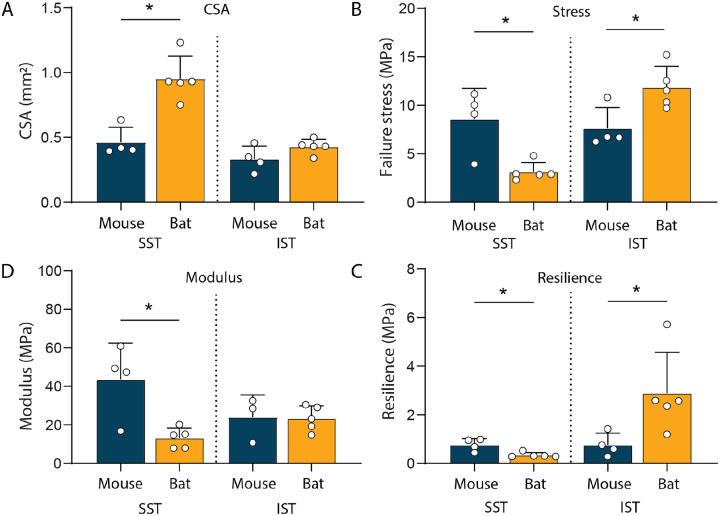
Figure 6.. (A-B) CSA measurement in bats and mice.
(A) The minimum tendon cross-sectional area for each sample was determined from microCT scans. The cross-sectional area (CSA) of the supraspinatus tendon in C. perspicillata was significantly larger compared to that of mice. No significant difference in CSA was observed when comparing the infraspinatus tendons of both species. Biomechanical testing results. (B) The C. perspicillata supraspinatus tendons exhibited significantly lower failure stress compared to mice, and the C. perspicillata infraspinatus tendons showed significantly higher failure stress than that of mice. (C) The modulus of C. perspicillata supraspinatus tendons was significantly lower compared to that of mice. There was no significant difference in the modulus of the infraspinatus tendon between C. perspicillata and mice. (D) C. perspicillata supraspinatus tendons showed significantly lower resilience compared to mice; C. perspicillata infraspinatus tendons showed significantly greater resilience compared to mice.
Figure 7.
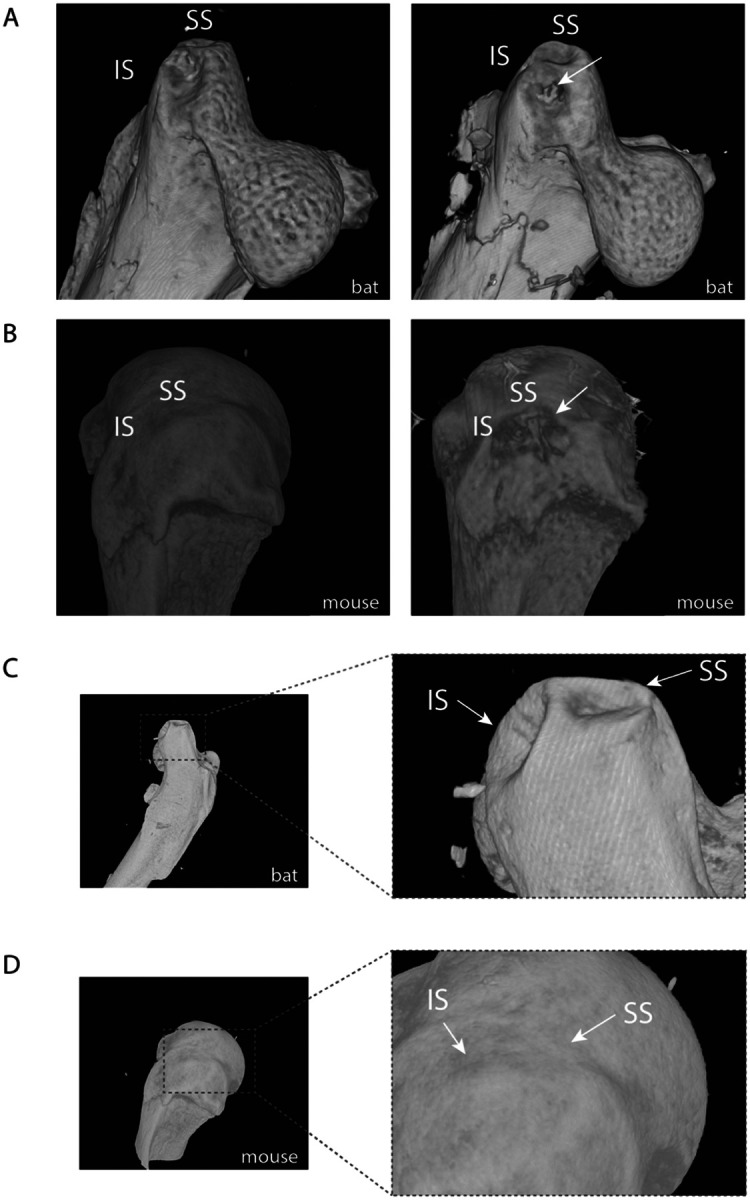
Figure 7.
(A-B) High-resolution microCT scans and 3D bony reconstructions of humeral head samples from bats and mice post mechanical testing failure showing supraspinatus and infraspinatus attachments. A representative bone avulsion site is visualized (right) for the infraspinatus of bats (C) and the supraspinatus of mice (bottom) (D). The mouse attachments are flat, similar to humans, whereas bat attachments have a concave groove shape.

References

    1. Chan L.K., Glenohumeral Mobility in Primates, (2006). 10.1159/000095682. - DOI - PubMed
    1. McCausland C., Sawyer E., Eovaldi B.J., Varacallo M., Anatomy, Shoulder and Upper Limb, Shoulder Muscles, in: StatPearls, StatPearls Publishing, Treasure Island (FL), 2023. http://www.ncbi.nlm.nih.gov/books/NBK534836/ (accessed August 15, 2023). - PubMed
    1. Cowan P.T., Mudreac A., Varacallo M., Anatomy, Back, Scapula, in: StatPearls, StatPearls Publishing, Treasure Island (FL), 2023. http://www.ncbi.nlm.nih.gov/books/NBK531475/ (accessed August 15, 2023).
    1. Roach N.T., Venkadesan M., Rainbow M.J., Lieberman D.E., Elastic energy storage in the shoulder and the evolution of high-speed throwing in Homo, Nature 498 (2013) 483–486. 10.1038/nature12267. - DOI - PMC - PubMed
    1. Hoppe M.W., Brochhagen J., Tischer T., Beitzel K., Seil R., Grim C., Risk factors and prevention strategies for shoulder injuries in overhead sports: an updated systematic review, Journal of Experimental Orthopaedics 9 (2022) 78. 10.1186/s40634-022-00493-9. - DOI - PMC - PubMed

Publication types

LinkOut - more resources