


Overlooked Enterobacterales as hosts of antimicrobial resistance in aquatic environments
- PMID: 40676003
- PMCID: PMC12271363
- DOI: 10.1038/s41598-025-08090-3
Overlooked Enterobacterales as hosts of antimicrobial resistance in aquatic environments
Abstract
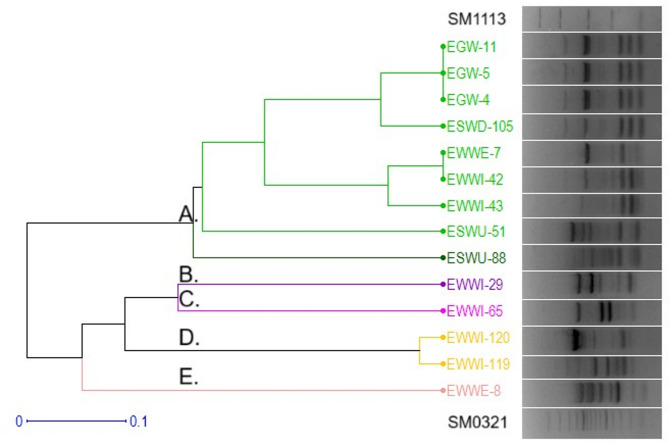
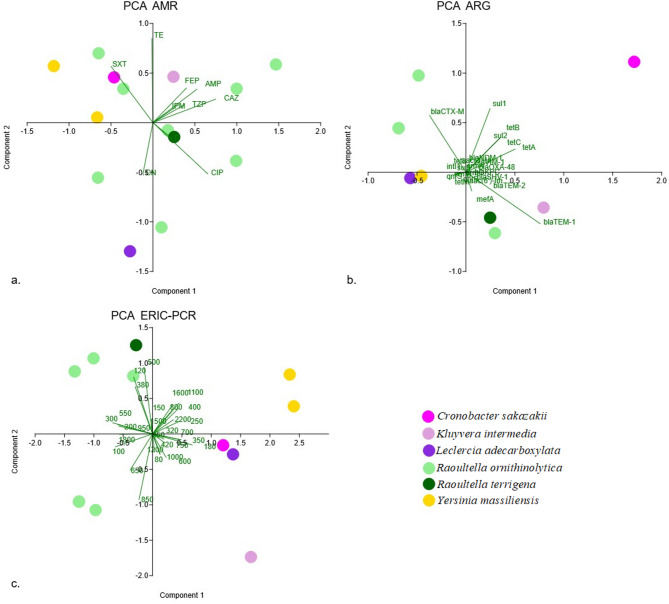
The increasing frequency of antibiotic resistant bacteria and their dissemination in environmental microbiomes is a critical health concern. Water quality assessment and AMR surveillance are broadly focused on commonly found Enterobacterales, and mainly on the faecal indicator E. coli. In this study, we analysed antibiotic resistance and biofilm formation in 14 environmental isolates belonging to six neglected species. Genetic diversity was assessed by ERIC-PCR. Identified as Cronobacter sakazakii (1), Kluyvera intermedia (1), Leclercia adecarboxylata (1), Raoultella ornithinolytica (8), Raoultella terrigena (1), and Yersinia massiliensis (2), each isolate had a unique and distinct AMR profile. The isolates demonstrated intrinsic resistance to erythromycin and increased resistance to ampicillin and tetracycline. None of the isolates exhibited carbapenem resistance. Ten isolates were MDR. Thirteen out of the 24 investigated ARGs were detected in bacterial genomes. Except for carbapenemases, various β-lactamases (blaTEM, blaCTX-M), and also tet, sul, erm, mef and qnr genes were found. A strong positive correlation was observed between the phenotypic and genotypic resistance. Due to its discriminatory power at the taxonomic level, ERIC-PCR fingerprinting provided a reliable and accurate molecular typing. Negative correlations between the number of ERIC bands, the magnitude of resistance and the biofilm score indicate that strains with abundant ERIC sequences are less likely to be resistant and to adhere to surfaces. This suggests that a high genome plasticity and adaptability prevents specific survival strategies and deserves further attention.
Keywords: Cronobacter; Kluyvera; Leclercia; Raoultella; Yersinia; Biofilm.
© 2025. The Author(s).
Conflict of interest statement
Declarations. Competing interests: The authors declare no competing interests.
Figures

References
-
- Adeolu, M., Alnajar, S., Naushad, S. S. & Gupta, R. ‘Enterobacteriales’: Proposal for Enterobacterales ord. nov. divided into the families Enterobacteriaceae, Erwiniaceae fam. nov., Pectobacteriaceae fam. nov., Yersiniaceae fam. nov., Hafniaceae fam. nov., Morganellaceae fam. nov., and Budviciaceae fam. nov. Int. J. Syst. Evol. Microbiol.66, 5575–5599. 10.1099/ijsem.0.001485 (2016). - PubMed
MeSH terms
Substances
Grants and funding
- EnviroAMR 3499/20.05.2015/EEA Grants/Norway Grants
- EnviroAMR 3499/20.05.2015/EEA Grants/Norway Grants
- EnviroAMR 3499/20.05.2015/EEA Grants/Norway Grants
- EnviroAMR 3499/20.05.2015/EEA Grants/Norway Grants
- EnviroAMR 3499/20.05.2015/EEA Grants/Norway Grants
- Grants GS-UBB-FBG-Farkas Ancuța-Cristina/Babes-Bolyai University
- Grants GS-UBB-FBG-Butiuc Anca/Babes-Bolyai University
- Grants GS-UBB-FBG-Carpa Rahela/Babes-Bolyai University
- PN-III-P1-1.1-PD-2021-0529/CNCS - UEFISCDI
- BIORESGREEN, subproject BioClimpact no. 7/30.12.2022 code 23020401/Ministry of Research, Innovation and Digitalization
LinkOut - more resources
Full Text Sources
Medical
