


Exploration of biomarkers of Alzheimer's disease based on orthogonal multi-task canonical correlation analysis
- PMID: 40676546
- PMCID: PMC12272997
- DOI: 10.1186/s12880-025-01782-2
Exploration of biomarkers of Alzheimer's disease based on orthogonal multi-task canonical correlation analysis
Abstract
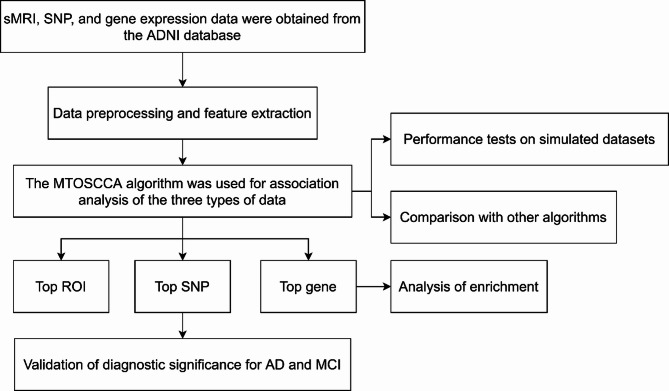
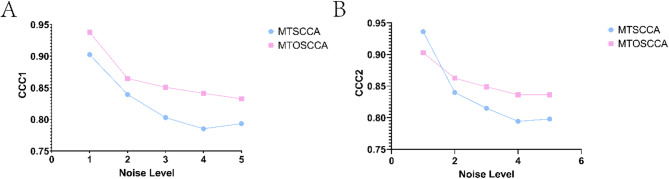
As a neurodegenerative disease, Alzheimer's disease (AD) has many symptoms, such as memory impairment, cognitive decline, and personality change. Image genetics is the correlation analysis between imageology and genetics, and image genetics research can effectively detect the biomarkers of AD. This paper proposed an orthogonal multi-task sparse canonical correlation analysis (MTOSCCA) algorithm. Based on the multi-task canonical correlation analysis, this algorithm added orthogonal constraints to the weight vectors U and V, which can effectively prevent the influence of redundant features on the results. In this paper, the MTOSCCA algorithm was applied to structural magnetic resonance imaging, single nucleotide polymorphism, and gene expression data integration. The results showed that the proposed algorithm has better correlation performance, and the obtained markers have diagnostic significance for AD and mild cognitive impairment (MCI).
Keywords: Alzheimer's disease; Biomarkers; Canonical correlation analysis; Image genetics; Orthogonal constraint.
© 2025. The Author(s).
Conflict of interest statement
Declarations. Ethical approval: Not applicable. Consent for publication: Not applicable. Competing interests: The authors declare no competing interests.
Figures
References
-
- Weller J, Budson A. Current understanding of Alzheimer’s disease diagnosis and treatment[J]. F1000Res, 2018, 7: F1000 Faculty Rev-1161.
MeSH terms
Substances
LinkOut - more resources
Full Text Sources
Medical
Research Materials
