


Meteorological drought severity forecasting utilizing blended modelling
- PMID: 40678463
- PMCID: PMC12268929
- DOI: 10.1016/j.mex.2025.103456
Meteorological drought severity forecasting utilizing blended modelling
Abstract
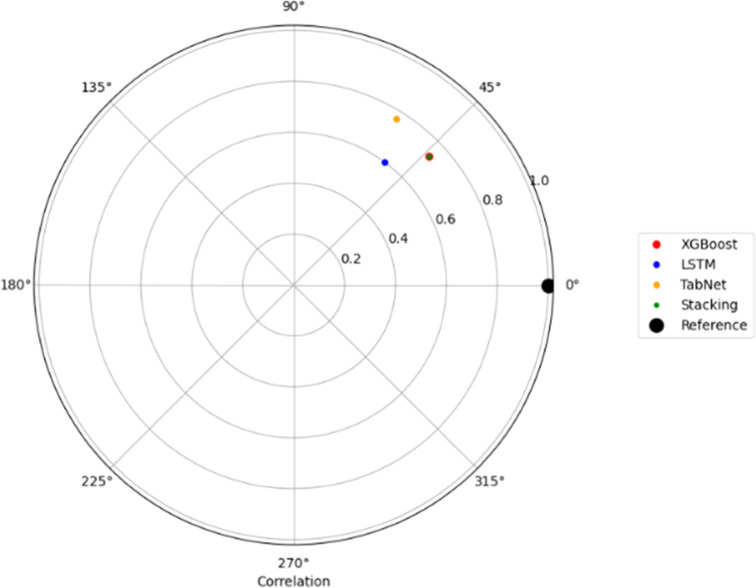
Prediction of droughts has recently become imperative as frequency and intensity are increasing mostly due to climatic variation. Indeed, drought is a highly significant disaster that results in widespread damage to all kinds of ecosystems, agricultural production systems, and water resources systems. Accurate techniques of forecasting are necessary for the purpose. Conventional methods lack the intricate time-space correlation in meteorological data. The research proposes an ensemble of Extreme Gradient Boosting (XGBoost), Long Short Term Memory (LSTM), and Tabular Network (TabNet) for a higher accuracy in drought forecasting. With the large meteorological dataset that involves temperature, precipitation, humidity, and wind speed as features, the model integrates:•The tree capabilities of XGBoost perform feature selection very effectively.•Temporal Pattern Analysis using LSTM.•Insight obtained from the attention mechanism-based TabNet.Empirical results demonstrate that the proposed ensemble outperforms individual models, achieving the lowest Root Mean Square Error (RMSE: 0.6582) and Mean Absolute Error (MAE: 0.5377), and the highest Coefficient of Determination (R²: 0.5069). Furthermore, it yields the best Nash-Sutcliffe Efficiency (NSE: 0.5107) and Kling-Gupta Efficiency (KGE: 0.6039), confirming its superiority in drought severity forecasting. The ensemble outperforms traditional models, aiding early drought warnings and water conservation planning.
Keywords: Deep Learning Approach to Forecast Drought Severity; Drought prediction, Ensemble model; LSTM; RMSE; TabNet; XGBoost.
© 2025 The Author(s).
Conflict of interest statement
The authors declare that they have no known competing financial interests or personal relationships that could have appeared to influence the work reported in this paper.
Figures



References
-
- Mishra A.K., Desai V.R. Drought forecasting using feed-forward recursive neural network. Ecolog. 32 Modell. 2006;198(1–2):127–138. doi: 10.1016/j.ecolmodel.2006.04.017. - DOI
-
- AghaKouchak A. A multivariate approach for persistence-based drought prediction: application to the 2010-34 2011 East Africa drought. J. Hydrol. 2015;526:127–135. doi: 10.1016/j.jhydrol.2014.09.063. - DOI
-
- N.A. Agana and A. Homaifar., “A deep learning based approach for long-term drought prediction”, SoutheastCon 2017, Concord, NC, USA, 2017, pp. 1–8, doi: 10.1109/SECON.2017.7925314. - DOI
-
- Gyaneshwar A., Mishra A., Chadha U., Raj Vincent P.M.D., Rajinikanth V., Pattukandan Ganapathy G., Srinivasan K. A contemporary review on deep learning models for drought prediction. In Sustain. (Switzerl.) 2023;15(7) doi: 10.3390/su15076160. - DOI
-
- Morid S., Smakhtin V., Bagherzadeh K. Drought forecasting using artificial neural networks and time 1 series of drought indices. Int. J. Climatol. 2007;27(15):2103–2111. doi: 10.1002/joc.1498. - DOI
LinkOut - more resources
Full Text Sources
