. 2025 Aug;301(8):110497.
doi: 10.1016/j.jbc.2025.110497. Epub 2025 Jul 18.

O-GlcNAcylation of fatty acid synthase is required for its proper subcellular localization, expression level, and activity

Affiliations

O-GlcNAcylation of fatty acid synthase is required for its proper subcellular localization, expression level, and activity

Dimitri Vanauberg et al. J Biol Chem. 2025 Aug.

Abstract

Fatty Acid Synthase (FASN) is involved in various fundamental cellular processes through its pivotal role in producing fatty acids through the de novo lipogenesis pathway. FASN is frequently overexpressed in tumors and participates in cancer cell proliferation. Little has been documented regarding post-translational modifications of FASN. We previously demonstrated that O-GlcNAcylation regulates FASN in mice livers and in the HepG2 hepatic cancer cell line. In the present study, we show that modulation of global O-GlcNAcylation levels impacts fatty acids production in HepG2 cells. We identified serine 595 and threonine 980 as major O-GlcNAcylation sites. While mutation of S595 moderately affects FASN behavior, T980 is crucial for FASN expression, membrane localization, homodimerization, stability, and activity in Hep3B cells. This residue is necessary for FASN properties, promoting cell survival, cell proliferation, and cell cycle progression. Our results suggest that targeting FASN at T980 may open an interesting path for controlling its catalytic activity.

Keywords: O-GlcNAc transferase; O-GlcNAcylation; fatty acid synthase; fatty acids; liver cancer cells.


Conflict of interest statement

Conflict of interest The authors declare that they have no conflicts of interest with the contents of this article.

Figures

Figure 1
Figure 1
OGT knockdown negatively impacts fatty acids synthesis. HepG2 cells were transfected with two different sets of siRNA targeting OGT mRNA. Cell lysates were analyzed by Western blot (n = 3 for siOGT#1 and n = 6 for siOGT#2) according to their OGT and O-GlcNAc contents (A). Molecular mass markers are indicated on the left (kDa). Optical densities were measured and normalized with β-actin expression. Global (B) and individual (C) amounts of FAMES from HepG2 transfected cells were measured by GC-FID (n = 6). Data are presented with means ± SD. ∗∗p < 0.01; ∗∗∗∗p < 0.0001.
Figure 2
Figure 2
OGA inhibition positively impacts fatty acids synthesis. Cell lysates from HepG2 treated with the FASN inhibitor C75 or OGA inhibitor Thiamet-G (TG) were analyzed by Western blot (n = 3) according to their O-GlcNAc content (A). Optical densities were measured and normalized with GAPDH expression. Global (B) and individual (C) amounts of FAMES from HepG2-treated cells were measured by GC-FID (n = 6). Data are presented with means ± SD. ∗p < 0.05; ∗∗p < 0.01; ∗∗∗p < 0.001; ∗∗∗∗p < 0.0001.
Figure 3
Figure 3
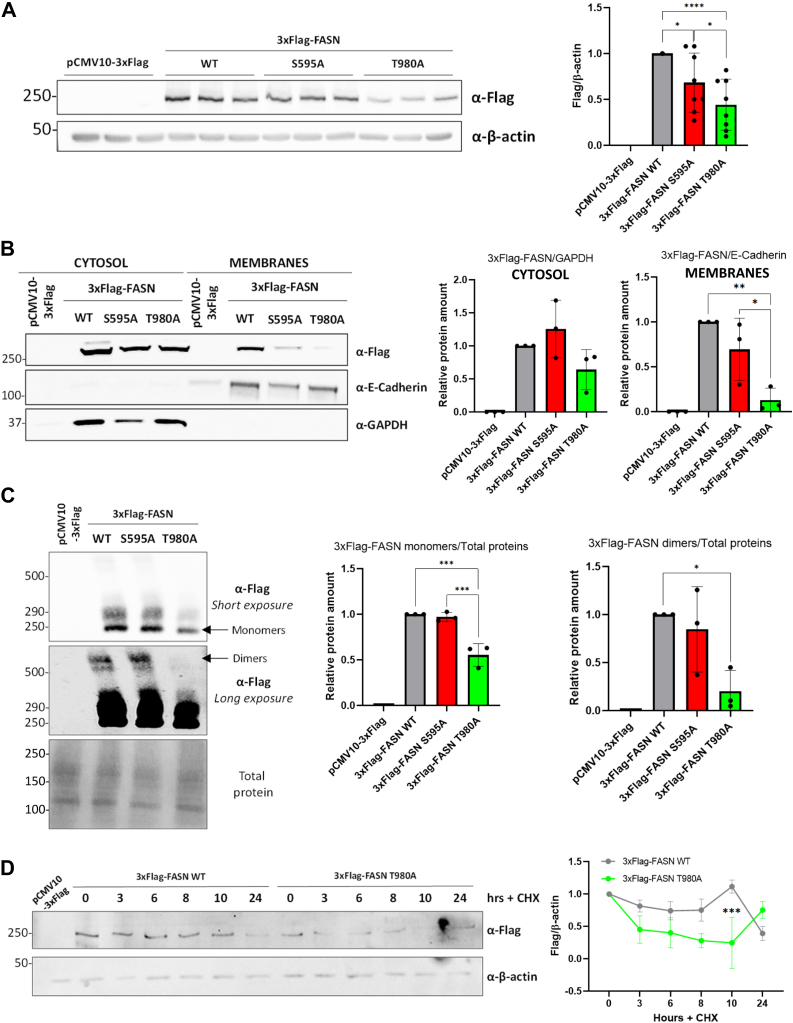
Mutation of the T980 O-GlcNAcylation site reduces FASN expression, membrane association, homodimerization, and stability. Hep3B cells were transfected with an empty vector or 3xFlag-FASN (wild type and mutants) expressing vectors. Cell lysates were analyzed by Western blot (n = 8) by using an anti-Flag antibody (A). Molecular mass markers are indicated on the left (kDa). Optical densities were measured and normalized with β-actin expression. B, cytosolic and membrane-associated 3xFlag-FASN contents were prepared by cell fractionation and analyzed by Western blot (n = 3). Fractionation efficiency was assessed using anti-GAPDH and anti-E-Cadherin antibodies for cytosolic and membrane fractions, respectively. Optical densities were measured and normalized with these markers. C, cell lysates were analyzed by Native-PAGE (n = 3) according to their 3xFlag-FASN monomers (∼250 kDa) and dimers (∼500 kDa) contents. Optical densities were measured and normalized with total protein. D, CHX chase assay was performed by treating cells with 40 μg/ml CHX for the indicated time periods (0–24 h). Data are presented with means ± SD. ∗p < 0.05; ∗∗p < 0.01; ∗∗∗p < 0.001; ∗∗∗∗p < 0.0001.
Figure 4
Figure 4
FASN T980 is crucial for FASN activity. Hep3B cells were transfected with an empty vector or 3xFlag-FASN (wild type and mutants) expressing vectors and incubated with the lipid droplet marker BODIPY 493/503 (n = 3) (A). Lipid droplets were counted using the ImageJ software (B). Confocal microscopy analysis indicates that FASN T980A mutation significantly impacts lipid droplets formation (bar size: 15 μm). Data are presented with means ± SD. ∗p < 0.05.
Figure 5
Figure 5
FASN O-GlcNAcylation at T980 is pivotal for Hep3B cells survival, proliferation, and cell cycle progression. Low-density Hep3B cells were transfected with an empty vector or 3xFlag-FASN (wild type and mutants) expressing vectors. Six days later, colonies were fixed and stained with crystal violet (n = 3) (A). Using MTS assay (B), cell survival was evaluated according to densitometry measured at λ = 490 nm (n = 6). Cell proliferation was determined by cell counting (n = 4) (C). Cell cycle was analyzed by flow cytometry (n = 3) (D). Data are presented with means ± SD. ∗p < 0.05; ∗∗p < 0.01; ∗∗∗p < 0.001; ∗∗∗∗p < 0.0001.
Figure 6
Figure 6
FASN T980 is crucial for various properties of Hep3B cells. The O-GlcNAcylation at T980 is crucial for FASN expression, stability, membrane residence, homodimerization, and activity, promoting Hep3B cells survival, proliferation, and cell cycle progression. This highlights the O-GlcNAcylation of FASN at T980 as a potential key modification that supports hepatic carcinogenesis.

References

    1. Sung H., Ferlay J., Siegel R.L., Laversanne M., Soerjomataram I., Jemal A., et al. Global cancer statistics 2020: GLOBOCAN estimates of incidence and mortality worldwide for 36 cancers in 185 countries. CA. Cancer J. Clin. 2021;71:209–249. - PubMed
    1. Chidambaranathan-Reghupaty S., Fisher P.B., Sarkar et D. Hepatocellular carcinoma (HCC): epidemiology, etiology and molecular classification. Adv. Cancer Res. 2021;149:1–61. - PMC - PubMed
    1. Cigliano A., Simile M.M., Vidili G., Pes G.M., Dore M.P., Urigo F., et al. Fatty acid synthase promotes hepatocellular carcinoma growth via S-phase kinase-associated protein 2/p27KIP1 regulation. Medicina (Mex.) 2024;60:1160. - PMC - PubMed
    1. Smith S., Witkowski A., Joshi A.K. Structural and functional organization of the animal fatty acid synthase. Prog. Lipid Res. 2003;42:289–317. - PubMed
    1. Witkowski A., Ghosal A., Joshi A.K., Witkowska H.E., Asturias F.J., Smith S. Head-to-Head coiled arrangement of the subunits of the animal fatty acid synthase. Chem. Biol. décembre 2004;11:1667–1676. - PubMed

LinkOut - more resources