


Decision-making of artificial nutrition and hydration in hospice care: A qualitative study of Chinese patients and family caregivers
- PMID: 40688103
- PMCID: PMC12270702
- DOI: 10.1016/j.apjon.2025.100744
Decision-making of artificial nutrition and hydration in hospice care: A qualitative study of Chinese patients and family caregivers
Abstract
Objective: Decision-making of artificial nutrition and hydration (ANH) is a complex ethical and emotional decision in hospice care, significantly impacting patients' comfort and quality of life at the end of life. This study explored behaviors about decision-making of ANH in hospice patients and their family caregivers, aiming to identify the trajectory and influencing factors of the decision.
Methods: This study employed constructivist grounded theory. Using purposive and theoretical sampling methods, in-depth interviews were conducted with 21 hospice patients and family caregivers in three Grade IIIA hospitals in Mainland China. Thematic analysis involved initial coding, focused coding, and theoretical coding to develop main categories and core categories.
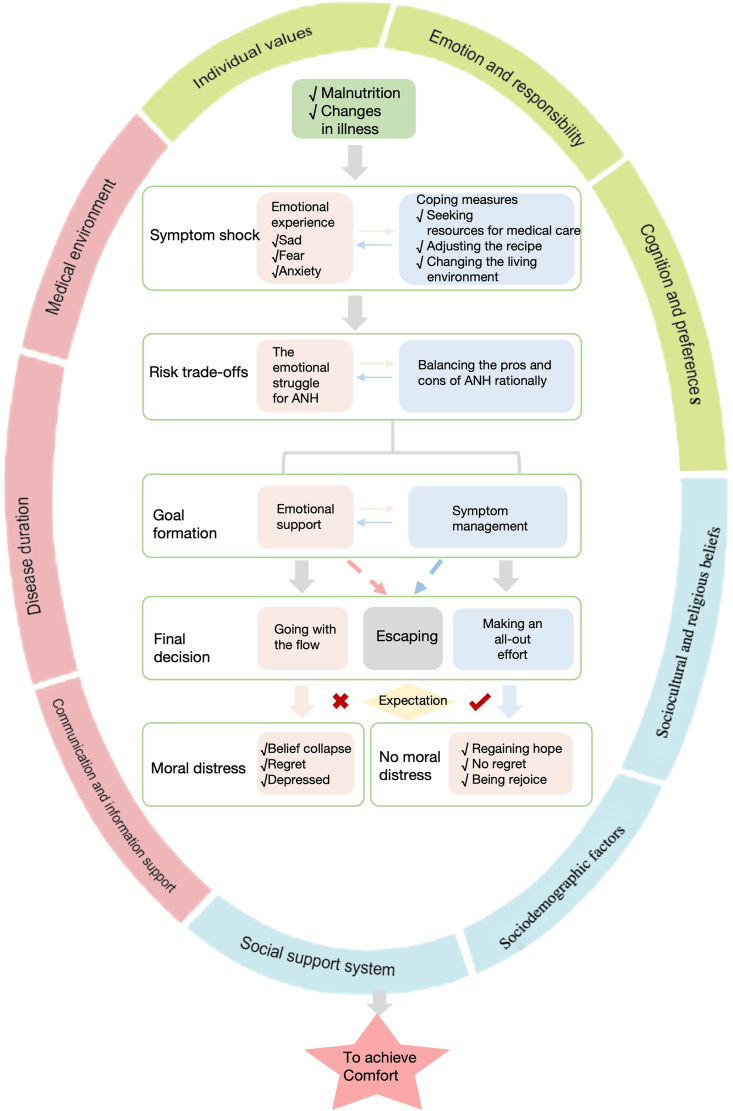
Results: This study identified a core category, alongside two main categories. A framework titled "The decision-making process of ANH for hospice patients and family caregivers" was developed. This decision-making began with the detection of malnutrition and progressed through five core stages, including "symptom shock", "risk trade-offs", "goal formation", "final decision", and "moral distress". Multiple individual, medical, and social factors influenced the final decision-making process of ANH.
Conclusions: Through the framework, this study can enhance health care providers' understanding of the decision-making process and also can aid in tailoring support to align treatment choices with patients' preferences. The study highlights the interplay between emotional and rational aspects in decision-making of ANH and emphasizes the need for health care providers to recognize individual, medical, and social factors. These findings can enhance the decision-making experience of hospice patients and family caregivers, ultimately improving the quality of hospice care.
Keywords: Decision-making; Enteral nutrition; Grounded theory; Hospice care; Parenteral nutrition; Qualitative research.
© 2025 The Author(s).
Conflict of interest statement
The authors declare no conflict of interest.
Figures

References
-
- WHO. Palliative. World Health Organization. Updated 5 August. Accessed 16 January 2025, https://www.who.int/news-room/fact-sheets/detail/palliative-care.
-
- UpToDate Stopping nutrition and hydration at the end of life. https://www.uptodate.com/contents/stopping-nutrition-and-hydration-at-th...
LinkOut - more resources
Full Text Sources
