


Prevalence, risk factors, and zoonotic implications of gastrointestinal parasites in urban cats in Kazakhstan: A cross-sectional multicity study
- PMID: 40689166
- PMCID: PMC12269952
- DOI: 10.14202/vetworld.2025.1748-1758
Prevalence, risk factors, and zoonotic implications of gastrointestinal parasites in urban cats in Kazakhstan: A cross-sectional multicity study
Abstract
Background and aim: Cats act as reservoirs for various gastrointestinal parasites, including species of significant zoonotic concern such as Toxocara cati, Toxoplasma gondii, and Giardia intestinalis. However, data on the prevalence and risk factors associated with feline endoparasites in Kazakhstan remain limited. This study aimed to determine the prevalence, species diversity, and risk factors of intestinal parasitic infections in urban cat populations across five major cities in Kazakhstan, thereby supporting the One Health framework for the prevention of zoonotic diseases.
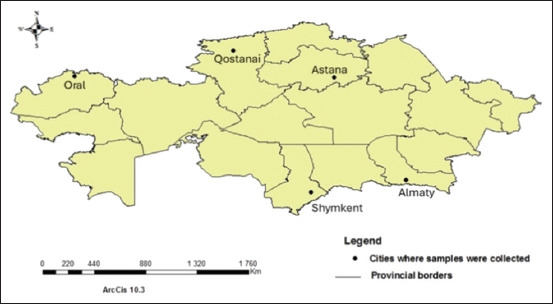
Materials and methods: A cross-sectional survey was conducted from August 2023 to January 2025, involving 1,301 fecal samples collected from both client-owned and stray cats in Almaty, Astana, Oral, Qostanai, and Shymkent. Standardized Sheather's sugar flotation was used to detect helminth eggs and coccidia oocysts in all samples, while Giardia coproantigen was assessed in 1,256 samples using a commercial immunochromatographic assay (FASTest® CRYPTO-GIARDIA strip test kit, MEGACOR, Austria). Prevalence differences across categories - ownership status, sex, age class, and city - were evaluated using the Chi-squared test, and odds ratios (OR) were calculated to identify significant risk factors.
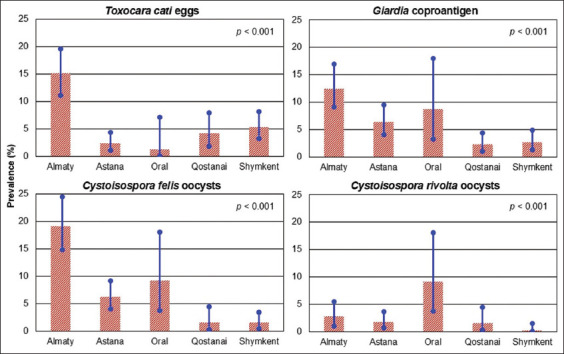
Results: Overall, 17.7% (230/1,301) of cats were infected with at least one intestinal parasite species. The most prevalent species were Cystoisospora felis (7.2%), T. cati (6.2%), Cystoisospora rivolta (2.0%), and Giardia (6.4%). T. gondii-like oocysts (T. gondii or Hammondia hammondi) were detected in 0.6% of samples. Significant variation in parasite prevalence was observed among cities. Stray cats were significantly more likely to harbor C. felis and C. rivolta. Female cats had higher odds of testing positive for Giardia (OR = 1.8). Infections with T. cati, C. felis, and Giardia showed a significant association with age, with kittens (<6 months) being approximately twice as likely to test positive for these parasites compared to adult cats.
Conclusion: This study represents the first comprehensive assessment of gastrointestinal parasitism in urban cats in Kazakhstan. The detection of zoonotic parasites and identification of significant demographic risk factors underscore the need for enhanced public health strategies, including educational outreach, targeted deworming protocols, and environmental hygiene measures. Future molecular investigations are necessary to differentiate T. gondii from Hammondia hammondi and to genotype Giardia assemblages. Soil surveillance in public spaces is also recommended to assess environmental contamination and potential exposure risk to humans, particularly children.
Keywords: Cystoisospora felis; Cystoisospora rivolta; Giardia duodenalis; Kazakhstan; One Health; Toxocara cati; Toxoplasma gondii-like coccidia; coproantigen detection; fecal flotation; feline endoparasites; gastrointestinal parasitism; helminths; public health risk; risk factors; stray versus owned cats; urban cats; zoonotic parasites.
Copyright: © Lider, et al.
Conflict of interest statement
The authors declare that they have no competing interests.
Figures
References
-
- World Population Review. Cat Population by Country 2024. 2024. Available from: https://worldpopulationreview.com/country-rankings/cat-population-by-cou... . Retrieved on 20-02-2025.
-
- TAÑBA in Digits. Animal Accounting Information System. 2025. Available from: https://tanba.kezekte.kz/en/tanba-public/stat . Retrieved on 20-02-2025.
-
- Deplazes P, Eckert J, Mathis A, Von Samson-Himmelstjerna G, Zahner H. Parasitology in Veterinary Medicine. Wageningen: Wageningen Academic Publishers; 2016.
-
- Maciag L, Morgan E.R, Holland C. Toxocara:Time to let cati 'out of the bag'. Trends Parasitol. 2022;38(4):280–289. - PubMed
LinkOut - more resources
Full Text Sources
Miscellaneous