


Peltophorum pterocarpum flower mediated synthesis of silver nanoparticles and its catalytic degradation of Acid Blue 113 dye
- PMID: 40691501
- PMCID: PMC12280203
- DOI: 10.1038/s41598-025-11980-1
Peltophorum pterocarpum flower mediated synthesis of silver nanoparticles and its catalytic degradation of Acid Blue 113 dye
Abstract
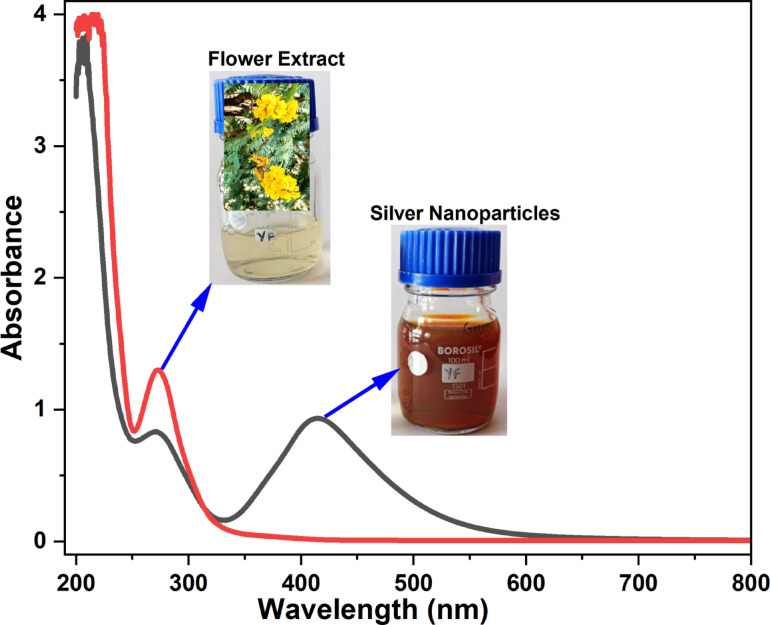
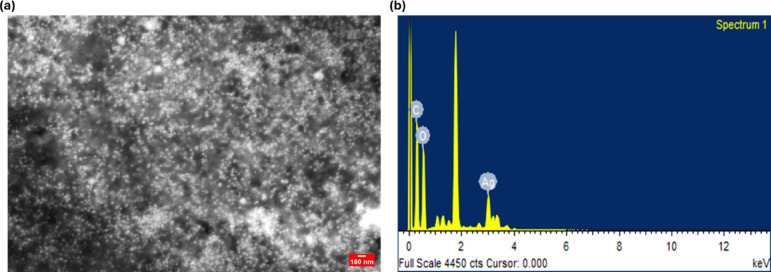
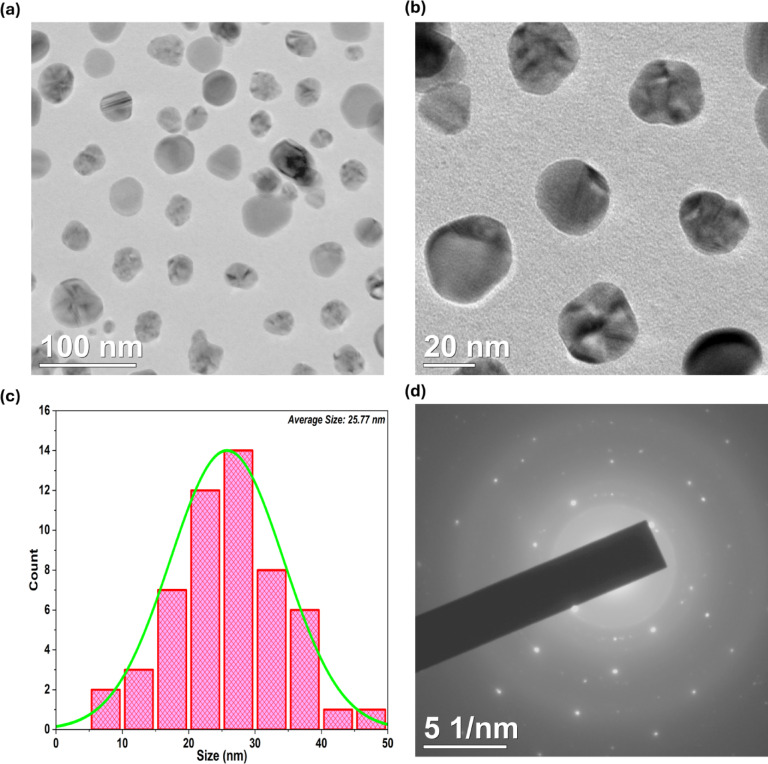
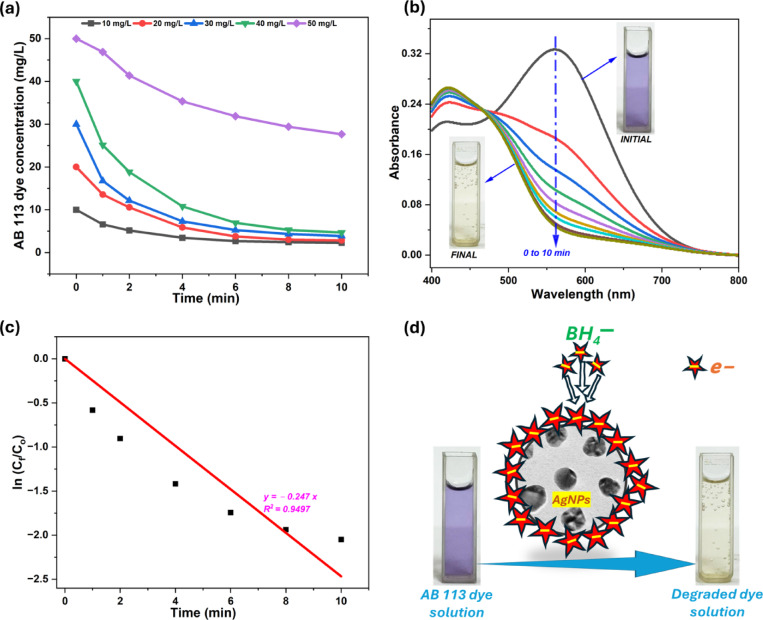
In this study, silver nanoparticles (AgNPs) were synthesized using a green method involving Peltophorum pterocarpum flower extract. Successful formation of AgNPs was confirmed by a characteristic surface plasmon resonance peak at 416 nm in the UV-Vis spectrum. SEM and TEM analyses revealed uniformly spheroidal nanoparticles with an average size of 25.77 nm, while EDX confirmed the presence of silver. SAED patterns showed bright spots, indicating a polycrystalline nature, which was further supported by XRD, revealing a crystallite size of 15.58 nm and a lattice parameter of 0.4007 nm. FTIR spectra identified hydroxyl and carboxyl groups as key agents in nanoparticle reduction and stabilization. DLS analysis reported a hydrodynamic diameter of 99.41 nm and a PDI of 0.326, suggesting good monodispersity. The nanoparticles exhibited good stability with a zeta potential of - 14.7 mV. Catalytic studies showed rapid degradation of Acid Blue 113 dye in the presence of NaBH4, achieving a rate constant of 0.247 min-1 at 30 mg/L. These results demonstrate the environmental remediation potential of biogenically synthesized AgNPs and underscore the benefits of sustainable green synthesis approaches for industrial wastewater treatment.
Keywords: Peltophorum pterocarpum; Acid Blue 113; Dye degradation; Green synthesis; Silver nanoparticles; Wastewater treatment.
© 2025. The Author(s).
Conflict of interest statement
Declarations. Competing interests: The authors declare no competing interests. Plant guidelines: The authors affirm that the utilization of plants or plant parts in this research adheres to all applicable international, national, and institutional guidelines. Permissions to collect the plants/plant parts: Dr. Gayathri Pai from the Department of Botany at MGM College, Udupi, India, has taxonomically verified and authenticated the tree flowers used in this study. Given that the tree is widely recognized, common, and not under any protection, there was no need for collection permits or licenses. Furthermore, due to its well-known status, no voucher specimen has been deposited in a herbarium. Source of the plant used in your study: Details regarding all plant names and their sources are provided in the Methodology section of this document. Declaration of generative AI and AI-assisted technologies in the writing process: The authors utilized ChatGPT to enhance grammar and refine sentence structure to prepare this article. Following its use, they thoroughly reviewed and edited the content as necessary, taking full responsibility for the final publication.
Figures


References
-
- Gokul Eswaran, S., Shahid Afridi, P. & Vasimalai, N. Effective multi toxic dyes degradation using bio-fabricated silver nanoparticles as a green catalyst. Appl. Biochem. Biotechnol.195(6), 3872–3887 (2023). - PubMed
-
- Varadavenkatesan, T., Nagendran, V., Vinayagam, R., Goveas, L. C. & Selvaraj, R. Green synthesis of silver nanoparticles using Lagerstroemia speciosa fruit extract: Catalytic efficiency in dye degradation, Mater. Technol.40, 2463955. 10.1080/10667857.2025.2463955 (2025).
-
- Sabouri, Z. et al. Plant-mediated synthesis of ag and se dual-doped ZnO-CaO-CuO nanocomposite using Nymphaea alba L. extract: Assessment of their photocatalytic and biological properties. Biomass Convers. Biorefinery14(24), 32121–32131. 10.1007/s13399-023-04984-2 (2024). - DOI
-
- Allah, M. A. H. D., Taqui, S. N., Syed, U. T. & Syed, A. A. Development of sustainable acid blue 113 dye adsorption system using nutraceutical industrial Tribulus terrestris spent. SN Appl. Sci.1(4), 1–18. 10.1007/s42452-018-0125-5 (2019). - DOI
-
- Reza Samarghandi, M., Tari, K., Shabanloo, A., Salari, M. & Zolghadr Nasab, H. Synergistic degradation of acid blue 113 dye in a thermally activated persulfate (TAP)/ZnO-GAC oxidation system: Degradation pathway and application for real textile wastewater. Sep. Purif. Technol.247, 116931. 10.1016/j.seppur.2020.116931 (2020). - DOI
LinkOut - more resources
Full Text Sources
Miscellaneous
